18 Best Open Source Zapier Alternatives
A curated collection of the 18 best open source and self-hosted alternatives to Zapier in 2026.
Looking for a free, privacy-friendly, or self-hosted replacement for Zapier in 2026? The top open-source alternative is n8n — AI-powered workflow automation platform.
Other highly rated open-source Zapier alternatives include Kestra, ActivePieces and Automa.

AI-powered workflow automation platform
n8n is an extensible workflow automation platform that uniquely combines AI capabilities with business process automation, giving technical teams the flexibility of code with the speed of no-code. - AI Agent Builder: Visually construct and control AI agents with traceable reasoning steps - 500+ Integrations: Pre-built nodes for common apps and custom API connections for everything else - Hybrid Workflows: Mix no-code drag-and-drop with custom JavaScript/Python code - Self-Hosting: Deploy on your infrastructure or use n8n's cloud service - Enterprise Ready: Scalable solution for teams with advanced security and compliance - 10,000+ Templates: Ready-to-use workflow automation templates - AI-Powered Features: RAG, lead automation, CRM enhancement, and more - Transparent Pricing: Fair-code license with transparent enterprise options n8n is open-source (Fair-code license) and can be self-hosted on any infrastructure. Supports Docker, Kubernetes, and cloud deployments. Documentation provides comprehensive setup guides for various hosting environments.
YAML-based orchestration platform with 1400+ plugins for running data pipelines, AI workflows, and infrastructure automation across teams at scale.
YAML-based orchestration platform with 1400+ plugins for running data pipelines, AI workflows, and infrastructure automation across teams at scale.

AI-first automation platform for teams with 761+ integrations and governance controls

Activepieces is an AI-first automation platform that enables teams to build self-driven AI workflows across HR, finance, marketing, sales, and more—while maintaining control through IT governance. The platform combines no-code/low-code tools with AI agent capabilities to automate tasks across 761+ integrations including Gmail, Slack, Notion, and OpenAI. - AI Agent Builder: Create and deploy AI agents without coding - 761+ Integrations: Connect with popular tools like Gmail, Slack, Notion, HubSpot, and OpenAI - Governance & Control: IT teams can enforce policies and monitor AI workflows - Multi-Deployment Options: Cloud, self-hosted, or hybrid deployments - AI Adoption Stack: Framework for scaling AI automation across organizations - Cost Optimization: Track and optimize AI automation costs - Enterprise-Grade Security: Built-in compliance and audit capabilities Activepieces is open-source and can be self-hosted on your own infrastructure. The platform supports Docker deployments and provides comprehensive documentation for setup. For enterprise needs, Activepieces offers managed cloud hosting with enterprise-grade security and support.

No-code AI automation & RPA platform
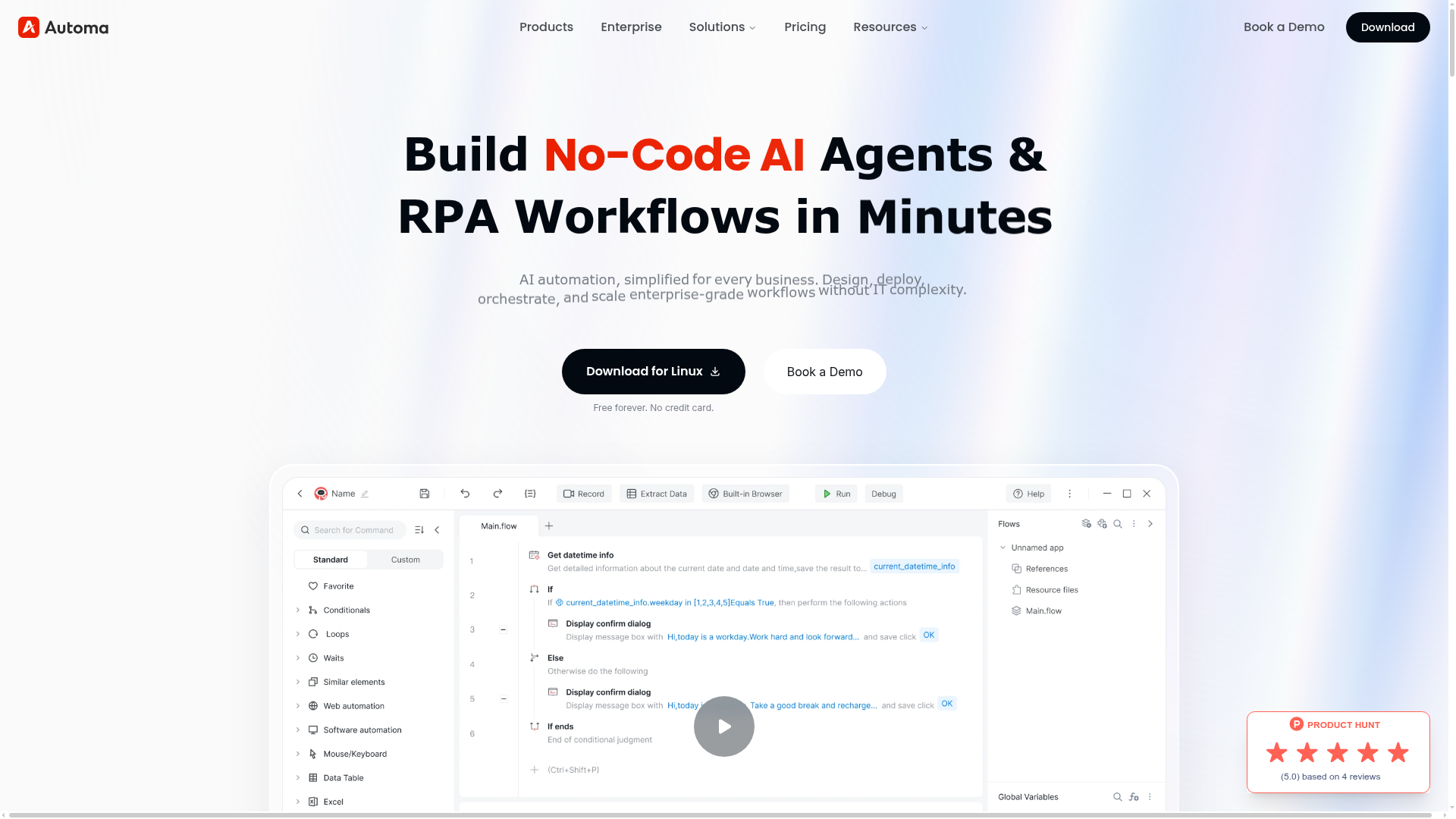
Automa is an enterprise-grade AI automation platform that enables organizations to build autonomous AI Agents, integrate RPA workflows, orchestrate systems, and automate complex business operations end-to-end. With a visual no-code builder, cross-platform compatibility, and AI-powered decision making, Automa simplifies automation for businesses of all sizes. - Visual No-Code Builder: Design workflows effortlessly with an intuitive drag-and-drop interface. - Cross-Platform Compatibility: Deploy bots seamlessly across various systems and devices. - AI-Powered Decision Making: Leverage AI for intelligent task execution and adaptive learning. - Enterprise-Grade Security: Ensure data integrity with robust encryption and compliance standards. - Real-Time Analytics: Gain insights with live dashboards and performance metrics. - Scalable Infrastructure: Adapt and grow with Automa's flexible automation solutions. - Ready-to-Use Templates: Start with pre-built automation templates for common tasks. - Chrome Extension: Automate browser tasks directly from your Chrome browser. Automa is primarily a cloud-based platform with a free tier available. The open-source version is available on GitHub, allowing for self-hosting and customization. The platform supports enterprise deployments with advanced security and scalability features.

Code-first platform for internal software
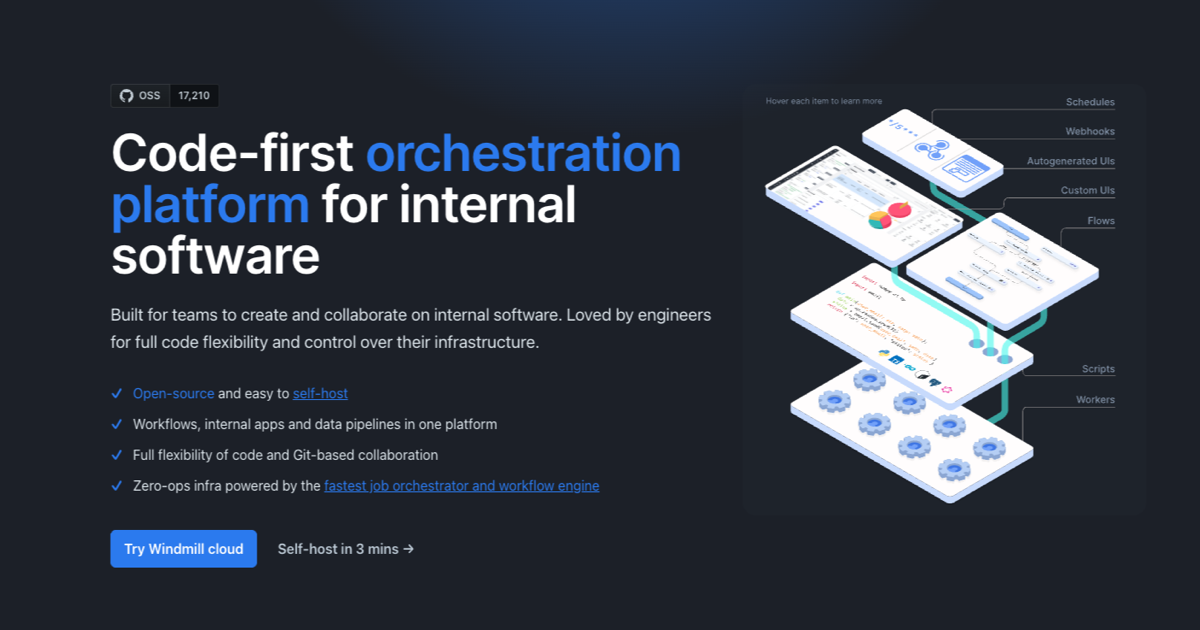
Windmill is a code-first orchestration platform designed for teams to create and collaborate on internal software. Built for engineers, it offers full code flexibility, Git-based collaboration, and zero-ops infrastructure powered by a high-performance job orchestrator. - Scripts: Write and run scripts in Python, TypeScript, Go, PHP, Bash, and SQL. - Workflows: Create dependency-based workflows (DAGs) for complex processes. - Internal Apps: Build custom UIs with a low-code drag-and-drop editor. - Auto-generated UIs: Automatically generate interfaces for scripts and flows based on parameters. - Scheduling: Run scripts and flows at specified frequencies. - Webhooks: Auto-generated webhooks for scripts and flows. - AI Agents: Integrate and orchestrate AI-powered agents. - Data Pipelines: Build and manage data pipelines alongside other internal tools. - Self-hosting: Deploy Windmill on your own infrastructure in minutes. - Enterprise Scalability: Trusted by 4,000+ organizations, including 300+ enterprise customers. Windmill is open-source and self-hostable, with support for Docker, Kubernetes, and cloud deployments. It is built for zero-ops infrastructure and offers benchmarks demonstrating its performance as the fastest job orchestrator and workflow engine. The platform is designed for teams requiring full control over their internal software stack.

Open source platform for AI workflows in TypeScript
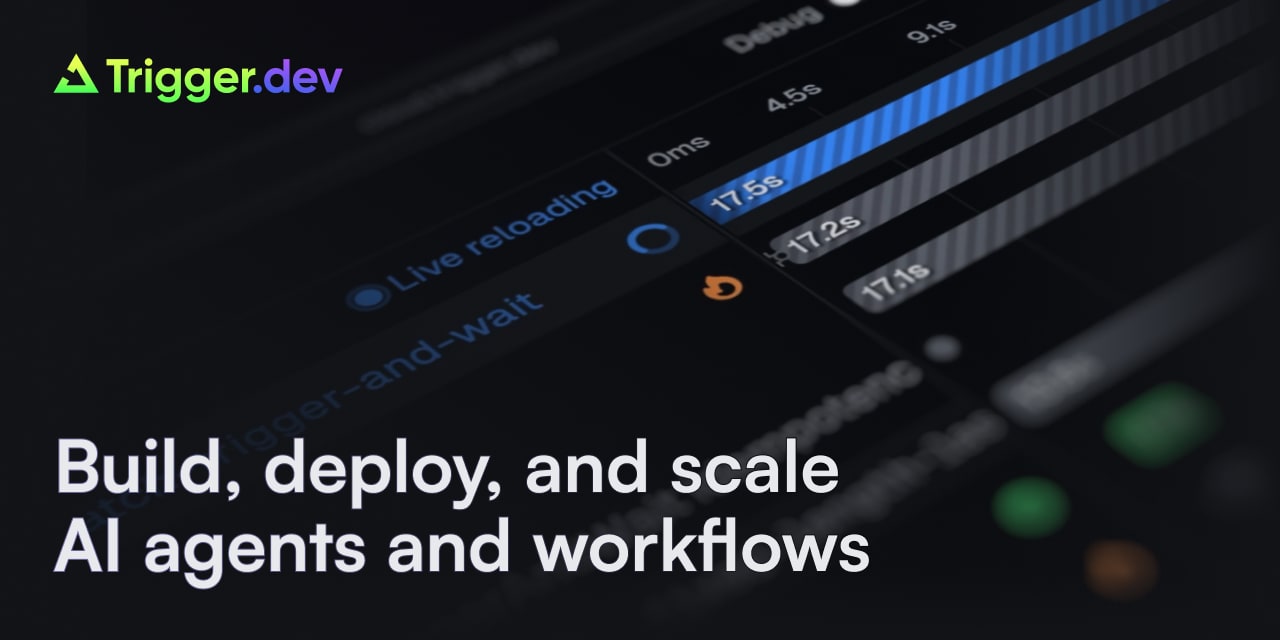
Trigger.dev is the open source platform for building AI workflows in TypeScript. It enables developers to create durable, long-running tasks with built-in retries, queues, observability, and elastic scaling. Whether you need to process media, run scheduled tasks, or build AI agents with human-in-the-loop workflows, Trigger.dev provides the infrastructure to keep your processes alive through refreshes, redeploys, and crashes. - Durable AI Agents: Build agents that survive refreshes, redeploys, and crashes with full state persistence - Human-in-the-Loop: Implement approval workflows and manual interventions within automated processes - Real-time Streaming: Stream results directly to your frontend without API routes - Concurrency & Queues: Control task execution with configurable concurrency limits and queue management - Scheduled Tasks: Durable cron schedules that persist across restarts and timeouts - Observability & Monitoring: Real-time tracing, logging, and monitoring of all workflows - Tool Calling: Native support for function calling and external tool integration - Multi-language Support: Run tasks in TypeScript, Python, and other languages - Self-hosting: Deploy Trigger.dev on your own infrastructure - MCP Server Integration: Connect with Model Context Protocol servers for enhanced capabilities Trigger.dev is built with TypeScript and supports self-hosting for full control over your data and infrastructure. The platform is designed for elastic scaling, automatically adjusting resources based on workload demands. Documentation covers quick start guides, framework-specific implementations (Node.js, Next.js, Bun, Remix), and detailed self-hosting instructions. Supported Runtimes: TypeScript, Python, Bun, Node.js Deployment Options: Cloud-hosted (managed) or self-hosted Integration: Works with Anthropic, OpenAI, and other LLM providers Observability: Built-in tracing, metrics, and logging Scalability: Automatic scaling based on task volume and complexity

Open source Zapier alternative

Automatisch is an open-source automation platform that helps businesses streamline workflows without requiring technical expertise. Whether you prefer a cloud-based solution or want full control by self-hosting, Automatisch provides the flexibility to automate tasks efficiently. - No-Code Automation: Build workflows using a visual editor with over 100 integrations (Slack, Twitter, GitHub, PostgreSQL, etc.). - Self-Hosting: Deploy on your own infrastructure for complete data control and GDPR compliance. - Affordable Cloud: Use the managed cloud service for hassle-free automation. - Open Source: Community-driven development with transparency and vendor lock-in avoidance. - Enterprise Ready: Trusted by companies in healthcare, finance, and other regulated industries. Automatisch is built with Node.js and TypeScript, using PostgreSQL for data storage. Self-hosting is straightforward via Docker or Kubernetes, with detailed installation guides available. The platform supports custom integrations and offers advanced configuration options for scalability.
Durable orchestration platform for managing AI agents, scheduling background tasks, and running mission-critical workflows.
Durable orchestration platform for managing AI agents, scheduling background tasks, and running mission-critical workflows.

Free webhook platform with HMAC signatures and EU hosting
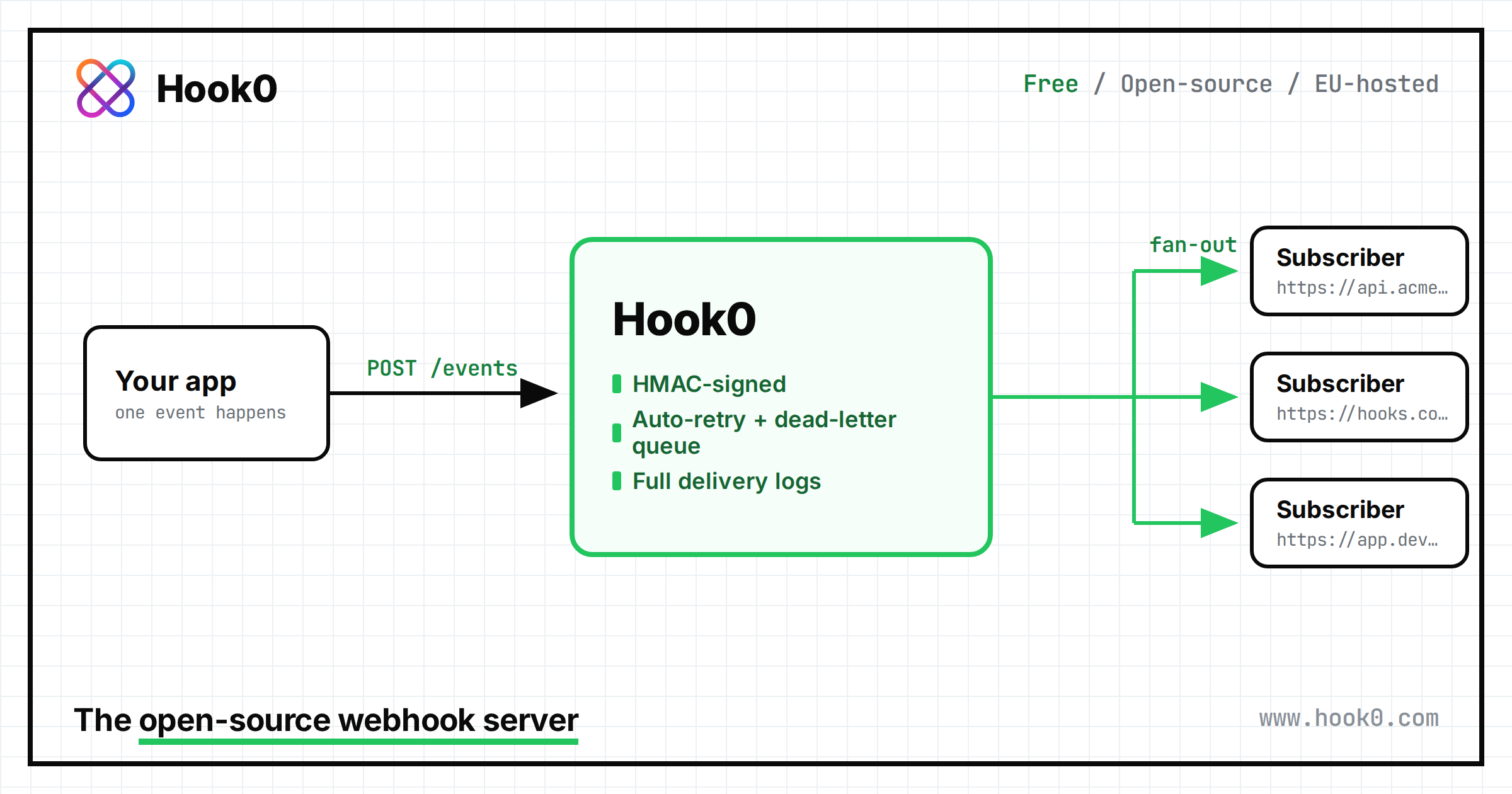
Hook0 is an open-source Webhooks-as-a-Service (WaaS) designed to simplify webhook delivery for developers. It handles deliverability, retries, security, and more with a single API call. - Full Delivery & Retries: Ensures reliable webhook delivery with configurable retries. - HMAC Signatures: Secure payloads with HMAC signatures for authenticity. - Replay Defense: Protects against replay attacks for enhanced security. - EU-Hosted Cloud: Hosted in France (EU) with GDPR compliance. - Self-Hosting: Open-source SSPL-1.0 code for full control over your data. - REST API & SDKs: Easy integration with REST APIs and SDKs, including MCP-native support. - Uptime SLA: 99.9% uptime guarantee for reliable service. - Scalability: Handles millions of webhooks with sub-100ms average delivery time. Hook0 is open-source under the SSPL-1.0 license and can be self-hosted for full data control. The platform is built for GDPR compliance and offers a transparent, bootstrapped alternative to VC-backed solutions. Documentation and quick-start guides are available for easy deployment.

Open-source workflow & AI agent builder
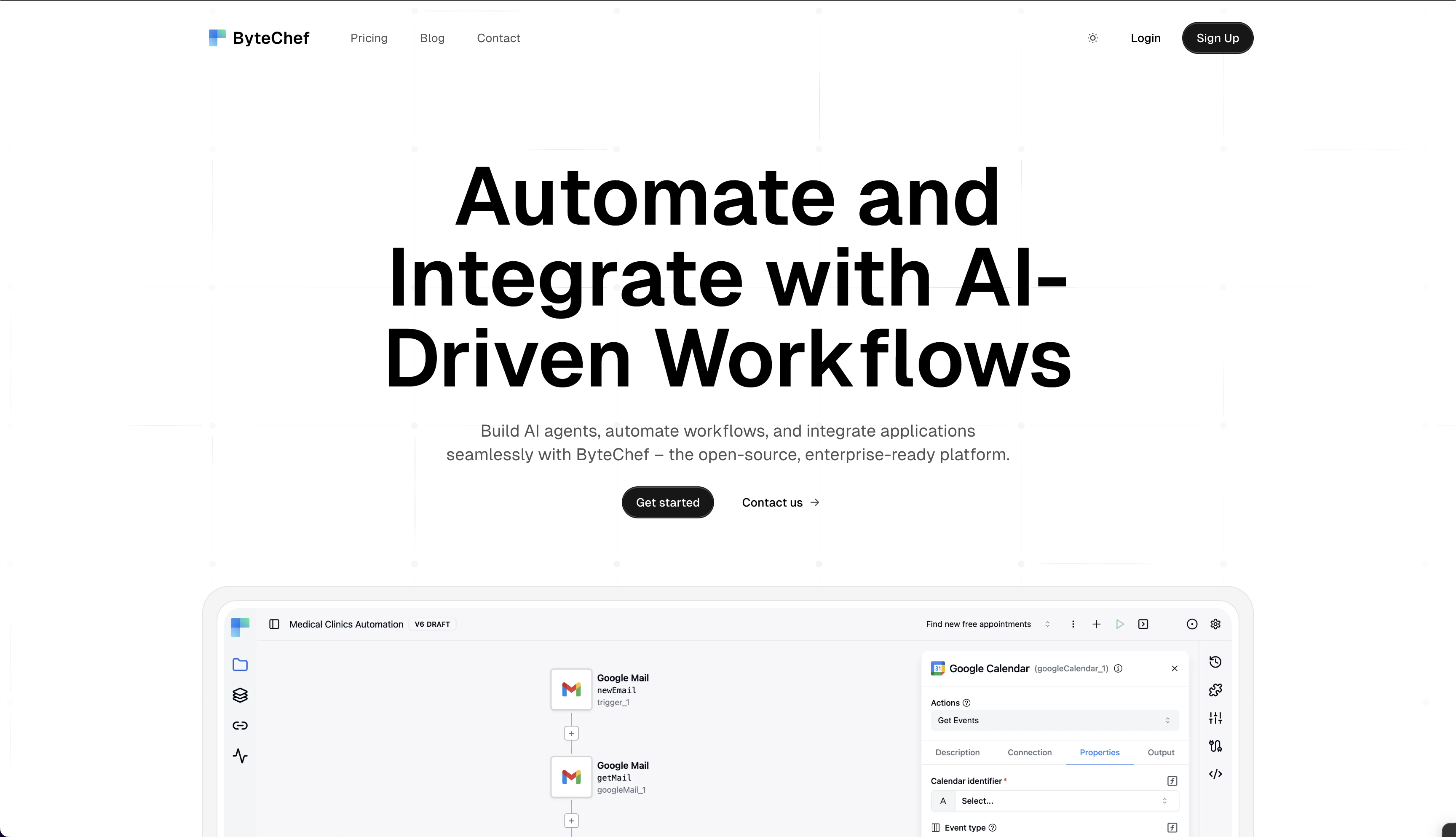
ByteChef is an open-source automation platform designed for building workflows, creating multi-step AI agents, and integrating applications seamlessly. With a focus on data ownership and transparent pricing, it empowers small to medium businesses to automate processes without vendor lock-in. - Visual Workflow Builder: Drag-and-drop interface for creating complex workflows and AI agents. - Extensive Integration Library: Connect with 50+ SaaS applications and services, including Gmail, Slack, OpenAI, PostgreSQL, and more. - Flow Controls: Advanced logic and conditional execution for precise automation. - Execution Preview: Real-time previews to test and debug workflows before deployment. - Multi-Step AI Agents: Build and deploy AI-powered agents with ease. - Transparent Pricing: No hidden costs or vendor lock-in, ensuring full data ownership. - Self-Hosting Capabilities: Deploy on your own infrastructure for complete control. ByteChef is open-source and can be self-hosted on your own infrastructure. It supports deployment on cloud platforms, on-premises servers, and Kubernetes clusters. The platform is built with scalability and security in mind, making it suitable for teams of all sizes.

Build AI agents and automate workflows with 3,000+ APIs
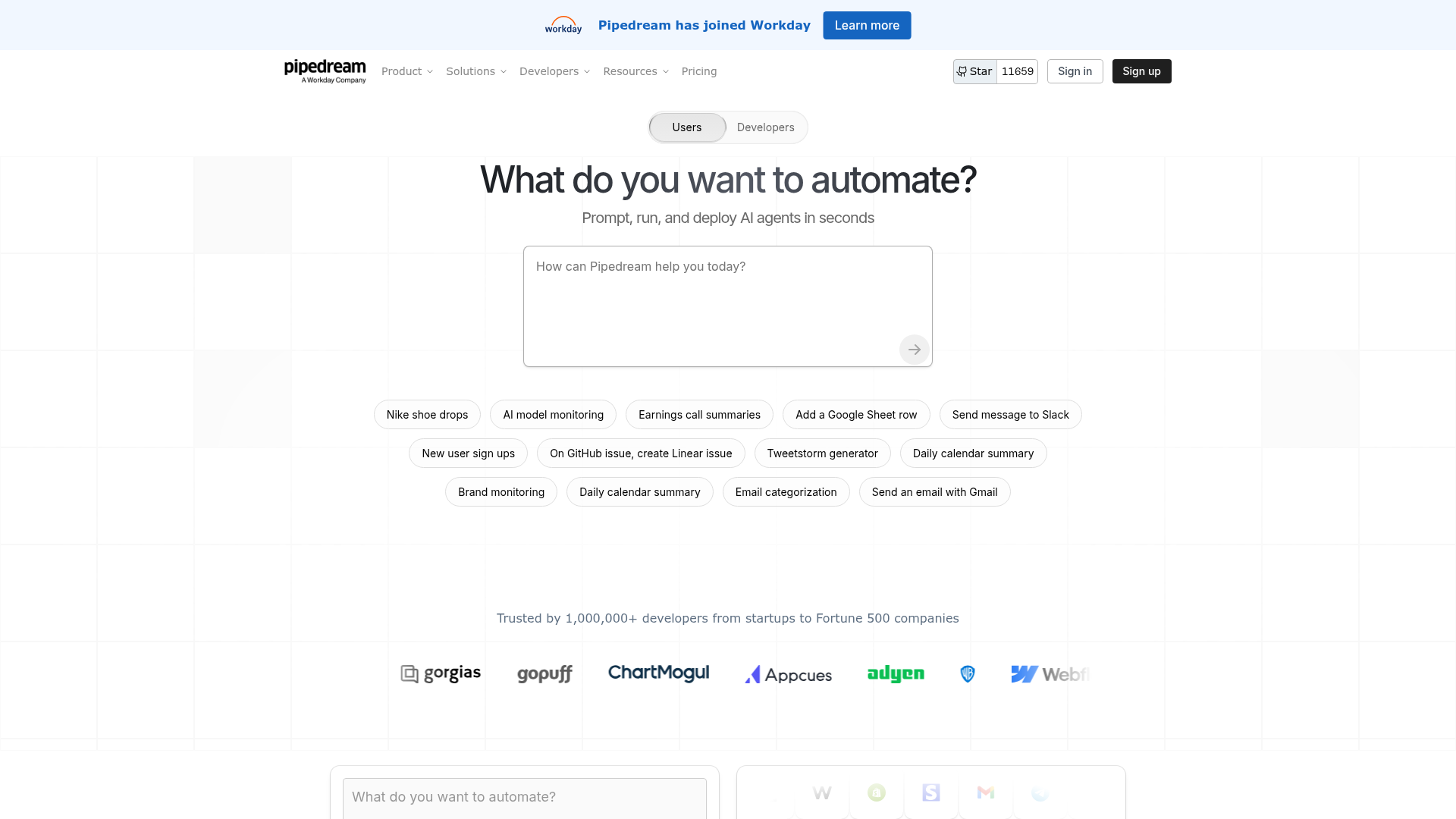
Pipedream is a low-code platform that enables developers to build powerful applications and automate workflows by connecting APIs, databases, and AI services. Whether you need to prompt, run, and deploy AI agents in seconds or create complex workflows with code-level control, Pipedream provides the tools to streamline your processes. - AI Agent Builder: Prompt, run, edit, and deploy AI agents in seconds with built-in MCP servers and 3,000+ integrated apps. - Workflow Automation: Connect APIs, databases, and services with a visual workflow builder for seamless automation. - One SDK, 1000s of Integrations: Access 3,000+ apps and 10,000+ tools with managed authentication and pre-built components. - Secure by Design: SOC 2 Type II, HIPAA, and GDPR compliant architecture to handle sensitive data securely. - Built-in Services: Includes queue, data stores, and one-click private networks for rapid deployment. - Code Generation: AI-powered code generation for any API, enabling faster development cycles. - Enterprise-Ready: Trusted by startups to Fortune 500 companies for scalable and secure automation solutions. Pipedream is a fully managed cloud service with no self-hosting option. It provides enterprise-grade security, compliance certifications, and scalable infrastructure for seamless integration into any tech stack.

AI-powered browser automation for any website

Your team logs into dozens of portals to download invoices, copy-paste data, and fill forms. Skyvern automates these workflows natively in the browser, just like a human would. - No-code Automation: Describe workflows in plain English using Copilot Chat or upload SOPs to turn documents into automated processes. - CAPTCHA & 2FA Support: Handles CAPTCHAs and two-factor authentication natively without third-party services. - Proxy Networks: Supports country, state, or zip-code level targeting across residential and datacenter proxies. - Explainable AI: Provides detailed summaries of every action taken, ensuring transparency and debugging. - Data Extraction: Extract structured data (JSON/CSV) from any website without APIs. - Document Processing: Download, parse, classify, and route documents from portals with OCR and structured output. - Form Filling: Submit applications, registrations, and compliance forms at scale. - Testing & QA: Adaptive browser testing that reduces flaky test suites. - Multi-language SDKs: Python and TypeScript SDKs for seamless integration with existing stacks. - Self-hosting: Deployable via Docker containers for on-premise or private cloud use. Skyvern offers multiple deployment options: - Cloud-based: Managed service with API access. - Self-hosted: Docker containers for on-premise or private cloud deployment. - Native SDKs: Python and TypeScript libraries for programmatic control. - Integrations: Compatible with Zapier, Make, n8n, Workato, and Clay. - Model Context Protocol (MCP): Ready for integration with MCP-compatible tools. Skyvern is built for developers, by developers, ensuring flexibility and scalability for any automation need.

Unified workspace for cross-system automations
Flowglad is a unified workspace designed to help teams analyze, act, and automate workflows across their favorite tools while maintaining strict data isolation and auditability. - Cross-System Automation: Pull context and push actions to multiple tools from a single interface. - Data Isolation: Dedicated, invite-only spaces for each client or project to ensure data privacy. - Audit Trails: Full visibility into actions and approvals for compliance and security. - Reusable Skills: Create and share automation instructions across teams and projects. - Explicit Approvals: Require manual approval for critical actions like QuickBooks write operations. - Connected-App Retrieval: Securely read data from external systems while preserving source identity. - Custom Workflows: Build automations tailored to your team's specific processes. Flowglad is a cloud-based platform with no self-hosting option currently available. The service emphasizes security through isolated workspaces, granular permissions, and audit logging. Data is hosted on cloud infrastructure with enterprise-grade security measures.

Self-healing API and data integration platform
Orbital is a data gateway that connects APIs, databases, event streams and more, enabling secure, self-repairing integrations without writing glue code or maintaining YAML mapping files. - Instant Integration: Deploy custom APIs, event streams, and batch workflows in minutes by driving everything from your API specs and deploying from Git. - Universal Authorization: Write once, apply everywhere with scriptable, field-level authorization policies. - Automated Orchestration: Instantly adapts to evolving APIs and schemas, eliminating the need for manual updates. - Data and API Catalog: Automatically maps APIs and data sources into an interactive, searchable catalog with beautiful diagrams. - Observability: End-to-end lineage and detailed call traces for diagnosing bottlenecks and performance issues. - Type Safety: Embed semantic type metadata directly in OpenAPI specs using powerful type safety and tooling to prevent errors. - No Glue Code: Eliminates the need for resolvers, API clients, or YAML mapping files, reducing maintenance overhead. - Multi-Platform Support: Integrates with PostgreSQL, AWS, Azure, Snowflake, MongoDB, and more. Orbital can be deployed via Docker or using the provided start.sh script. It supports self-hosting and integrates seamlessly with modern cloud and database platforms. The platform is designed for scalability and adaptability, making it suitable for enterprise environments.

Open-source event tracker for SaaS products
Operational.co is an open-source event tracking tool designed for SaaS products, providing real-time monitoring and notifications for critical events such as user signups, payments, cancellations, webhooks, jobs, and errors. - Real-time notifications: Receive push notifications on mobile or web app for critical events. - Action buttons: Trigger webhooks within your product directly from events. - Event contexts: Chain events together to understand complex workflows. - JSON logging: Easily track and log webhooks with structured data. - Playground: Simplify integration with a code playground for quick setup. - AI-assisted setup: Generate integration snippets using AI agents like ChatGPT or Claude. - Multi-platform support: Works with SaaS, WordPress, eCommerce, and DevOps tools. - Extensive API: Highly expressive API for custom event ingestion and monitoring. Operational.co is open-source and can be self-hosted. The project is available on GitHub with detailed documentation for setup and integration. The platform supports multiple programming languages and frameworks, making it adaptable to various tech stacks.

Connect 900+ APIs for AI agents and products
Nango is a platform for building, running, and maintaining integrations with AI agents and products. It enables developers to connect their applications to 900+ APIs seamlessly, with features for authorization, syncs, webhooks, and agent-ready tools. - AI-Powered Integration Generation: Describe use cases in plain English to generate integration code automatically. - 900+ API Integrations: Access a catalog of pre-built templates for popular APIs or build custom integrations. - Agent-Ready Tools: Expose integrations as MCP tools, APIs, or SDKs for AI agents. - Real-Time Webhooks & Triggers: React to external events with managed webhook handling. - Secure Authorization: OAuth, API keys, and token refresh handled securely for every API. - Managed Syncs & Ingestion: Keep data fresh with incremental, resumable syncs. - Production-Ready Runtime: High concurrency, tenant isolation, and sub-100ms execution latency. - Granular Access Control: RBAC and per-user API scopes for secure integrations. - Self-Hostable: Deploy in your environment for full control and compliance. - Enterprise-Grade Infrastructure: 99.9% uptime, 1M+ integrations managed, and certified security standards. Nango is open-source and can be self-hosted in your environment. It supports local development, CI/CD pipelines, and provides logs, metrics, and alerts for monitoring. The platform is designed for scalability, reliability, and security, making it suitable for enterprise use cases.

Unified API & MCP platform for 837+ integrations

Unified.to provides a real-time unified API and MCP platform that enables B2B SaaS applications and AI agents to access, update, and monitor data from 837+ sources across 34 categories—including HR, CRM, accounting, and more—without storing end-customer data. - Real-time API Access: Every request hits the source API live with no caching or stale data. - Native & Virtual Webhooks: Instant updates via native and virtual webhooks for real-time synchronization. - Zero-Storage Design: No end-customer data is stored, reducing compliance scope. - Regionalized Traffic: Traffic is stateless and regionalized (US/EU/AU) for better performance and compliance. - 837+ Integrations: Access data from HR, sales, marketing, support, ticketing, accounting, and more. - MCP Server Support: Built-in Model Context Protocol (MCP) server for AI agent integration. - Free 30-Day Trial: Start with a free trial to explore the platform. - Embedded Authorization: Simplified OAuth flows for seamless integration. Unified.to is a cloud-native SaaS platform with no self-hosting option. The platform is designed for scalability, security, and compliance, with regionalized traffic handling and zero data storage. Developers can integrate via REST API, SDKs, or MCP server. - Primary Website: https://unified.to - API Documentation: https://docs.unified.to - GitHub Repository: https://github.com/unified-to/unified-cli - Postman Collections: https://www.postman.com/unified-to - Discord Support: https://discord.gg/85z7HF7JbD

Integration platform for AI agents and products
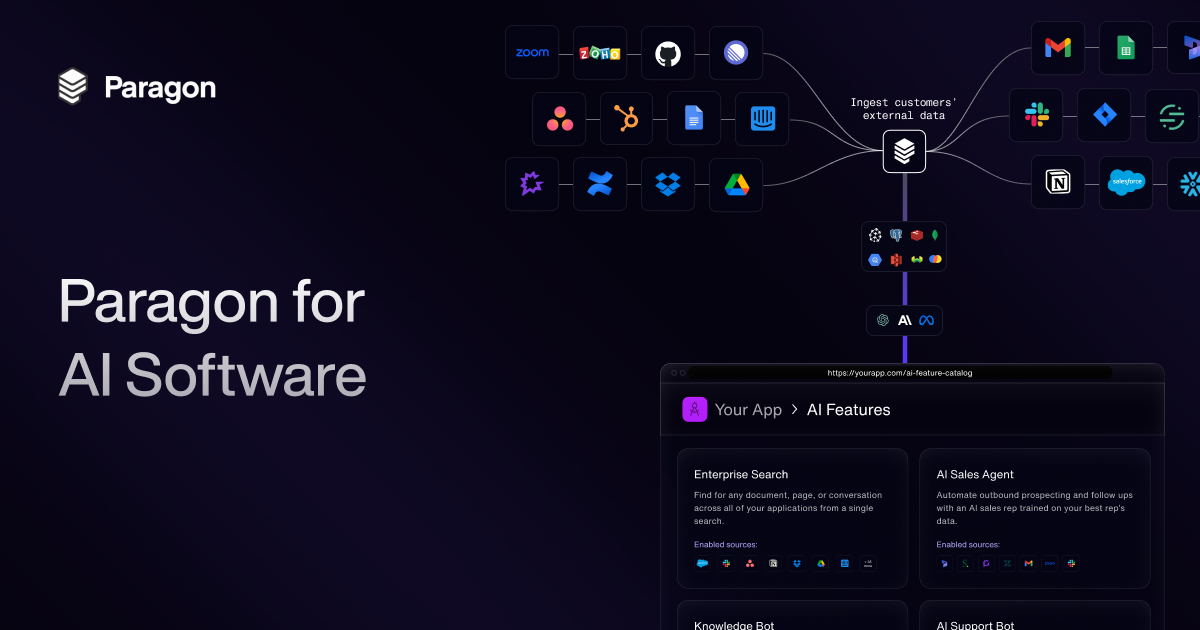
Paragon provides the integration infrastructure that enterprise AI teams build on. Connect your product to your customers’ tools for RAG ingestion, agent tool-calling, and ship integrations 10x faster. - Managed Sync for RAG: Real-time ingestion of third-party data into your vector database with a managed permissions index to ensure RAG results respect user access. - ActionKit for Agent Actions: Enable agents to query and act in customer third-party apps with plug-and-play LLM framework support and fine-tuned tool descriptions. - Event Forwarding: React to user events in third-party tools with normalized webhooks, built-in retries, and rate limiting. - Workflows for Integration Steps: Add hundreds of integration steps to your product with a single API, supporting user-specific schemas and fully managed abstractions. - Production-Ready Integrations: Enterprise-grade infrastructure designed for reliability, scalability, and security. - Customer-Specific Custom Parameters: Tailor integrations to individual user needs with customizable parameters. Paragon is a cloud-based SaaS platform with no self-hosting option. The service is designed for enterprise AI teams and provides secure, scalable integration infrastructure. For development and testing, Paragon offers a Next.js example repository to demonstrate integration patterns.
About Zapier
Zapier is the leading no-code automation platform that enables users to connect thousands of applications and build intelligent workflows without writing code. Trusted by over 3 million businesses, Zapier helps teams automate repetitive tasks, integrate disparate systems, and leverage AI capabilities to enhance productivity.
Key Features of Zapier
- 9,000+ App Integrations: Connect with popular tools like Salesforce, Slack, HubSpot, and OpenAI
- AI Workflow Automation: Build and scale AI agents and workflows with no-code tools
- Zapier MCP & SDK: Add Zapier to AI chat interfaces and coding agents
- Tables: Store and manage data for workflows
- Canvas: Plan and map workflows with AI assistance
- Enterprise-Grade Security: SOC 2 Type II compliant with enterprise security features
- Pre-built Templates: Access hundreds of automation templates for common use cases
- Multi-team Solutions: Tailored automation for RevOps, Marketing, IT, HR, Sales, and Customer Support
Tech / Self-Hosting
Zapier is a fully managed SaaS platform with no self-hosting options. The service operates as a cloud-based automation hub with enterprise-grade infrastructure, security, and compliance certifications including GDPR compliance.