22 Best Open Source Claude Alternatives
A curated collection of the 22 best open source and self-hosted alternatives to Claude in 2026.
Looking for a free, privacy-friendly, or self-hosted replacement for Claude in 2026? The top open-source alternative is Proton Lumo — Privacy-first AI assistant from Proton.
Other highly rated open-source Claude alternatives include Open WebUI, LobeChat and AnythingLLM.

Privacy-first AI assistant from Proton
Lumo is a privacy-first AI assistant developed by Proton, designed to help you stay productive while ensuring your data remains secure and private. - Privacy-First AI: Built with Proton’s zero-access encryption and no-logs policy to protect your data. - Multi-Platform Support: Available as a web app, iOS, and Android application. - Personal & Business Plans: Tailored solutions for individuals and teams with enterprise-grade security. - AI-Powered Productivity: Features include chat assistance, image generation, and personalized AI experiences. - GDPR & HIPAA Compliant: Meets strict privacy regulations for professional and healthcare use. - Proton Ecosystem Integration: Seamlessly connects with Proton Mail, Drive, Calendar, and other Proton services. Lumo is developed by Proton and operates as a cloud-based service with no self-hosting option. The application is available through Proton’s infrastructure, ensuring high availability and security. For businesses, Proton provides dedicated support and compliance certifications (ISO 27001, GDPR).

Self-hosted AI platform for complete control

Open WebUI is a self-hosted AI platform designed for complete data sovereignty and flexibility. Whether you're running models locally, in the cloud, or in air-gapped environments, Open WebUI provides the tools to connect, extend, and protect your AI workflows without compromise. - Model Agnostic: Connect to any AI model—local or cloud-based—including Ollama, OpenAI, Anthropic, and compatible alternatives. - Full Customization: Extend functionality with Python-based tools, functions, and plugins. Build and share custom workflows with the community. - Enterprise-Grade Security: Deploy with SSO, RBAC, audit logs, and data residency controls. Ideal for regulated industries and air-gapped environments. - Community Library: Access 381M+ downloads of prompts, models, tools, and functions shared by 484K+ community members. - Scalable Deployment: Run on your own hardware, scale from startups to global enterprises, and maintain complete control over data and infrastructure. - Built-in Tools: Voice, vision, retrieval, generation, and search capabilities out of the box. No additional setup required. - Open Source: Self-hosted under permissive licenses, ensuring transparency and long-term ownership. - Developer-Friendly: Integrate seamlessly with existing workflows using Docker, pip, or direct deployment. Open WebUI is designed for self-hosting and can be deployed on any infrastructure—local machines, cloud servers, or on-premises environments. The platform supports Docker for easy installation and provides comprehensive documentation for advanced configurations, including air-gapped deployments and enterprise-grade security setups. No proprietary dependencies or vendor lock-in ensures full data portability and control.

AI agent orchestration platform for teams
LobeHub is a next-generation platform designed to transform how teams work with AI agents. It serves as a centralized hub where you can hire, schedule, and oversee your AI workforce while maintaining full control over strategy and execution. - Agent Orchestration: Hire, schedule, and manage your AI team with 24/7 operation capabilities - Agent Builder: Create custom agents with automatic role, skill, and behavior configuration from simple prompts - Skill Marketplace: Access 333,595+ skills and 93,020+ MCP servers to enhance agent capabilities - Unified Intelligence: Support for any AI model and modality under your direct control - Collaborative Workflows: Organize work through Pages, Projects, Schedules, and shared Workspaces - Personal Memory System: Agents build understanding of your work patterns and preferences - IM Gateway Integration: Deploy agents directly in your existing chat platforms - Adaptive Behavior: Agents learn and improve from your workflow patterns - White-Box Memory: Structured, editable memory system for transparency and control LobeHub is primarily a cloud-based platform with a web application interface. While the core platform runs as a managed service, the project maintains open-source components and provides downloadable versions for Linux systems. The platform emphasizes user control over AI models and data, making it suitable for privacy-conscious teams.

Private AI assistant running entirely on your device
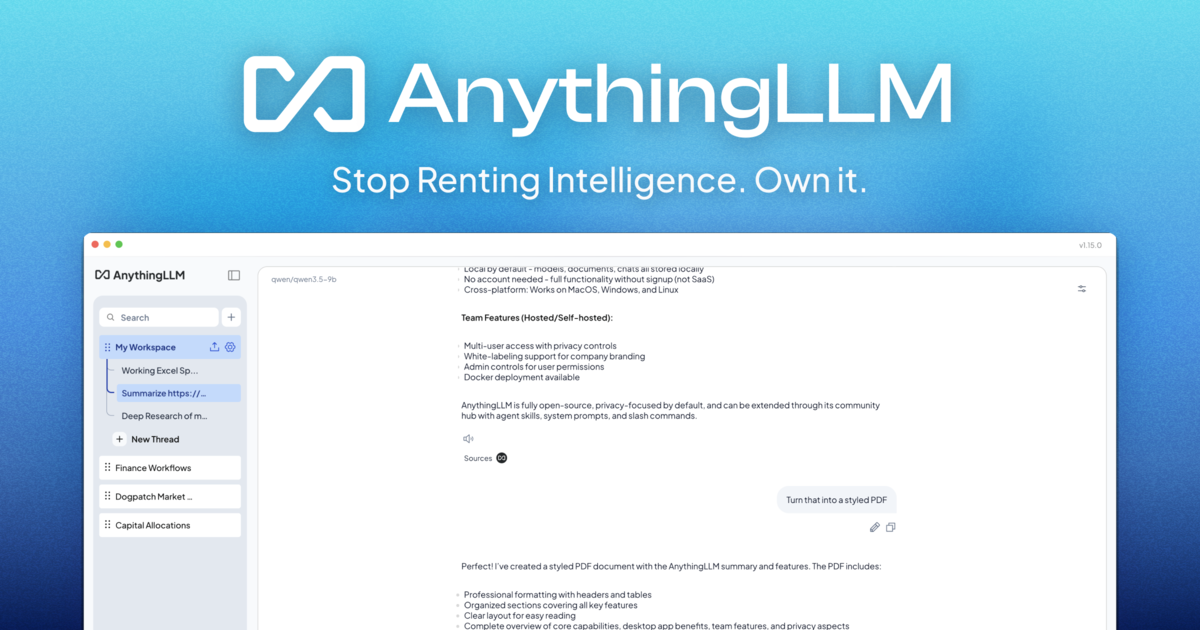
A private AI assistant that runs entirely on your computer. No accounts, no API keys, no token limits. - On-device AI: Runs entirely locally with no cloud processing or data leaving your device - Document Knowledge: Every document becomes part of your agent's knowledge base - Meeting Assistant: Automatically transcribes and summarizes meetings with action items and key decisions - Background Jobs: Automate recurring tasks and workflows - Dynamic Model Selection: Choose or auto-select the best model for your hardware - Web Scraping & Search: Access real-time information from the web - Custom Agent Skills: Build and deploy custom AI capabilities - Magic Features: Includes intelligent dictation, real-time text refinement, and context-aware autocomplete - Cross-platform: Available for macOS, Windows, and Linux - Easy Setup: One-file installation with no dependencies - Docker Support: Available for containerized deployment - Open Source: Full source code available on GitHub - Self-hosted Options: Cloud and mobile versions available for team collaboration

All-in-one AI desktop client for heavy users

Cherry Studio is a powerful, open-source AI desktop client designed for heavy AI users. It provides a unified interface to interact with frontier LLMs, AI agents, and creative tools—all while keeping your data local. - AI Chat: Engage in document, image, formula, and HTML conversations with AI - Autonomous Agents: Built-in 1000+ assistants for various tasks and workflows - AI Art & Drawing: Generate images using multiple AI models - AI Translation: Instant translation across conversations and documents - Multi-source Knowledge Base: Integrate local files, web pages, and other sources - Local & Cloud Backup: Secure data storage with flexible backup options - Cross-platform Support: Runs on Windows, macOS, and Linux - 300+ AI Models: Seamlessly switch between leading LLMs - Flagship Model Support: Early access to latest models like DeepSeek V4 Pro and GLM-5.3 Cherry Studio is open-source and can be self-hosted. All data is stored locally by default, ensuring privacy and control. The application supports integration with multiple AI providers and offers enterprise solutions for teams requiring additional features and support.

Open-source unified AI conversation platform
LibreChat is an open-source platform that unifies all your AI conversations in one customizable interface. Designed for developers and enterprises, it offers advanced features like persistent memory, code interpreter, MCP support, and enterprise-grade authentication. - Unified AI Interface: Consolidate conversations from multiple AI models in a single dashboard - Advanced Agents: Deploy agents with file handling, code interpretation, and API actions - Code Interpreter: Execute code in multiple languages securely with zero setup - Multi-Model Support: Connect to Anthropic, AWS, OpenAI, Azure, and other AI providers - Artifacts Creation: Generate React, HTML, and Mermaid diagrams directly in chat - Persistent Memory: Maintain context across conversations for personalized interactions - Web Search Integration: Provide live internet access to any model with built-in search - Enterprise Authentication: SSO with OAuth, SAML, LDAP, and two-factor authentication - Model Context Protocol (MCP): Connect to external tools and services seamlessly - Self-Hosting: Full control with Docker, Kubernetes, and remote deployment options LibreChat is fully open-source and can be self-hosted using Docker, Kubernetes, or remote installation methods. The platform supports various AI providers and offers comprehensive documentation for local and remote deployments. With 42.6k+ GitHub stars and 50M+ Docker pulls, it's a widely adopted solution for AI-powered conversations.
Jan runs open-source AI models on your own hardware or connects to cloud providers like OpenAI, Anthropic, and Google, keeping your conversations off third-party servers.
Jan runs open-source AI models on your own hardware or connects to cloud providers like OpenAI, Anthropic, and Google, keeping your conversations off third-party servers.
Self-hostable AI assistant that connects to your docs and the web, lets you build agents, schedule automations, and run research with verifiable citations.
Self-hostable AI assistant that connects to your docs and the web, lets you build agents, schedule automations, and run research with verifiable citations.
Open-source answer engine that dynamically generates UI components while providing AI-powered responses, combining conversational AI with interactive interfaces.
Open-source answer engine that dynamically generates UI components while providing AI-powered responses, combining conversational AI with interactive interfaces.

Open-source desktop AI assistant with MCP support

5ire is a sleek, cross-platform desktop AI assistant and MCP (Model Context Protocol) client designed for simplicity and user-friendliness. It provides an intuitive interface for interacting with large language models while offering advanced features like local knowledge bases, custom prompt libraries, and usage analytics. - MCP Support: Standardized connection to AI models via MCP servers, enabling access to tools like file systems, databases, and remote data sources. - Local Knowledge Base: Integrates the bge-m3 embedding model for multilingual vectorization, supporting document parsing (DOCX, XLSX, PPTX, PDF, TXT, CSV) and local RAG capabilities. - Usage Analytics: Tracks API usage and spending to help users optimize their AI service consumption. - Prompts Library: Create and organize custom prompts with variable support for versatile use cases. - Bookmarks: Save and retain conversations even after original messages are deleted. - Global Search: Perform keyword searches across all conversations for quick information retrieval. 5ire is an open-source project available for Mac (Silicon/Intel), Windows, and Linux. It can also be installed via Homebrew on macOS. The project is licensed under Apache 2.0 and encourages community contributions.

Chat with private local LLMs offline

Fullmoon is a lightweight app designed to bring the power of large language models to your Apple devices. Whether you're using an iPhone, iPad, Mac, or Vision Pro, Fullmoon provides a seamless way to interact with LLMs without compromising your privacy. - Private & Local: Runs models entirely on-device with no cloud dependency, ensuring your data never leaves your device. - Offline Capability: Works fully offline when internet is unavailable, perfect for travel or areas with poor connectivity. - Apple Silicon Optimized: Leverages Metal 3 and Swift MLX for maximum performance on Apple hardware. - Model Variety: Supports multiple quantized models including Llama 3.2 (1B/3B) and DeepSeek R1 variants. - Customization: Personalize themes, fonts, and system prompts to tailor the experience to your preferences. - Shortcuts Integration: Use local models with Apple Shortcuts for automation and workflow integration. - TestFlight Access: Get early access to new features and models through TestFlight. Fullmoon is currently available as an iOS/iPadOS/macOS app with no self-hosting option. The app is open source (GitHub repository) and runs exclusively on Apple devices with Apple Silicon processors. Models are quantized for efficient on-device inference.

Open chat interface for all your AI models
Zola is a self-hosted chat interface designed to provide a unified experience for interacting with multiple AI models. Built with privacy and developer experience in mind, it allows users to connect and manage various AI models from a single dashboard. - Unified AI Model Interface: Connect and interact with multiple AI models in one place. - Self-Hosted: Full control over your data with self-hosting capabilities. - Privacy-Focused: No telemetry or tracking, ensuring your conversations remain private. - Open Source: Transparent and customizable codebase. - Multi-Model Support: Compatible with various AI models and providers. - Developer-Friendly: Built with modern web technologies for easy integration and extension. - Customizable UI: Tailor the interface to your preferences. Zola is built with Next.js and TypeScript, making it easy to deploy on platforms like Vercel, Netlify, or any Node.js-compatible server. The project includes a Dockerfile for containerized deployments, simplifying the setup process. Configuration is managed via environment variables, allowing for flexible customization.

Local-first workspace for parallel coding agents
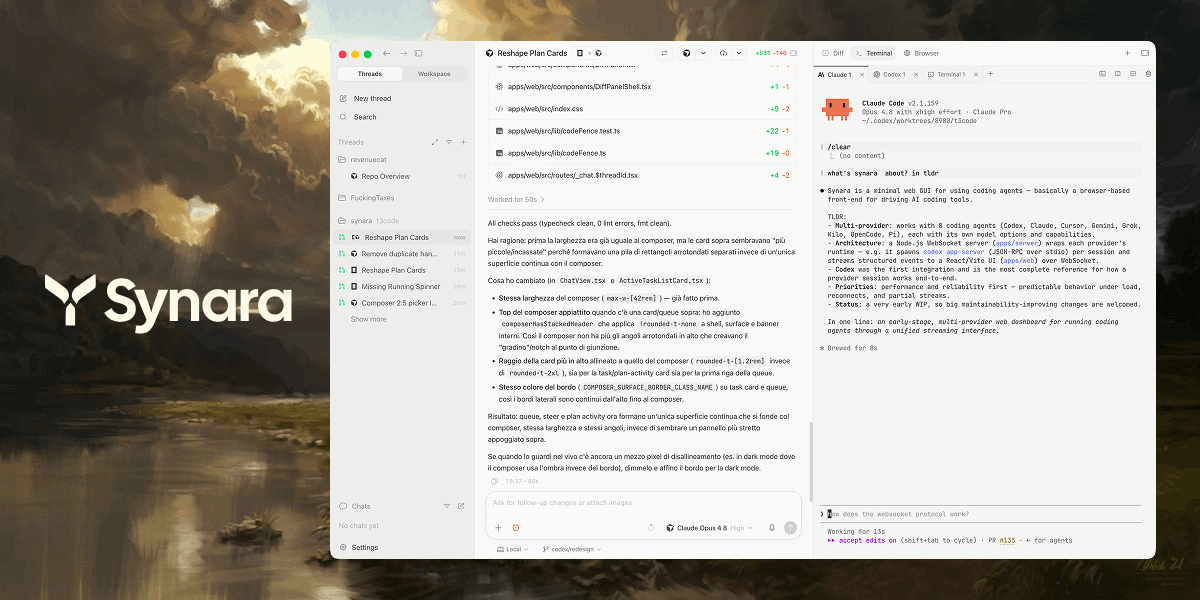
Synara is a free, open-source, local-first workspace designed to streamline agentic coding workflows. It provides a unified command center for running multiple coding agents in parallel while maintaining task isolation, Git worktrees, and pull-request delivery. - Parallel Agent Execution: Run multiple coding agents (Claude Code, Codex, Cursor, OpenCode, Antigravity, Grok Build, Kilo Code, Pi, Factory Droid) simultaneously in isolated environments. - Git Worktree Integration: Each task operates in a separate Git worktree, preventing conflicts and ensuring clean branch management. - Terminal & Process Management: Built-in terminals for running development servers, test watchers, and custom commands alongside agent tasks. - Browser Verification: Inspect rendered results, capture console output, and verify behavior directly within the workspace. - Task Ownership & Handoffs: Explicit task ownership with the ability to hand off work between different providers while preserving context. - Pull Request Delivery: Review diffs, run checks, commit changes, and open pull requests without leaving the workspace. - Project Context Preservation: Maintains repository-specific tasks, provider sessions, and activity state for seamless context switching. - Local-First Architecture: Operates entirely on your local machine, ensuring privacy and offline capability. Synara is self-hosted and runs entirely on your local machine. It is open-source (MIT License) and available for Linux. The project is actively maintained on GitHub.

Open-source AI command center for your company
Kortix is the open-source AI command center for your company, providing a complete AI workforce platform where every agent, skill, and memory is a file in a single versioned repository you own. - Single Git Repo Company: Agents, skills, memory, connectors, and triggers are all text files in one repo you control. Use grep, diff, and version control for full transparency. - 3,000+ App Integrations: Connect Slack, Teams, Notion, GitHub, Linear, Stripe, and more via MCP, OpenAPI, Postman, GraphQL, or raw HTTP. - Any Model, Your Keys: Run any LLM (Claude, OpenAI, Gemini, OpenRouter) with your own API keys—no vendor lock-in. - Fine-Grained Permissions: Rule each tool call (allow, ask, block) down to specific arguments for security. - Multi-Interface Access: Interact via Web, CLI, Slack, MS Teams, Email, or Mobile. - Self-Hostable: Deploy on-prem, VPC, or managed cloud for full data control. Kortix is open-source (GitHub) and designed for self-hosting. The platform runs as a single binary with a web interface and supports Docker deployments. Configuration is YAML-based (kortix.yaml) for defining agents, skills, memory, and connectors. Credentials are brokered server-side and never enter the machine image, ensuring security. The system is built for scalability and integrates with existing DevOps workflows.

Agent Development Environment for coding agents
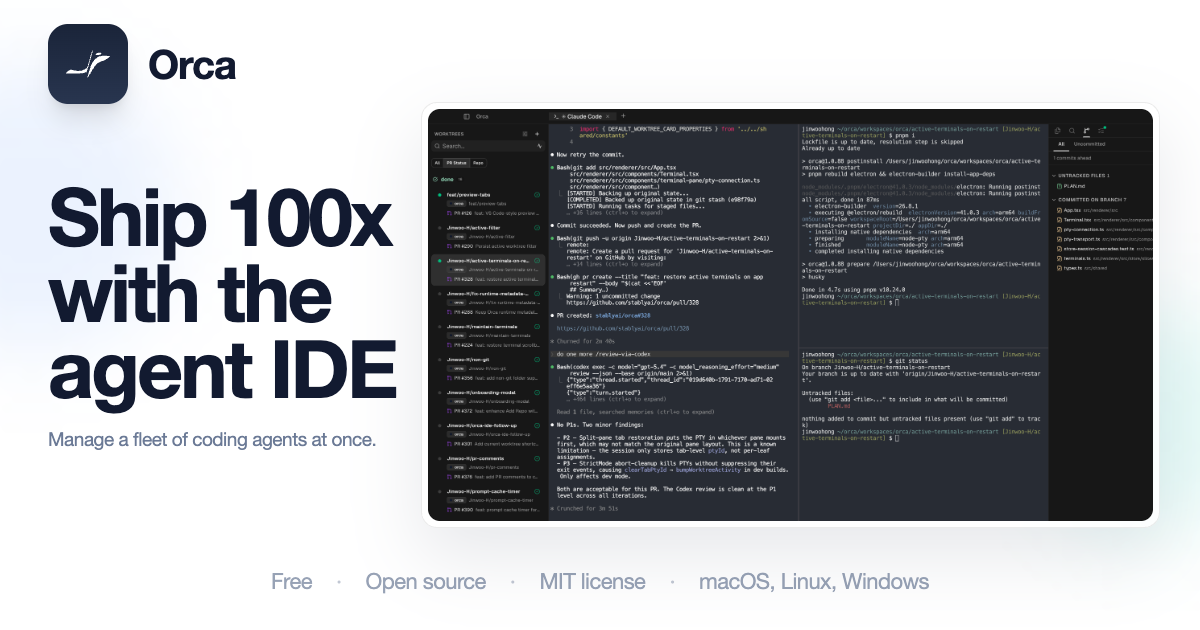
Orca is the Agent Development Environment (ADE) designed to supercharge your coding workflow with AI agents. Run tools like Claude Code, Codex, and Cursor CLI simultaneously in isolated environments, enabling parallel task execution and faster development cycles. - Parallel Agent Execution: Run multiple coding agents (Claude Code, Codex, OpenCode, etc.) side by side in isolated worktrees for concurrent task handling. - Isolated Workspaces: Each agent operates in a separate environment, preventing conflicts and ensuring clean execution. - Built-in Terminal & Editor: Ghostty-inspired terminals and an integrated file editor streamline the development process. - Git Integration: Seamless Git tracking keeps every branch moving efficiently. - Cross-Platform Support: Available on macOS, Windows, Linux, iOS, and Android. - Observability Dashboard: Monitor agent performance, task status, and resource usage in real-time. - Mobile Companion: iOS and Android apps for on-the-go development and monitoring. - Enterprise Features: Advanced orchestration, security, and scalability options for teams. Orca is open-source and can be self-hosted for complete control over your development environment. The project is actively maintained with frequent updates and a strong community backing. For enterprise needs, Orca offers additional features and support. Backed by Y Combinator, Orca is trusted by developers for its performance, flexibility, and innovative approach to AI-powered development.

Open-source control plane for coding agents
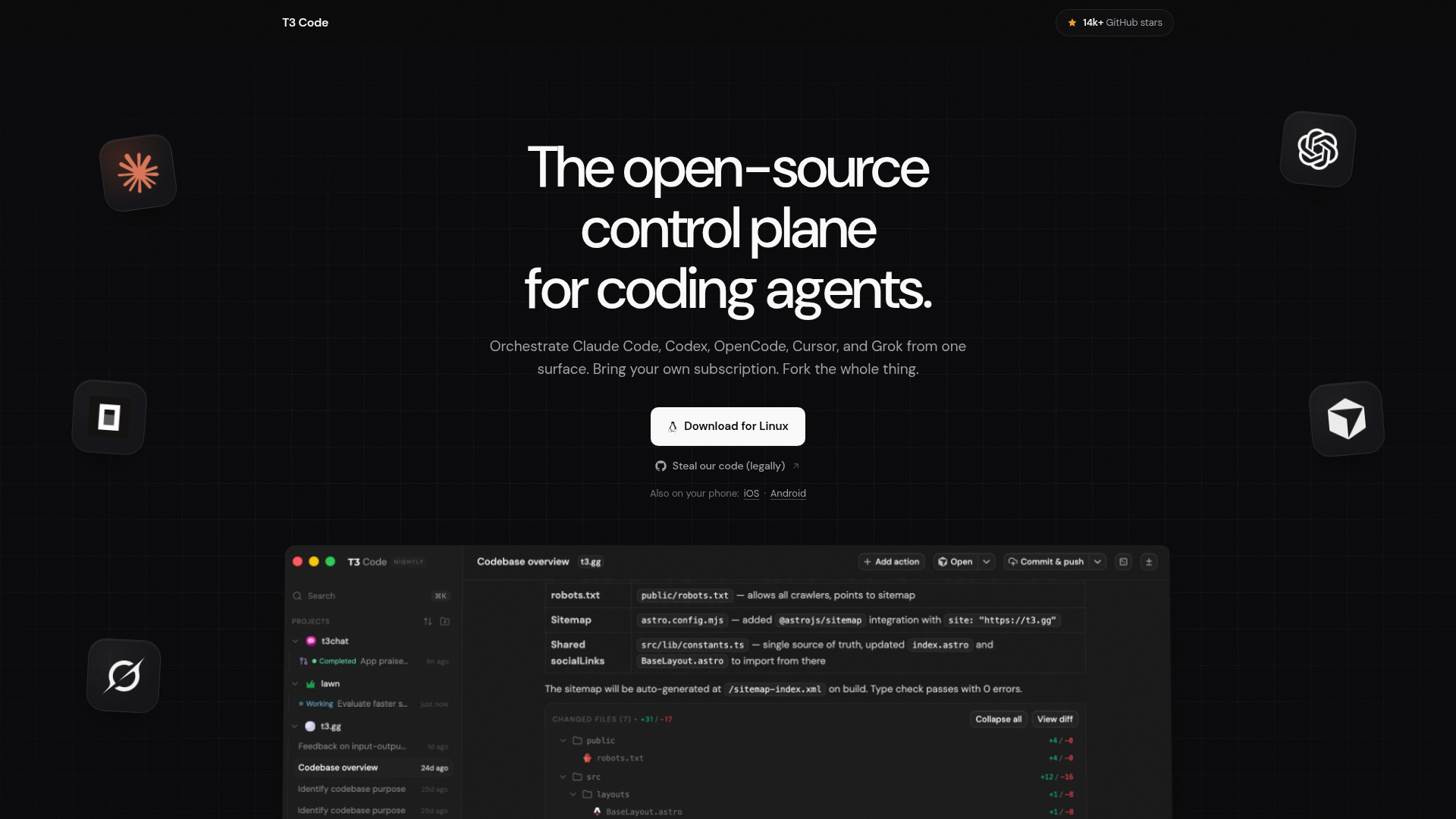
T3 Code is an open-source control plane designed to orchestrate multiple AI coding agents—such as Claude Code, OpenCode, Cursor, and Grok—from a single unified workspace. Bring your own subscriptions and fork the entire project to customize it for your needs. - Multi-Agent Orchestration: Manage Claude Code, OpenCode, Cursor, and Grok from one interface. - Bring Your Own Subscription: Use your existing AI model subscriptions without restrictions. - Forkable & Customizable: Open-source codebase allows for full customization and forking. - Cross-Platform Support: Available on Linux, iOS, and Android. - Performance Optimized: Designed for efficiency and responsiveness. - Community-Driven: Built with feedback from over 100,000 developers. T3 Code is open-source and can be self-hosted. The project is available on GitHub and supports Linux, iOS, and Android platforms. Users can download the app or build from source for full control over their setup.

Orchestrate any coding agent in one workspace
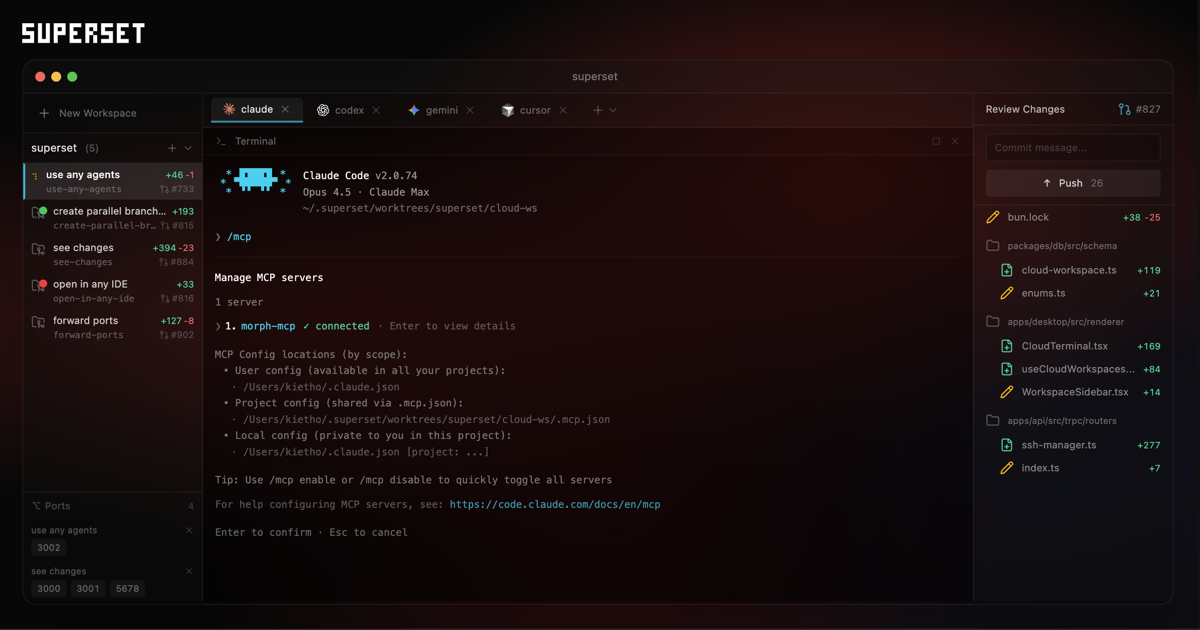
Superset is a unified workspace designed to orchestrate multiple coding agents like Claude Code, Codex, OpenCode, and others. It enables developers to run tasks in parallel, isolate changes in clean branches, and review all work in one place. - Unified Workspace: Bring together Claude Code, Codex, OpenCode, and other coding agents in a single interface. - Parallel Execution: Run multiple agents simultaneously for different tasks, scaling from two to 100+ agents. - Isolated Workspaces: Each task gets its own isolated workspace and clean branch to prevent conflicts. - Real-Time Monitoring: Track agent progress, status, and results at a glance with a centralized dashboard. - Agent Independence: Switch between agents (Claude, Codex, OpenCode, etc.) without changing your workflow. - Automations: Schedule recurring tasks like triage, changelog updates, and dependency upgrades. - Remote Access: Connect to remote machines (e.g., GPU boxes) and manage workspaces across different environments. - Review & Merge: Review changes, provide feedback, and merge work directly from the interface. Superset is open-source and can be self-hosted. The project is actively maintained on GitHub with detailed documentation for setup and configuration.

Minimal terminal-based AI coding agent
Pi is a minimal agent harness designed for developers who want to adapt AI workflows to their own processes rather than the other way around. It runs in the terminal and offers powerful customization through extensions, skills, prompt templates, and themes. - Minimal & Customizable: Skip bloated features like sub-agents and plan mode. Build exactly what you need. - Multi-Model Support: Switch between 15+ providers (Anthropic, OpenAI, Google, Ollama, etc.) mid-session with /model or Ctrl+L. - Tree-Structured History: Sessions are stored as trees. Navigate to any prior point with /tree, export to HTML, or share via GitHub gist. - Context Engineering: Load project-specific instructions via AGENTS.md, SYSTEM.md, and skills. Customize compaction strategies. - Four Operational Modes: Interactive, print/JSON, RPC, and SDK for programmatic usage. - Extensible Architecture: Add custom providers, models, and UI tweaks via extensions. Bundle as Pi packages and share via npm or git. - Token Efficiency: Minimal system prompt ensures efficient token usage. Pi is open source and can be self-hosted. Installation options include: bash curl -fsSL https://pi.dev/install.sh | sh powershell -c "irm https://pi.dev/install.ps1 | iex" npm install -g --ignore-scripts @earendil-works/pi-coding-agent pnpm add -g --ignore-scripts @earendil-works/pi-coding-agent bun add -g --ignore-scripts @earendil-works/pi-coding-agent Pi supports custom installations and can be extended with third-party packages like @termdraw/pi for enhanced TUI capabilities.

Open-source AI coding assistant alternative
OpenWork is an open-source AI coding assistant designed to integrate seamlessly into your development workflow. Built as an alternative to proprietary AI coding tools, it provides code generation, review, and automation features powered by open models. - AI-Powered Code Generation: Generate, refactor, and optimize code using local or remote AI models - Code Review Automation: Automated code analysis and suggestions for improvements - Workflow Integration: Works with your existing tools and IDEs - Self-Hostable: Full control over your data and infrastructure - Multi-Model Support: Compatible with various AI models including open alternatives - Developer-First Design: Built by developers for developers with a focus on practical use cases OpenWork is designed for self-hosting with comprehensive documentation available for deployment. It supports containerized setups and can be integrated with popular development environments. The project is actively maintained with regular updates and community contributions.

AI-powered unified inbox for faster email management
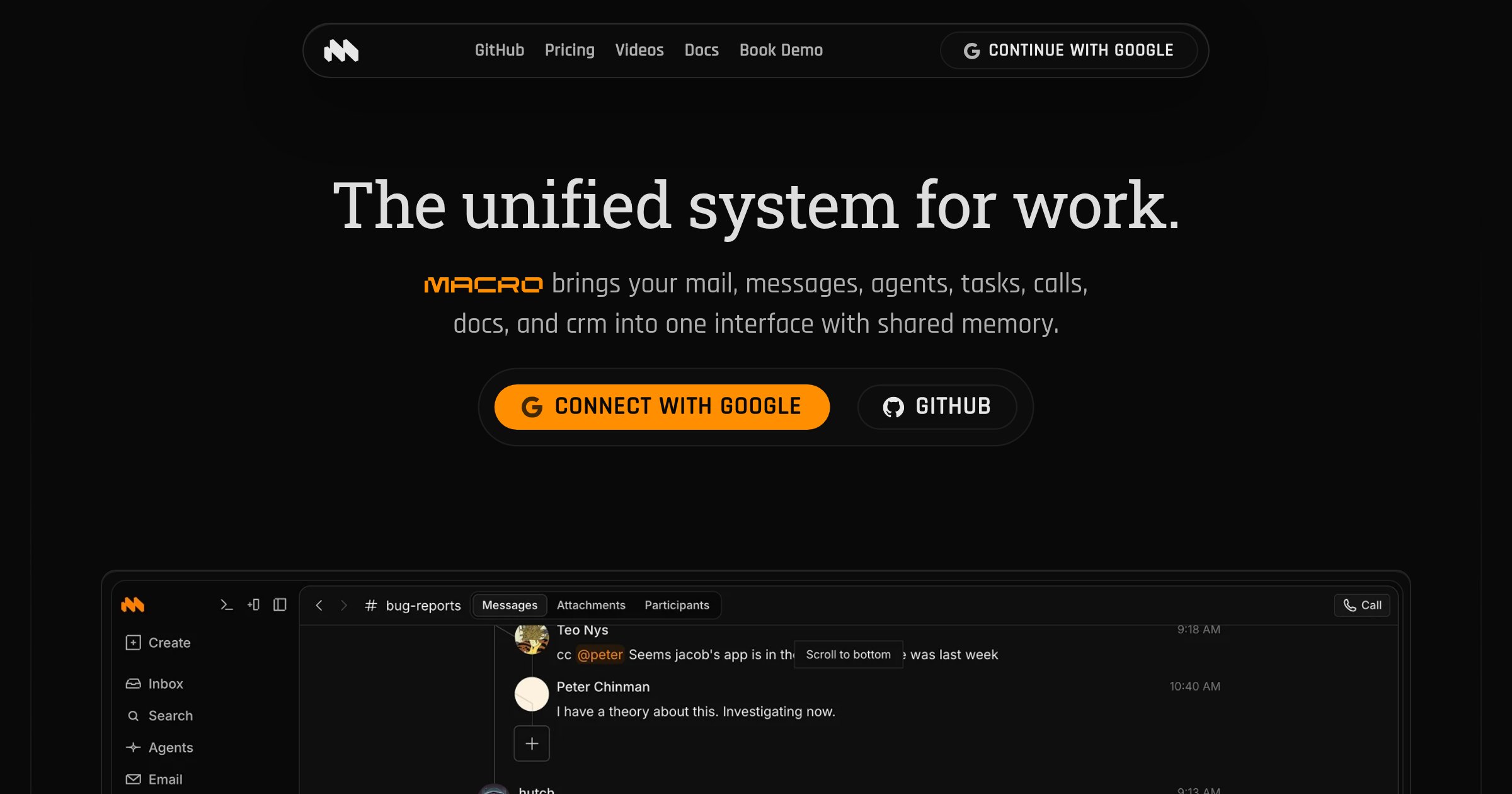
Macro Mail combines the speed of Superhuman, the multitasking of Outlook, the intelligence of Claude, and the simplicity of Gmail in one keyboard-first inbox. It intelligently ranks emails, learns your priorities, and helps you reach inbox zero faster with AI-powered drafting and automation. - Unified Inbox: Triage all your email accounts in a single view with split-second search and AI-powered organization. - AI Drafting: Automatically draft replies in your voice, scanning prior threads to maintain consistency. - Keyboard-First: Full keyboard shortcuts for triage, composition, and navigation—no mouse required. - Agent Automations: Set up agents to send daily summaries, fire custom notifications, and clear your inbox on a schedule. - Contextual Compose: Type @ to quickly add recipients and files without context switching. - Instant Search & Sync: Fast search, send, and sync across all accounts. - Signal/Noise Filtering: Intelligently ranks emails to highlight what matters most to you. - Multi-Account Support: Connect and manage multiple email accounts in one unified interface. Macro Mail is a cloud-hosted SaaS with no self-hosting option. The platform is built for speed and AI integration, requiring centralized infrastructure for real-time sync and machine learning features. For teams or individuals seeking privacy-focused alternatives, consider self-hosted email clients like Mailspring or Thunderbird.

Open-source agentic development environment
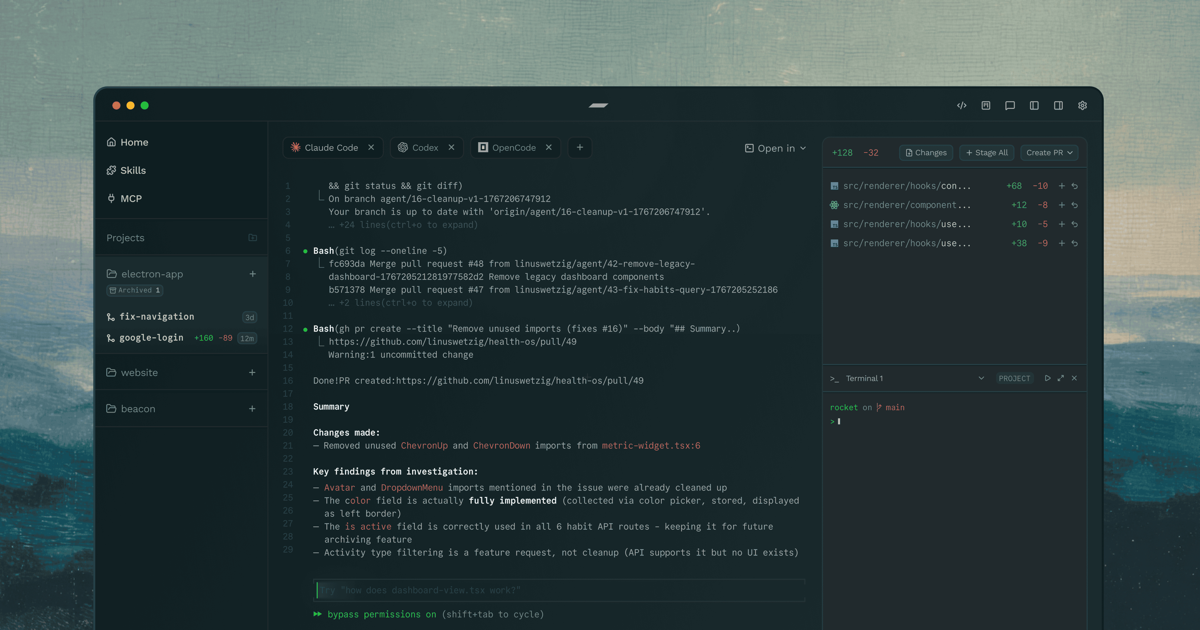
Emdash is a free, open-source agentic development environment designed to streamline coding workflows. It allows developers to run coding agents such as Claude Code and Codex in parallel, schedule recurring tasks, and review changes—all within a unified interface. - Parallel Agent Execution: Run multiple coding agents simultaneously in isolated workspaces with Git worktrees. - Task Scheduling: Automate bug sweeps, release prep, reviews, and checks with recurring agent runs. - In-App Browser: Preview applications directly within the environment. - Review and Ship: Inspect diffs, commit changes, push updates, and open pull requests without switching tools. - Remote Development: Connect over SSH to dev servers, cloud VMs, or GPU boxes for remote agent execution. - Workspace Provisioning: Set up and tear down isolated environments on demand for each task. - Agent Flexibility: Works with 25+ coding agents, including Codex, Cursor, Claude Code, Amp, and Antigravity. - Library Integration: Save prompts, install skills, and sync MCP servers for reusable agent resources. Emdash is open-source and can be self-hosted on macOS, Windows, and Linux. It supports remote development via SSH and integrates with various tools for seamless workflow automation.

AI coding analytics for developers
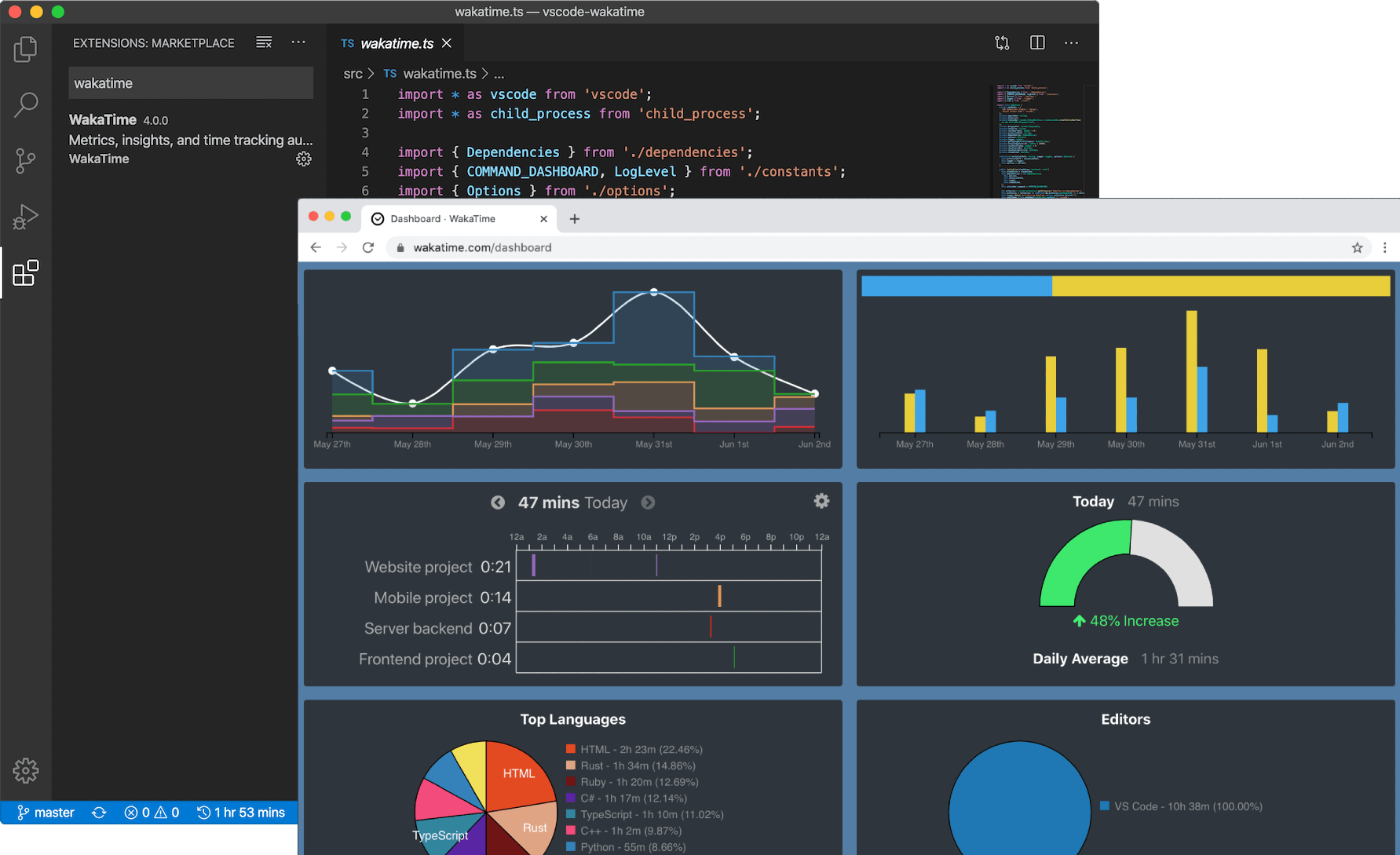
WakaTime provides AI-powered coding analytics to help developers, teams, and organizations measure and optimize AI tool usage. - AI Cost Tracking: Monitor AI spend across models with per-developer breakdowns to stay on budget - AI Adoption Metrics: Track which AI models developers use and the ratio of AI-generated vs human-written code - AI Effectiveness Analysis: Measure how often AI-generated code is modified to prove real productivity gains - Model Efficiency Comparison: Compare tokens per line and prompt length across models to balance quality and cost - Per-Model Breakdown: Detailed insights into lines changed, tokens spent, and estimated costs by model (Claude Code, Cursor, Copilot, etc.) - Prompt Length Analysis: Understand developer interaction patterns with AI tools through input context measurement - 100+ Editor/IDE Support: Works with popular tools including VS Code, IntelliJ, Neovim, Chrome, Firefox, and terminal-based AI assistants - Team & Company Dashboards: Visualize adoption trends and ROI across engineering teams WakaTime offers both cloud and self-hosted options. The open-source wakatime-cli can be self-hosted for complete data control. The platform is GDPR compliant and prioritizes developer privacy with local data processing before optional cloud sync.
About Claude
A next generation AI assistant built for work and trained to be safe, accurate, and secure.