16 Best Open Source Tableau Alternatives
A curated collection of the 16 best open source and self-hosted alternatives to Tableau in 2026.
Looking for a free, privacy-friendly, or self-hosted replacement for Tableau in 2026? The top open-source alternative is Apache Superset — Open-source data visualization and exploration platform.
Other highly rated open-source Tableau alternatives include Grafana, OpenBB and Metabase.
Open-source data visualization and exploration platform
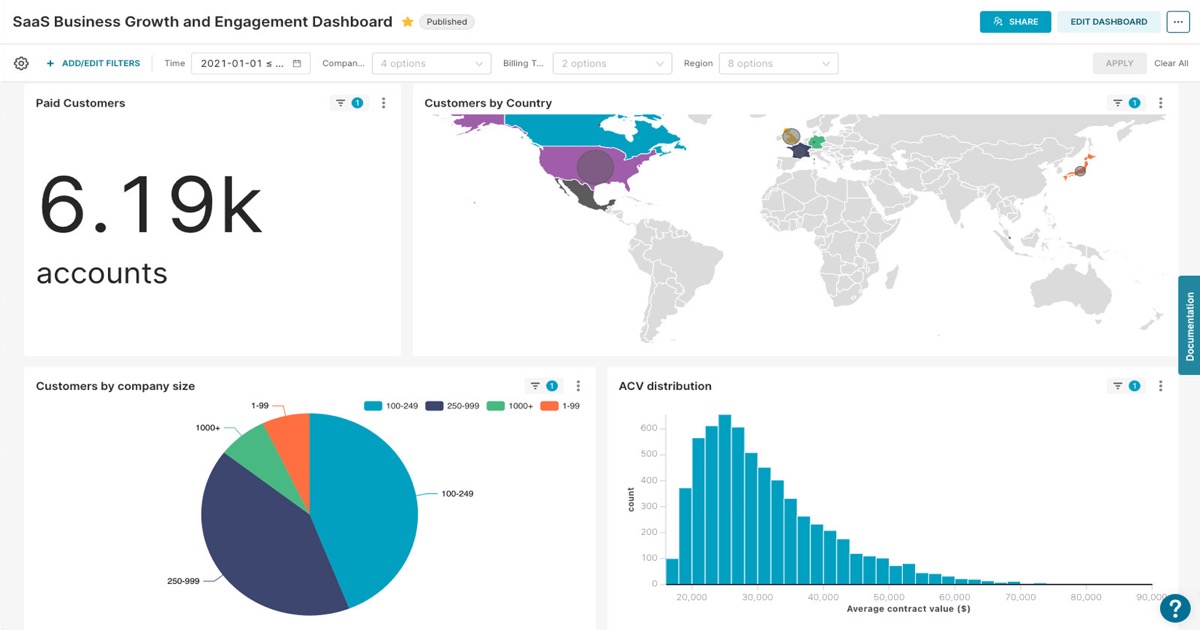
Apache Superset™ is an open-source modern data exploration and visualization platform designed for the cloud-native era. It enables users to create interactive dashboards and charts from any SQL database with a powerful no-code interface or advanced SQL IDE. - 40+ pre-installed visualization types including charts, graphs, and geospatial visualizations - No-code visualization builder for quick chart creation without SQL knowledge - SQL Lab for advanced users to write custom queries, use Jinja templating, and explore database metadata - Scalable architecture that integrates with modern cloud-native databases and engines at petabyte scale - Plug-in architecture for building custom visualizations and extending functionality - Self-serve analytics allowing business users to explore data independently - Dataset management supporting both physical and virtual datasets with unified metric definitions - Security features including role-based access control and database connection management Superset is built on modern web technologies and can be deployed on any infrastructure. It supports containerized deployments (Docker, Kubernetes) and integrates with existing data stacks without requiring additional ingestion layers. The project is Apache 2.0 licensed and welcomes community contributions.
Grafana unifies metrics, logs, traces, profiles, and business data into one OpenTelemetry-native platform with AI-assisted root cause analysis and adaptive cost controls.
Grafana unifies metrics, logs, traces, profiles, and business data into one OpenTelemetry-native platform with AI-assisted root cause analysis and adaptive cost controls.

Build your own financial workspace
OpenBB is the workspace where investment teams bring their data, workflows, and AI together under their control. It solves the infrastructure problem of gated data, fragmented tools, and manual workarounds by connecting to any vendor, database, or internal model. - Unified Data Integration: Connect to any vendor, database, internal models, or files without rebuilding integrations. - Customizable Dashboards: Turn analyses into interactive dashboards for teams, analysts, PMs, and AI agents. - AI Agent Collaboration: AI agents work alongside humans using the same governed data, context, and tools. - Open Data Platform (ODP): Open-source foundation for building financial applications. - Workspace Lite: Free tier for small investment teams with core functionality. - App Marketplace: Discover and integrate third-party apps and MCP servers. - Snowflake Native App: Deploy OpenBB directly within Snowflake environments. - Security & Governance: Enterprise-grade controls for data access and workflow distribution. OpenBB is available as a commercial product (OpenBB Workspace) with a free tier (Workspace Lite) and an open-source foundation (Open Data Platform). The platform supports self-hosting for full data control and can be deployed in cloud or on-premises environments. It integrates with existing financial data sources and AI models while maintaining strict data governance.

Open source AI analytics with verified queries
Metabase is an open-source business intelligence and embedded analytics platform designed for teams to explore, visualize, and share data without requiring SQL knowledge. Grounded in your semantic layer—your metrics and business logic—Metabase ensures every answer is verifiable and traceable to its source query. - Self-service analytics: Drag-and-drop query builder for non-technical users - Embedded analytics: SDK for integrating analytics into customer-facing applications - Metabase AI: AI-powered insights and natural language querying - Semantic layer: Centralized metrics and business logic for consistency - Dashboards & reporting: Customizable, shareable dashboards with drill-through capabilities - Data segregation: Role-based access control and permissions - SQL editor: Advanced users can write and execute custom SQL queries - White-label analytics: Fully customizable branding for embedded solutions - CSV uploads: Direct data import for quick analysis - Usage analytics: Track engagement and adoption across teams Metabase is open-source and can be self-hosted on your own infrastructure. It supports a wide range of databases including PostgreSQL, MySQL, BigQuery, Snowflake, and more. The platform is available as a Docker container, on Kubernetes, or as a standalone JAR file. Metabase Cloud offers a managed hosting option with enterprise-grade security and scalability.

Open source data visualization and dashboarding tool
Redash is a powerful open-source platform for connecting to databases and APIs, writing SQL queries, and creating interactive dashboards. It helps teams transform raw data into actionable insights through collaborative visualization and sharing. - Multi-source data connections: Supports PostgreSQL, MySQL, Redshift, BigQuery, MongoDB, and more - Collaborative SQL editor: Browse schemas, create reusable snippets, and write queries with team collaboration - Drag-and-drop dashboards: Visualize data with customizable charts and graphs - Scheduled refreshes: Automatically update dashboards with fresh data - Alerts system: Get notified when data meets specific conditions - User management: Control access and permissions for teams - API access: Integrate with other tools and systems - Open source: Self-hostable with no vendor lock-in Redash is fully open-source and can be self-hosted on your own infrastructure. The project provides comprehensive setup guides for Docker, Kubernetes, and bare-metal installations. It's built with Python, JavaScript, and PostgreSQL, making it suitable for most modern environments.

Open source log collection and processing pipeline
Logstash is a flexible, open-source data processing pipeline that integrates data from multiple sources, formats, and locations in real-time. As part of the Elastic Stack, it enables centralized log collection, parsing, and enrichment before indexing into Elasticsearch for storage and analysis. - Multi-source data ingestion: Collect logs from files, syslog, HTTP, databases, and cloud services - Real-time processing: Parse and transform logs as they arrive with customizable filters - Extensible plugin ecosystem: Over 200 plugins for input, filter, and output operations - Data enrichment: Add context to logs using geo-IP, user agent parsing, and custom lookups - Scalable architecture: Handle high-volume log streams with distributed processing - Integration with Elastic Stack: Seamless connection to Elasticsearch and Kibana for visualization - Flexible deployment: Run as standalone, in containers, or as part of Kubernetes clusters - Security features: TLS encryption, authentication, and role-based access control Logstash is open-source software that can be self-hosted on any infrastructure. It supports: - Standalone deployment: Single-node setup for development or small-scale use - Containerized deployment: Docker images available for easy container orchestration - Kubernetes integration: Helm charts for deploying in Kubernetes environments - Cloud deployment: Available as part of Elastic Cloud for managed hosting The software is written in JRuby and requires Java runtime environment. Configuration is done through a declarative pipeline definition file.

Open source observability platform for logs, traces and errors
HyperDX is an open source observability platform designed to help engineering teams resolve production issues faster. It unifies session replays, logs, traces, metrics, and errors into a single interface, eliminating the need for multiple tools. - End-to-End Tracing: Automatically trace requests from browser to backend servers and async workers - Blazing Fast Search: Search terabytes of events in seconds using ClickHouse - Intuitive Search Syntax: Simple full-text search without complex syntax requirements - Automatic Pattern Clustering: Aggregate log patterns and condense billions of events into distinctive clusters - Correlated Session Replays: Link session replays with backend logs and traces automatically - Visualization Tools: Build and share intuitive charts for logs, metrics, and traces - Automatic Instrumentation: Trace logs, API requests, DB queries with minimal code - Alerts & Notifications: Get notified via Slack, Email, or PagerDuty when issues occur - Intercom Integration: Jump directly from Intercom to user sessions and logs - Live Tail: View and search log streams in real-time - Native JSON Parsing: Search and graph structured JSON logs without configuration - Vendor Agnostic: Powered by OpenTelemetry for no vendor lock-in - Agent-Free Install: No additional agents, sidecars, or containers required HyperDX is built on ClickHouse and OpenTelemetry, making it highly scalable and compatible with various deployment environments. The platform offers both cloud-hosted and self-hosted options, with automatic instrumentation supporting multiple languages including Node.js, Python, Java, Go, Elixir, and React Native. Deployment is supported on Kubernetes, AWS EC2, Vercel, Fly.io, Heroku, and Cloudflare.
Create data-driven websites and reports using SQL and Markdown, with automatic visualizations and interactive elements.
Create data-driven websites and reports using SQL and Markdown, with automatic visualizations and interactive elements.

Open-source, code-first BI platform for modern data teams
Lightdash is the open-source, code-first BI platform designed for modern data teams. It enables you to connect directly to dbt, define metrics once, and instantly generate reliable insights that AI agents can trust. - AI-Native Analytics: Give AI agents access to governed metrics via Slack, Claude, or Lightdash for automated insights. - Code-First Semantic Layer: Define metrics in code (YAML) for consistency and reusability across teams. - Legacy BI Migration: Seamlessly migrate from Looker, Power BI, or Tableau without rebuilding dashboards. - Self-Hosted & Cloud Options: Deploy on your infrastructure or use Lightdash Cloud for managed hosting. - Governed Data Access: Control permissions and data access while empowering teams to build custom data apps. - Trustworthy Metrics: Ensure data accuracy with version-controlled metrics and transparent definitions. - Scalable Pricing: Start for free and scale as your team grows. Lightdash is open-source and can be self-hosted on your own infrastructure. It supports Docker deployments and integrates with existing data stacks like dbt, Snowflake, BigQuery, and PostgreSQL. The platform is built with TypeScript, React, and Node.js, making it extensible for custom integrations.

Build live KPI dashboards from databases & APIs
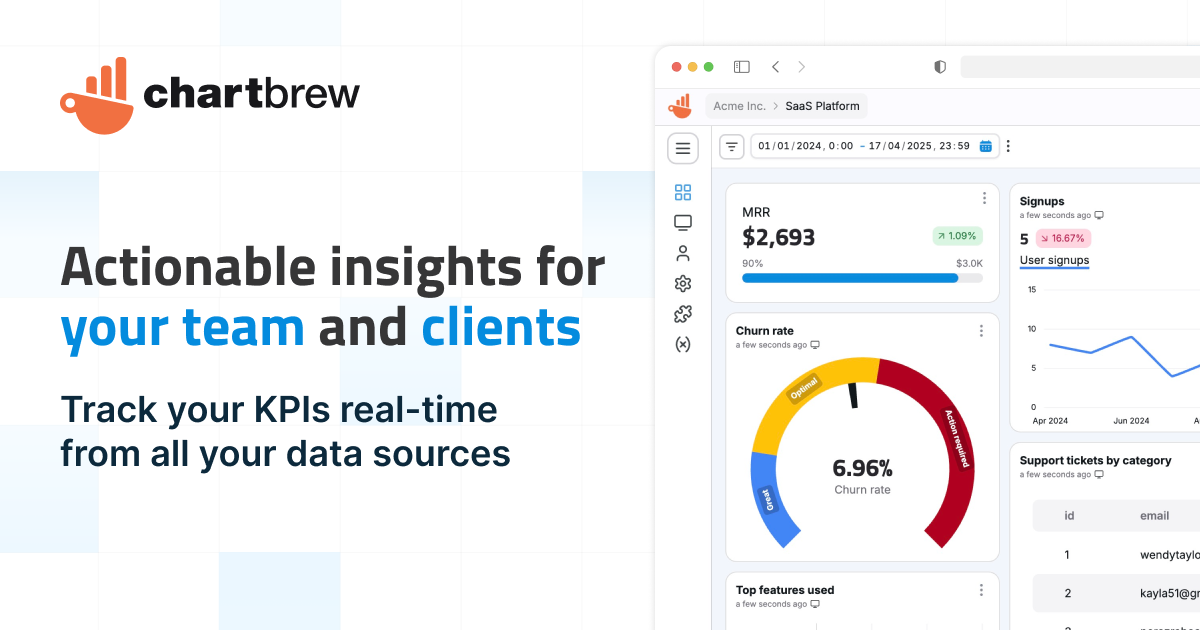
Chartbrew is a self-hostable platform for building live KPI dashboards from your existing data sources. Whether you're tracking internal metrics or sharing client-facing reports, Chartbrew streamlines the process with reusable datasets, AI-assisted setup, and automated sharing. - Multi-source data connection: Pull data from databases (Postgres, MySQL, MongoDB), APIs (Stripe, Google Analytics, Plausible), and analytics tools into a single platform. - Reusable datasets: Create and reuse datasets across charts and dashboards, with support for joining data from multiple sources. - Live KPI dashboards: Build customizable dashboards with charts, tables, goals, and filters to track business health at a glance. - AI-assisted setup: Get help writing SQL queries, building datasets, and exploring data without starting from scratch. - Automated reporting: Schedule chart refreshes, send snapshots via email or Slack, and trigger alerts through webhooks. - Secure sharing: Share dashboards internally, embed them in products, or provide controlled client access with granular permissions. - Self-hosting option: Deploy Chartbrew on your own infrastructure for full data control and customization. - Enterprise-ready: Used by product teams, SaaS companies, and agencies for both internal and client-facing reporting. Chartbrew is built with Node.js and React, offering both cloud-hosted and self-hosted options. The self-hosted version provides full control over data and infrastructure, making it ideal for privacy-conscious teams. The platform supports PostgreSQL, MySQL, and MongoDB for dataset storage and offers integrations with popular data sources like Stripe, Google Analytics, and Supabase. View documentation for deployment guides and API references.

Collaborative data science notebook for teams
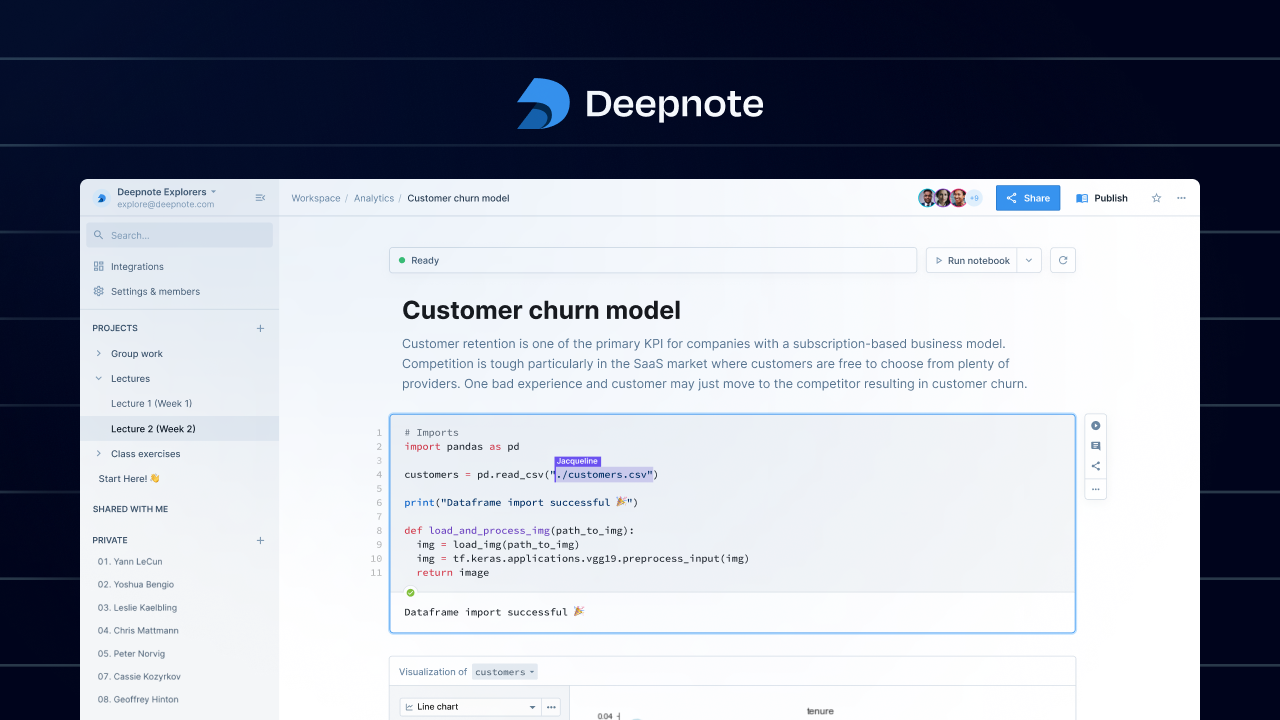
Deepnote is a collaborative data science notebook designed for teams to explore data, build models, and share insights. Whether you're working with Python, SQL, or AI agents, Deepnote provides a unified workspace for data analytics, engineering, and machine learning workflows. - Collaborative Notebooks: Real-time multi-user editing with built-in version control and history tracking. - AI-Powered Insights: Generate dashboards, data apps, and AI-driven insights directly from notebooks. - Data Analytics: Advanced Python and SQL support with semantic layers, modules, and dbt integration. - Data Engineering: ETL/ELT pipelines, Spark and Snowpark support, and data cataloging. - Machine Learning: Train, deploy, and monitor models with GPU support and automated workflows. - Security & Compliance: SOC2, HIPAA, and enterprise-grade auditing with audit logs. - Integrations: Connect to any data source, including databases, APIs, and cloud services. - Autonomous Agents: Build and deploy AI agents for tasks like fraud detection and churn analysis. Deepnote is a fully managed cloud platform with no self-hosting option. It supports local development with VS Code integration and seamless cloud deployment. The platform is designed for scalability, security, and collaboration, making it ideal for teams of all sizes.
Open source business intelligence tool
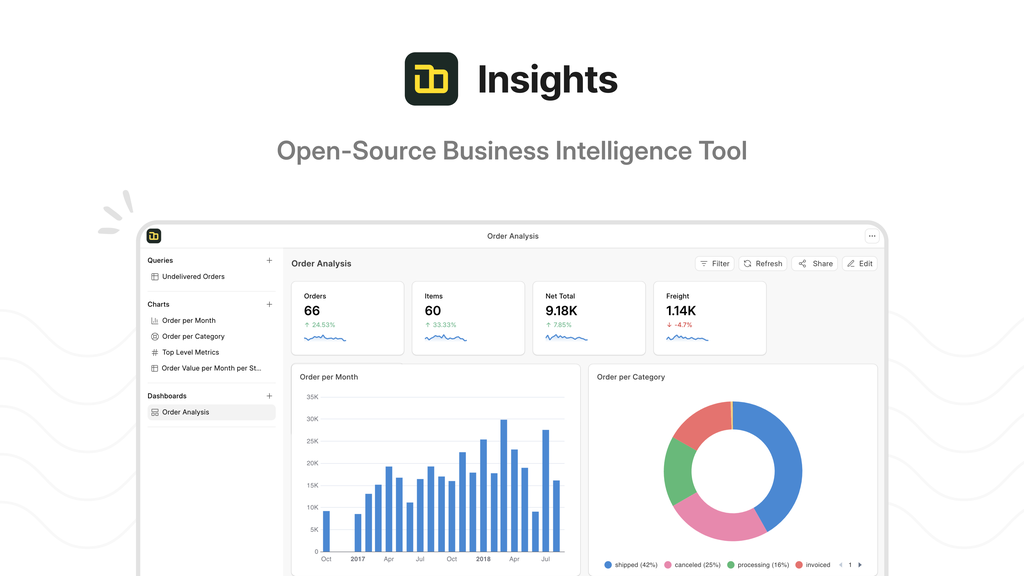
Frappe Insights is an open-source business intelligence (BI) tool designed to help organizations make data-driven decisions efficiently. It simplifies data integration, analysis, and visualization, enabling users to connect disparate data sources, build complex queries without heavy coding, and create reusable reports. - Multi-source Data Integration: Connect and merge data from spreadsheets, databases, and other sources into a single system for unified analysis. - Intuitive Query Builder: Filter, select, and summarize data using built-in functions or custom formulas. Combine datasets with joins and use pivot tables for better summarization. - Automated Reporting: Build reusable reports that update automatically, saving time and effort. - Powerful Visualizations: Generate insightful charts and graphs to comprehend data trends and patterns effectively. - Cost-Effective: Offers a budget-friendly alternative to traditional BI tools while maintaining robust functionality. Frappe Insights is open-source and can be self-hosted. It is built on the Frappe Framework, which supports deployment on various cloud platforms or on-premise infrastructure. The project is actively maintained by Frappe Technologies and is licensed under AGPL-3.0.

Enterprise BI platform with embedded analytics
Looker is a leading enterprise platform for business intelligence (BI), data applications, and embedded analytics. It helps organizations transform raw data into actionable insights through a governed, AI-powered experience. - Conversational Analytics: Move beyond static dashboards with AI agents that interpret and execute data-driven decisions using natural language queries powered by Gemini. - Agentic BI Platform: A composable, governed intelligence experience that combines foundational AI, cloud-first infrastructure, and a flexible semantic layer for enterprise-wide consistency. - Universal Semantic Layer: A trusted backbone built on LookML that translates complex SQL into business metrics, ensuring accuracy and eliminating agent hallucinations across all applications. - Embedded Analytics: Transform data into deeply integrated, value-driving experiences within any application using Looker’s powerful APIs and SDKs. - Self-Service BI: Empower business users to explore and analyze data independently without relying on technical analysts. - Real-Time Insights: Deliver up-to-date data insights with cloud-native infrastructure and seamless integration with Google Cloud. - Custom Data Applications: Build and deploy AI-first data products with embedded conversational AI capabilities. - Industry-Leading APIs: Enable rapid development and integration with third-party systems through robust and flexible APIs. Looker is a fully managed cloud service provided by Google Cloud, requiring no self-hosting. It integrates seamlessly with Google Cloud’s infrastructure and supports multi-cloud environments. While primarily a SaaS solution, Looker’s semantic layer (LookML) and APIs allow for custom deployments and integrations within enterprise ecosystems.

Open source spreadsheet-like UI for PostgreSQL
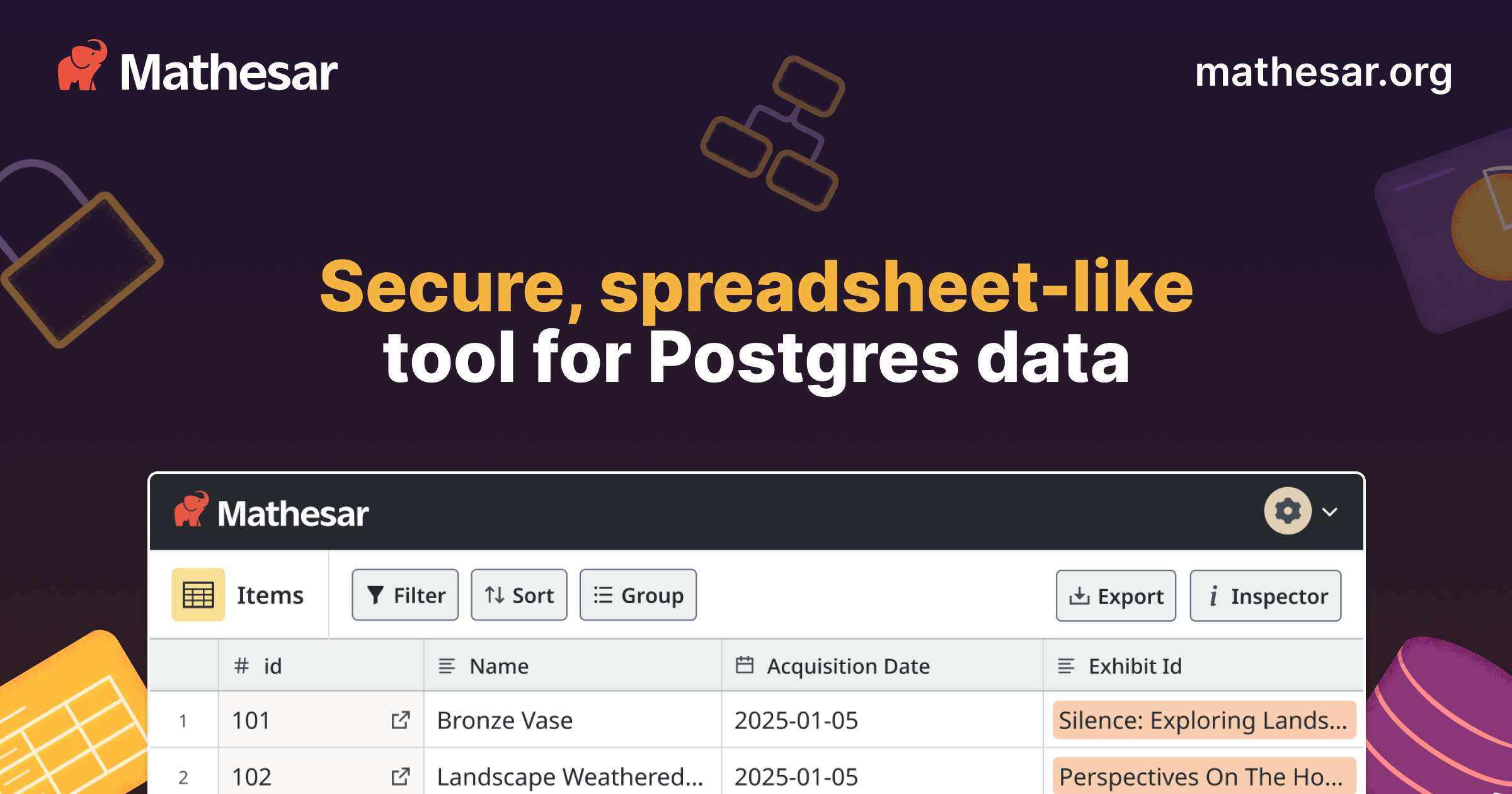
Mathesar is an intuitive, open-source tool that provides a spreadsheet-like interface to PostgreSQL databases. Designed for both database administrators and business users, it simplifies data management with direct integration into Postgres permissions, schemas, and tables. - Spreadsheet-like UI: Familiar interface for viewing, editing, and querying PostgreSQL data without requiring SQL knowledge. - Direct Postgres Integration: Works with existing Postgres permissions, schemas, and tables—no extra layers or abstractions. - Scalability: Built for production databases, scaling as easily as Postgres itself. - Easy Installation: Minimal setup required; installs in minutes with no code dependencies. - Self-Hosted: Deploy on your own infrastructure for full data control and privacy. - Robust Access Control: Leverages Postgres database permissions for secure access management. - Nonprofit-Backed: Maintained by a 501(c)(3) nonprofit, ensuring long-term open-source commitment. - Versatile Use Cases: Supports asset management, CRUD frontends, customer support, dashboards, grant tracking, and timesheet management. Mathesar is built on PostgreSQL and designed for self-hosting. It requires minimal additions to existing databases and can be deployed on your infrastructure in minutes. The tool is 100% open-source, eliminating vendor lock-in risks. For those preferring a managed solution, Mathesar Cloud is available as a free trial option.

Agentic analytics platform with a semantic layer

Cube is the agentic analytics platform built on a semantic layer, delivering AI-native business intelligence and embedded analytics with answers your team and customers can trust. - Semantic Layer Foundation: Single governed model ensures consistent, reliable analytics across all surfaces. - Agentic AI Capabilities: Enables AI agents to query and interpret business data accurately. - Embedded Analytics: Ship AI-powered analytics inside your product without rebuilding your BI stack. - Multi-tenant Governance: Built-in multi-tenancy with permissions flowing from your semantic model. - Analytics Chat API: Build custom AI analytics experiences with agent-to-agent capabilities via MCP. - Creator Mode: Allow customers to build their own workbooks and dashboards within your app. - Core Data APIs: Maximum control at the data layer for flexible UI integration. - Trusted by Enterprises: Used by modern data teams at Maersk, Wix, Patagonia, Tesla, and more. Cube is available as a cloud-hosted solution or can be self-hosted for full control over your data infrastructure. The platform integrates seamlessly with major data warehouses including Snowflake, Databricks, and BigQuery.

AI-powered SQL client for natural language queries
Connect to all your data sources and instantly generate optimized SQL queries with AI to gain fast, actionable insights. - AI-Powered SQL Generation: Transform natural language into optimized SQL queries with context-aware AI - Multi-Database Support: Connect to 20+ databases including MySQL, PostgreSQL, MongoDB, Redis, Snowflake, Oracle, and more - Visual Data Management: GUI-based table editing, ER diagrams, and smart data visualization - Text-to-SQL Editor: AI SQL Copilot with one-click error fixing and schema-aware suggestions - Data Migration Tools: Import/export data from CSV, XLSX, and SQL files with support for millions of rows - AI Data Analysis: Generate BI dashboards, auto-charts, and chain reasoning insights from your data - Custom Business Terms: Train AI with column comments for optimized query generation - Context-Aware Chatbot: Natural language interface for database interactions - Schema Synchronization: Real-time structure synchronization across databases Chat2DB is available as a desktop application and web-based client. The open-source version can be self-hosted for complete data control. Supports Windows, macOS, and Linux platforms. Download | Documentation | GitHub
About Tableau
Tableau
Tableau is a powerful business intelligence and analytics platform designed to help anyone see and understand their data. Connect to almost any database, drag and drop to create visualizations, and share insights with a click. Whether deployed in the cloud, on-premises, or integrated with Salesforce CRM, Tableau provides a governed, flexible environment for data exploration and intelligent insights.
Key Features of Tableau
- Drag-and-Drop Visualization: Create interactive dashboards and reports without coding.
- Multi-Source Data Connectivity: Connect to databases, spreadsheets, cloud services, and big data platforms.
- Agentic AI Integration: Leverage AI-powered analytics to turn insights into autonomous actions.
- Cloud & On-Premises Deployment: Choose between fully hosted (Tableau Cloud), self-hosted (Tableau Server), or hybrid solutions.
- Collaboration & Sharing: Share insights securely with teams and stakeholders.
- Governance & Security: Ensure data integrity with robust access controls and compliance features.
- Extensive Integrations: Native integration with Salesforce CRM and other enterprise tools.
- Community & Learning Resources: Access a global community, free training, and comprehensive support.
Tech / Self-Hosting
- Tableau Cloud: Fully hosted, cloud-based analytics platform with no server management required.
- Tableau Server: Self-hosted solution for full control over data and infrastructure.
- Tableau Desktop: Offline-capable desktop application for data exploration and visualization.
- Tableau Next: Open analytics platform combining AI, modular architecture, and workflow integration.
Tableau supports deployment across cloud, on-premises, and hybrid environments, making it adaptable to diverse organizational needs.