11 Best Open Source Pinecone Alternatives
A curated collection of the 11 best open source and self-hosted alternatives to Pinecone in 2026.
Looking for a free, privacy-friendly, or self-hosted replacement for Pinecone in 2026? The top open-source alternative is Mem0 — AI memory layer for persistent agent context.
Other highly rated open-source Pinecone alternatives include Milvus, Qdrant and Chroma.

AI memory layer for persistent agent context

Mem0 provides persistent memory infrastructure for AI agents and applications, enabling them to continuously learn from past interactions and maintain context across sessions. Built for production with enterprise-grade security and compliance. - Persistent Memory: Retains user context and preferences across sessions without pipeline changes - Memory Compression Engine: Automatically condenses chat history into compact memories to reduce tokens and latency - Multi-Signal Retrieval: Advanced retrieval system for accurate context matching - Cross-Domain Adaptation: Configurable for healthcare, education, e-commerce, customer support, and sales - Enterprise Governance: SOC 2, HIPAA, GDPR compliant with BYOK and zero-trust architecture - Portable Deployment: Runs on Kubernetes, private cloud, or air-gapped environments - Full Observability: Complete audit logs for every read/write operation - SDK Integration: Python and Node.js SDKs for easy implementation Mem0 is primarily offered as a cloud service with enterprise-grade infrastructure. The platform is SOC 2 Type 1, HIPAA, and GDPR compliant, ensuring robust security and privacy standards. While the core service is managed, Mem0 provides portable deployment options including Kubernetes and private cloud configurations for organizations requiring on-premises or air-gapped solutions. The open-source components and SDKs allow for integration into existing AI agent frameworks and applications, with the main repository available at https://github.com/mem0ai/mem0.

Open-source vector database for GenAI applications
Milvus is an open-source vector database built for GenAI applications, enabling developers to perform high-speed searches and scale to tens of billions of vectors with minimal performance loss. - High-Performance Vector Search: Optimized for fast and accurate similarity searches across large datasets. - Scalability: Supports standalone, distributed, and cloud-native deployments to handle millions or billions of vectors. - Multi-Model Support: Enables hybrid, multimodal, and graph-based retrieval for advanced AI applications. - Easy Integration: Compatible with popular AI frameworks like LangChain, LlamaIndex, OpenAI, and Hugging Face. - Multiple Deployment Options: - Milvus Lite: Lightweight, pip-installable version for prototyping. - Milvus Standalone: Robust single-machine deployment for production. - Milvus Distributed: Enterprise-grade, horizontally scalable solution. - Zilliz Cloud: Fully managed Milvus with serverless and dedicated cluster options. - Rich Tooling Ecosystem: Includes Attu (GUI), Milvus CLI, Backup, and Sizing Tool for operational efficiency. - Open-Source Core: Community-driven development with enterprise-grade reliability. Milvus is open-source and can be self-hosted in multiple configurations: - Milvus Lite: Ideal for local development and testing. - Milvus Standalone: Suitable for small to medium-scale production workloads. - Milvus Distributed: Designed for large-scale, distributed deployments with high availability. For managed solutions, Zilliz Cloud offers a fully managed Milvus experience with serverless and dedicated cluster options, including BYOC for compliance and security requirements. Milvus is compatible with cloud storage solutions like S3 and supports integration with popular AI tools and frameworks, making it a versatile choice for GenAI applications.

Open-source vector search engine for AI applications

Qdrant is an open-source vector search engine written in Rust, optimized for AI applications that require efficient similarity search. It provides a scalable and fast vector similarity search service with a convenient API, making it ideal for use cases like recommendation systems, RAG (Retrieval-Augmented Generation), and advanced search. - High Performance: Built in Rust for speed and efficiency, supporting fast vector similarity search. - Scalability: Designed to handle large-scale vector datasets with ease. - Flexible API: Offers a user-friendly API for seamless integration with applications. - Multi-Tenancy Support: Enables efficient management of multiple collections and tenants. - Hybrid Search: Supports both vector and scalar filtering for enhanced search capabilities. - Cloud & Self-Hosted Options: Available as Qdrant Cloud, Hybrid Cloud, or self-hosted solutions. - Enterprise Solutions: Tailored offerings for businesses with advanced requirements. - AI Integration: Optimized for AI applications, including RAG, recommendation systems, and anomaly detection. Qdrant is open-source and can be self-hosted on any infrastructure. It supports Docker deployments and provides comprehensive documentation for setup and configuration. The project is actively maintained with regular updates and a strong community backing.

Open-source search infrastructure for AI
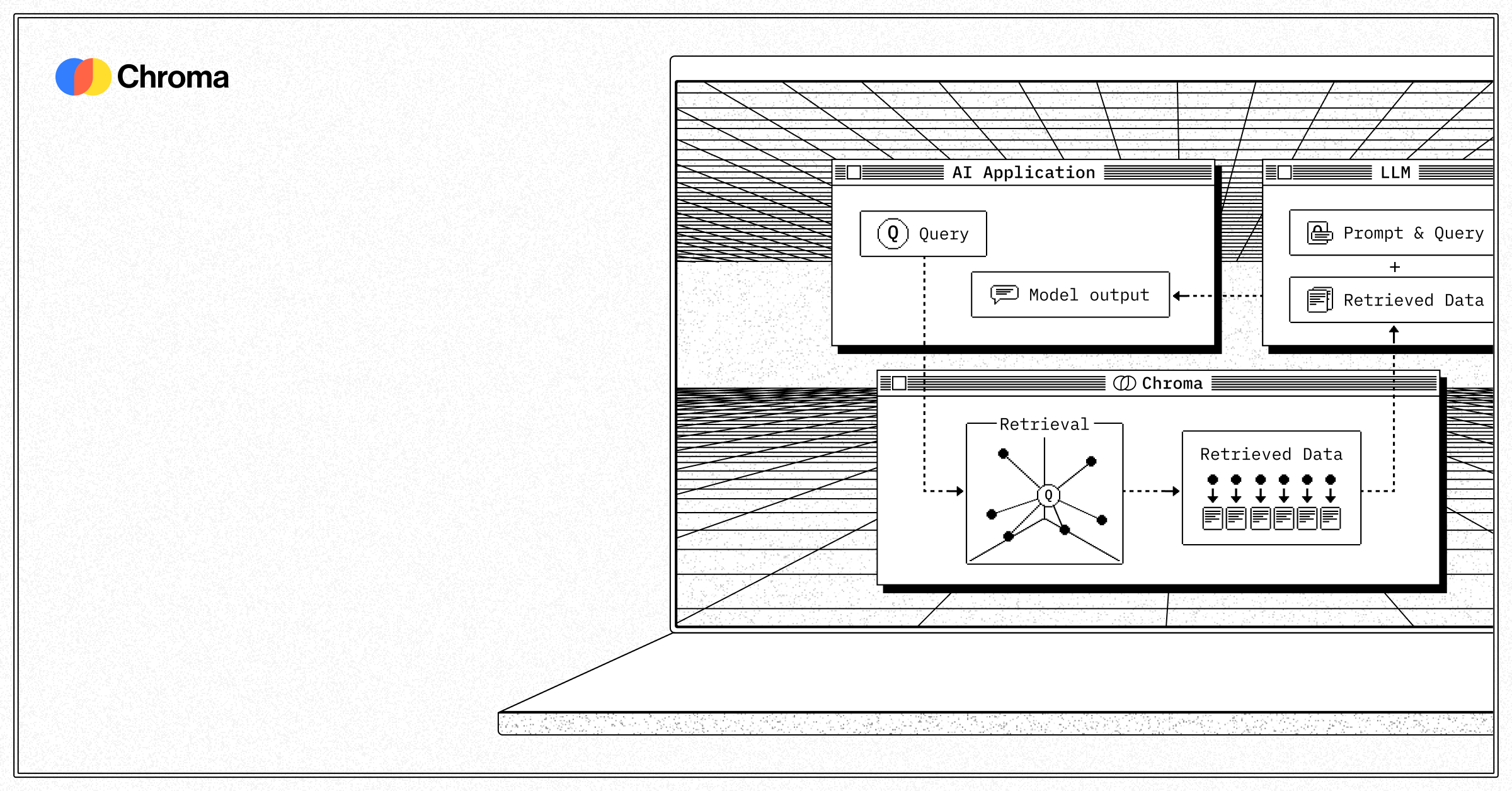
Chroma is the open-source search infrastructure for AI, designed to provide fast, scalable, and cost-effective search capabilities. Built on object storage, Chroma supports vector, full-text, regex, and metadata search, making it ideal for AI applications requiring low-latency and high-performance search operations. - Multi-modal search: Supports vector, full-text, regex, and metadata search in a single system. - High performance: Achieves p50 latency of 20ms and p99 latency of 57ms for warm queries. - Scalability: Handles billions of records across multi-tenant indexes with automatic data tiering. - Cost efficiency: Built on object storage with automatic tiering, reducing costs by up to 10x compared to legacy systems. - Zero-ops infrastructure: Auto-scales with usage, eliminating manual tuning and operational overhead. - Enterprise-ready: SOC 2 Type II compliant, supports BYOC in your VPC, and offers multi-cloud/multi-region deployments. - Developer-friendly: Provides CLI tools, TypeScript, Python, and Rust SDKs for seamless integration. - Data versioning: Supports dataset versioning, A/B testing, and roll-outs for robust experimentation. Chroma is open-source (Apache 2.0) and can be self-hosted on any infrastructure. It is designed to leverage object storage (S3, GCS) for cost-effective scalability. The system automatically tiers data between hot (memory/SSD) and cold (object storage) layers, optimizing both performance and cost. For enterprise needs, Chroma offers dedicated clusters with customizable scaling and security compliance. The platform is SOC 2 Type II certified and supports Bring Your Own Cloud (BYOC) deployments within your VPC. Supported SDKs: TypeScript, Python, Rust Deployment options: Self-hosted, Cloud (serverless), Dedicated clusters Enterprise features: SOC 2 Type II compliance, BYOC, multi-cloud/multi-region support

AI agents that learn continuously and improve over time

Letta is an AI research lab in San Francisco focused on building machines that learn. Their vision is a future where humans coexist with digital people: experiential agents that remember everything, learn continuously, and improve themselves over time. - Stateful AI Agents: Create agents with persistent memory that evolves through experience - Memory-Native Learning: Agents learn through specialized memory models trained with memory-native reinforcement learning - Git-Based Memory: Programmatic context management with git-based versioning for agent memory - Offline Learning: Sleep-time compute allows agents to reason and learn during idle periods - Self-Improving Capabilities: Agents continuously refine their identity, memory, and capabilities based on interactions - Research-Backed: Built on foundational work like MemGPT (LLM Operating System) from UC Berkeley's Sky Computing Lab Letta's research ships as software through the Letta Agent, available as a npm package (@letta-ai/letta-code). The technology is designed for enterprise and research applications, with case studies from companies like Bilt, 11x, Kognitos, and Hunt Club. The team consists of researchers and engineers from UC Berkeley's Sky Computing Lab, advised by industry leaders including Ion Stoica and Joey Gonzalez.
Open-source search engine for fast, typo-tolerant results
Typesense is a lightning-fast, open-source search engine designed to deliver instant, relevant search results with minimal setup. Built for developers, it combines cutting-edge algorithms with ease of use, making advanced search accessible without requiring a PhD in rocket science. - Blazing Fast Performance: Optimized for speed with in-memory processing, delivering results in milliseconds. - Typo Tolerance: Handles typos gracefully, ensuring users find what they need even with imperfect queries. - Vector Search: Supports semantic and vector-based search for AI-powered relevance. - Simple APIs: Easy-to-use RESTful APIs for quick integration with any application. - Self-Hosting: Deploy on-premises or in your cloud for full data control. - Faceted Navigation: Enables dynamic filtering and categorization of search results. - Geo Search: Built-in support for location-based search queries. - Autocomplete: Real-time suggestions as users type for a seamless search experience. - Scalability: Handles millions of documents and high query volumes efficiently. - Open Source: Fully open-source under the GPL license with a vibrant community. Typesense is written in C++ and Go, with clients available for multiple languages. It can be self-hosted via Docker, Kubernetes, or bare-metal installations. For managed hosting, Typesense Cloud offers a fully managed solution with enterprise-grade support. Quick Start Guide | Documentation | GitHub Repository

Open-source vector database for AI-native apps
Weaviate is an open-source vector database designed to power AI-native applications. It combines vector search, Retrieval-Augmented Generation (RAG), and memory capabilities into a single platform, enabling developers to build production-grade AI systems with reduced hallucinations and no vendor lock-in. - Vector Search: High-performance similarity search for vectors, enabling semantic search and recommendations. - Retrieval-Augmented Generation (RAG): Seamlessly integrates with LLMs to provide context-aware responses with reduced hallucinations. - AI Memory: Persistent memory for AI agents, allowing them to retain context across interactions. - Multi-modal Support: Handles text, images, and other data types with built-in vectorization. - Modular Architecture: Pluggable modules for custom vectorization, storage, and search. - Scalability: Designed for horizontal scaling to handle large datasets and high query loads. - Open Source: Fully open-source under the BSD-3-Clause license. - Enterprise Features: Includes authentication, monitoring, and advanced security controls. Weaviate is self-hostable and can be deployed on any cloud provider or on-premises infrastructure. It supports Docker, Kubernetes, and cloud-native deployments. The project is actively maintained with a vibrant community and comprehensive documentation. - Deployment Options: Docker, Kubernetes, cloud VMs, or managed services. - Data Storage: Supports multiple storage backends including disk, memory, and cloud storage. - Vectorization: Built-in vectorization for text and images, with support for custom models. - APIs: RESTful and GraphQL APIs for easy integration with applications. - Monitoring: Prometheus metrics and Grafana dashboards for observability. - Security: Role-based access control, TLS encryption, and audit logging. For more details, visit the official documentation.

Continual Learning Infrastructure for AI Agents

Activeloop provides the infrastructure for continual learning, enabling AI agents to improve with each execution. Their GPU database, Deeplake, unifies vector and tensor data for efficient agent operations. - Deeplake Database: GPU-native database combining vector and tensor storage for AI agents - Hivemind Memory: Agent traces become shared organizational skills for cross-team reuse - Refinery Software Factory: Continuous learning pipeline that turns feedback into production improvements - GPU Streaming: Enables real-time fine-tuning and optimization - Serverless Postgres Interface: Familiar SQL interface for vector and tensor data - Trajectory Capture: Records agent execution paths for analysis and improvement - Skill Distribution: Shares learned skills across teams and projects - Benchmarking & Verification: Ensures only validated improvements move forward Activeloop offers both cloud-hosted and self-hosted solutions. The open-source Deeplake database can be deployed on-premises or in cloud environments. The company provides enterprise-grade support and professional services for production deployments.
Rust-built native graph-vector database combining vector similarity search and graph traversals. 10x faster development with unified architecture, sub-1ms queries.
Rust-built native graph-vector database combining vector similarity search and graph traversals. 10x faster development with unified architecture, sub-1ms queries.

Open-source AI agent observability platform
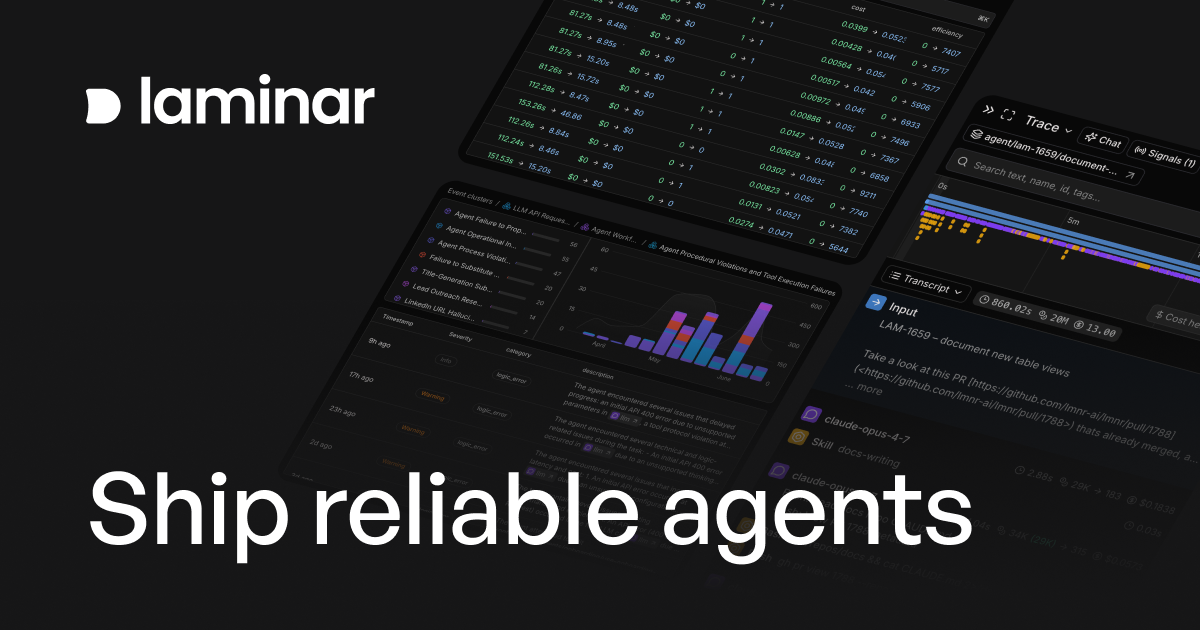
Laminar is an open-source platform designed to help developers trace, evaluate, and debug AI agents in production. It automatically captures agent interactions, costs, and failures, providing actionable insights to improve reliability. - Automated Tracing: Capture LLM calls, tool invocations, sub-agents, costs, and tokens in a readable transcript view. - Failure Detection: AI-powered Signals analyze every agent run to surface unexpected failure modes without manual configuration. - Signal Clustering: Group similar failures into patterns for high-level insights and trend analysis. - Real-time Alerts: Receive notifications in Slack about new failures and clusters. - Debugging Tools: Use the CLI and MCP to query traces, replay checkpoints, and verify fixes. - Cost & Performance Monitoring: Visualize agent costs and performance with heatmaps and detailed metrics. - Integration-Friendly: Works with popular AI frameworks and tools for seamless adoption. Laminar is open-source (Apache 2.0) and can be self-hosted. The platform supports Docker-based deployments and integrates with existing infrastructure. Documentation and setup guides are available on the official website.

AI-powered search foundation for multilingual data

Jina AI provides a comprehensive search foundation for AI applications, enabling developers to build powerful search systems with minimal effort. - Embeddings & Rerankers: High-quality text embeddings and reranking models for semantic search - Web Reader: Extract clean content from URLs with configurable parameters (CSS selectors, timeout, token budget) - DeepSearch: Advanced search capabilities for multilingual and multimodal data - Small Language Models: Optimized models for efficient processing - MCP Server Integration: Add mcp.jina.ai as an MCP server to access APIs directly in LLMs - Rate Limiting: Configurable rate limits with API key support for higher quotas - Browser Engine Options: Choose between different browser engines (X-Engine) for quality/speed tradeoffs - Content Formatting: Multiple response formats including JSON with customizable sections (links, images) - Experimental Features: Advanced HTML-to-Markdown conversion with ReaderLM-v2 Jina AI is primarily a cloud-based service with API access. While the core technology is open-source, the managed service provides additional features and support. For self-hosting, the Jina Reader repository offers the web reading component that can be deployed independently.
About Pinecone
A scalable vector database service that is optimized for machine learning and AI applications, enabling similarity search at scale.