10 Best Open Source Atlassian Statuspage Alternatives
A curated collection of the 10 best open source and self-hosted alternatives to Atlassian Statuspage in 2026.
Looking for a free, privacy-friendly, or self-hosted replacement for Atlassian Statuspage in 2026? The top open-source alternative is Uptime Kuma — Self-hosted website monitoring tool.
Other highly rated open-source Atlassian Statuspage alternatives include Cachet, Gatus and OpenStatus.

Self-hosted website monitoring tool
Uptime Kuma is a lightweight, self-hosted monitoring tool designed for developers and small teams. It provides real-time monitoring of websites and services, tracking uptime, response times, and status pages with minimal resource usage. - Real-time Monitoring: Tracks uptime and response times of websites and services. - Status Pages: Public or private status pages to communicate service status. - Notifications: Supports multiple notification channels (Discord, Slack, Telegram, etc.). - Multi-language: Available in multiple languages for global accessibility. - Lightweight: Runs efficiently on low-resource systems. - Docker Support: Easy deployment via Docker containers. - Customizable: Configure checks, intervals, and thresholds. - Open Source: Fully open-source with community-driven development. Uptime Kuma is built with Node.js and can be self-hosted on any system with Docker support. It requires minimal setup and is compatible with most cloud and on-premise environments. The project is actively maintained and welcomes contributions from the community.

Open source status page system
Cachet is the leading open source status page system designed to help organizations communicate downtime and system outages transparently. From startups to Fortune 500 companies, Cachet enables teams to keep their customers informed and build trust even during service disruptions. - Branded Status Pages: Customize your status page to reflect your brand identity and maintain a professional appearance across all devices. - API-First Design: Automate incident management with a robust JSON API that integrates seamlessly with monitoring tools. - Multi-Language Support: Communicate with global audiences using built-in support for 10+ languages. - Planned Maintenance: Schedule updates in advance to keep users informed about upcoming maintenance windows. - Custom Metrics & Charts: Visualize system health with custom metrics and generate easy-to-read charts for better transparency. - Security Features: Protect your data with two-factor authentication and password manager integration. - 100% Open Source: Self-host Cachet on your own infrastructure at no cost, with full control over your data. Cachet is built with Laravel, Tailwind CSS, and Filament, making it easy to deploy and maintain. The system is designed for self-hosting, allowing organizations to run it on their own servers or cloud infrastructure. Comprehensive documentation and community support are available to assist with setup and configuration.

Automated status pages with advanced uptime monitoring

Gatus is an open-source status page and uptime monitoring tool designed to help teams track the health of their services with precision. Whether you're monitoring simple HTTP endpoints or complex multi-step workflows, Gatus provides the flexibility to set custom health check conditions and receive immediate notifications when issues arise. - Comprehensive Uptime Monitoring: Track HTTP/HTTPS, DNS, TCP, ICMP endpoints with custom conditions. Validate JSON responses, check SSL certificates, and monitor response times for complete service health visibility. - Test Suites for Complex Workflows: Execute sequential endpoint tests with shared context to validate entire business processes, authentication flows, CRUD operations, and end-to-end transactions. - Instant Alerting: Receive downtime notifications via Slack, Discord, PagerDuty, email, and 15+ other platforms. Configure custom thresholds and escalation rules for proactive incident management. - Public Status Pages: Create transparent, user-focused status pages that automatically update based on real-time monitoring data. Display incident reports, maintenance schedules, and resolution timelines with color-coded priority levels. - Push-Based Monitoring: Monitor services in private networks using custom agents that push status updates to Gatus, eliminating the need to expose internal systems to the internet. - Developer-Friendly API: Integrate uptime checks with CI/CD pipelines, webhook monitoring, and comprehensive logging for technical diagnostics and issue resolution. - SSL Certificate Monitoring: Track SSL certificate expiration dates to prevent unexpected outages due to expired certificates. - Custom Health Check Conditions: Go beyond simple ping checks by validating specific response codes, JSON payloads, and custom monitoring logic tailored to your services. Gatus is built on open-source technology and can be self-hosted for complete control over your monitoring infrastructure. The project is actively maintained on GitHub with transparent development and community contributions. The software is lightweight, easy to deploy, and designed for scalability to handle monitoring needs of any size.

Free & open source status page for teams
OpenStatus provides a professional status page and uptime monitoring solution trusted by growing teams. Whether hosted or self-hosted, it helps organizations communicate incidents effectively, demonstrate compliance readiness, and maintain audit trails automatically. - Branded Status Pages: Create custom status pages on your own domain with themes, custom domains, and password protection options. - Uptime Monitoring: Monitor endpoints from 28 regions across multiple clouds with instant alerts via Slack, Discord, PagerDuty, or email. - Automated Incident Communication: Status page updates automatically during incidents with timestamped reports for audit trails. - Compliance Ready: SOC 2 compliant incident communication with documented, timestamped status reports that satisfy auditor requirements. - Programmatic Access: Manage everything via CLI, API (with OpenAPI spec), MCP server for AI agents, or Terraform provider. - Global Speed Checker: Test any URL's response time from 28 regions without account creation or credit card. - Enterprise Features: Themes, maintenance windows, subscriptions, and public or private status pages. OpenStatus is open source and self-hostable. The project is available on GitHub with comprehensive documentation for deployment and management. The platform supports both managed SaaS and self-hosted options, making it suitable for organizations of all sizes.

Open-source observability & incident management

OneUptime is a comprehensive open-source platform designed to streamline reliability operations for modern infrastructure. Whether you're a DevOps engineer, Site Reliability Engineer (SRE), or platform team, OneUptime provides the tools needed to monitor systems, detect incidents, and resolve issues efficiently. - Unified Observability: Consolidate logs, metrics, traces, and exceptions in a single interface for comprehensive system visibility. - Incident Management: Detect outages in seconds, page the right engineer, and coordinate incident resolution with smart routing and escalations. - Status Page: Communicate incidents and maintenance windows to users with a customizable public status page. - AI-Powered Incident Investigation: Leverage AI to investigate incidents and generate fix pull requests for faster resolution. - Topology Mapping: Visualize service, infrastructure, and network dependencies to understand system relationships. - On-Call & Alerts: Configure smart alerting with escalation policies to ensure the right team members are notified promptly. - Scheduled Maintenance: Plan and communicate downtime proactively to minimize user impact. - Security Events: Monitor and respond to security incidents with SIEM signals and Sigma detections. - Multi-Environment Support: Monitor Kubernetes, Docker, cloud services, IoT devices, network devices, and more. - Self-Hosting & Enterprise: Deploy on your own infrastructure or opt for enterprise-grade solutions with dedicated support. OneUptime is 100% open-source and can be self-hosted on your own infrastructure. It supports deployment via Docker, Kubernetes, and other container orchestration platforms. The platform is designed for scalability and reliability, making it suitable for both small teams and large enterprises. Comprehensive documentation and community support are available to assist with deployment and configuration.
Free, open-source status page and uptime monitor with Docker deployment. Track 11 service types, manage incidents, schedule maintenance, and notify subscribers instantly.
Free, open-source status page and uptime monitor with Docker deployment. Track 11 service types, manage incidents, schedule maintenance, and notify subscribers instantly.

Self-hosted uptime monitoring for websites and APIs
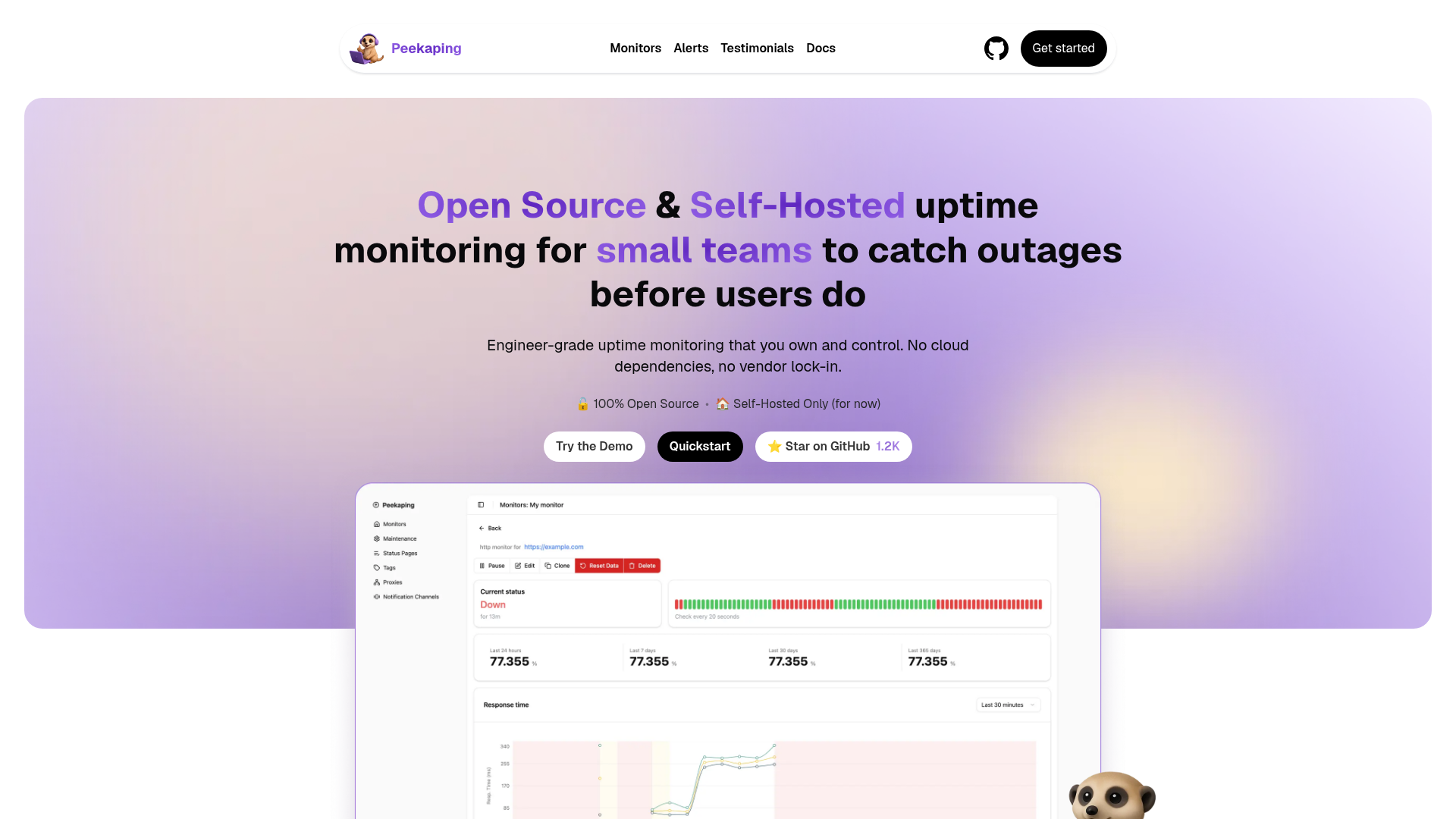
Peekaping is an open-source, self-hosted uptime monitoring solution designed for small teams and businesses that need to catch outages before users do. Built with Go and React, it provides engineer-grade monitoring with complete data ownership and no cloud dependencies. Monitor Types - Web & Network: HTTP/HTTPS, TCP, Ping (ICMP), DNS - Application & Infrastructure: Push webhooks, Docker containers, gRPC, SNMP - Databases & Caches: PostgreSQL, Microsoft SQL Server, MongoDB, Redis - Messaging & Streaming: MQTT Broker, RabbitMQ, Kafka Producer Alert Channels - Email & Webhooks: SMTP, custom webhooks - Chat & Collaboration: Telegram, Slack, Google Chat, Signal, Mattermost, Matrix, Discord, WeCom, WhatsApp - On-Call & Incident: PagerDuty, Opsgenie, Grafana OnCall - Mobile Push & Self-Hosted: NTFY, Gotify, Pushover Status Pages - Public branded status pages showing uptime and performance metrics - Customizable branding and metrics display API-First Design - REST API with Swagger/OpenAPI documentation - Modular architecture for easy extension - Pluggable storage backends (PostgreSQL, MongoDB, SQLite) Core Technologies - Backend: Go (Golang) for high-performance monitoring - Frontend: React + TypeScript for admin dashboard and status pages - Deployment: Official Docker images with docker-compose support - Storage Options: PostgreSQL, MongoDB, or SQLite for flexible setups Peekaping is MIT-licensed and completely free for both personal and commercial use. It offers a modern alternative to proprietary uptime monitoring services while maintaining full data privacy and control.

Self-hosted status page and endpoint monitoring tool
Statusnook is a self-hosted status page and endpoint monitoring tool designed for effortless deployment and management. - Status Page: Share incident & maintenance alerts with customizable public status pages - Endpoint Monitoring: Create high-frequency monitors with custom HTTP methods, headers, and request bodies - Notifications: Receive alerts via Slack, email (SMTP), and mail groups - Automatic HTTPS: Automatic certificate renewal and domain configuration - In-app Updates: Effortless upgrades without manual SSH tasks - Docker Support: Official Docker images for straightforward container upgrades - Reverse Proxy Compatible: Integrates seamlessly with existing infrastructure - Multiple Deployment Options: Standalone, reverse proxy, Docker, or one-click cloud deployment - License: MIT License (fully open-source) - Self-hosted: Runs on any VPS or dedicated server ($5 VPS compatible) - Supported Distributions: Ubuntu, Debian, AlmaLinux, Fedora, Rocky Linux, CentOS - Port Flexibility: Can run on custom ports (e.g., 8000) - Deployment Methods: - Standalone installation via CLI - Docker container deployment - One-click cloud deployment with official templates - Data Control: Your data remains entirely under your control

Self-hosted uptime monitoring with multi-region probes
EasyMonitor is an open-source, self-hosted uptime monitoring solution that uses multi-region probes and quorum-based alerts to eliminate false positives. Deploy with a single docker compose up and gain full control over your monitoring data. - Multi-region probes: Deploy lightweight Go probes on any server you own via Tailscale, Cloudflare Tunnel, or VPN - Quorum-based alerts: Cross-probe voting eliminates false alarms from single flaky vantage points - Unlimited monitors: No tier caps or per-monitor pricing—just unlimited monitoring on your hardware - Multi-channel alerts: Email, Pushover, Slack, Discord, and webhooks with per-user channel preferences - Custom status pages: Public, unlisted, or private pages with custom domains, themes, and auto-HTTPS - TimescaleDB integration: Automatic compression (90%+ smaller) and configurable retention for scalable time-series data - Teams & projects: Role-based permissions and per-user notification preferences - One-command install: Interactive setup with automatic DNS configuration and secret generation - Stack: Laravel 12 (PHP 8.4), PostgreSQL 18, TimescaleDB 2.26, Redis 7 Streams, Go 1.24 probes - Deployment: Single Docker Compose setup with Caddy for automatic TLS - Hardware requirements: ~2GB RAM for basic use, $5 VPS sufficient for hundreds of monitors - License: MIT - Probe binary: ~10MB lightweight Go binary deployable anywhere Why self-host? SaaS monitoring vendors can become blind spots during their own outages. EasyMonitor puts the watcher under your control with unlimited monitors, custom domains, and enterprise-grade features at no cost.

Security and uptime monitoring for developers

StatusScout is a comprehensive security and uptime monitoring tool designed for developers and agencies. It provides real-time alerts for downtime, SSL issues, missing security headers, and exposed secrets, ensuring your applications remain secure and operational. - Uptime Monitoring: 24/7 monitoring with instant alerts when your site stops responding. - SSL Certificate Tracking: Alerts before certificates expire to prevent visitor warnings. - Security Header Scanning: Automatically detects missing critical browser security headers. - Subdomain Takeover Protection: Monitors SPF, DKIM, DMARC records and vulnerable subdomains. - Exposed Secrets Detection: Scans for accidentally public environment files, API keys, and sensitive credentials. - User Flow Monitoring: Scheduled tests for key user flows like signup and checkout with failure alerts. - Multi-Channel Alerts: Supports email, SMS, and ntfy notifications. - Self-Hosting Option: Deploy to your own server with full feature access and data ownership. StatusScout is open-source and can be self-hosted on your own infrastructure. The self-hosted version includes all features with no restrictions, though you manage updates, backups, and infrastructure. Cloud-hosted plans are also available for managed services. Made and hosted in the EU with renewable energy-powered infrastructure.
About Atlassian Statuspage
Statuspage is a real-time incident communication tool that helps teams share status updates with users during service disruptions. It provides customizable public and private status pages, integrates with monitoring and alerting tools, and offers historical uptime metrics to showcase reliability.
Key Features of Atlassian Statuspage
- Customizable Status Pages: Create public, private, or audience-specific pages to communicate incidents.
- Multi-Channel Notifications: Send updates via email, SMS, Slack, Microsoft Teams, and webhooks.
- Component Monitoring: Display status of 150+ third-party services (e.g., Stripe, Mailgun, Shopify).
- Historical Uptime Showcase: Highlight reliability metrics to current and prospective customers.
- Pre-Written Templates: Streamline incident communication with ready-to-use message templates.
- Team Collaboration: Support for multiple team members with role-based access control.
- REST API Access: Integrate with existing workflows and tools.
- Scalable Pricing: Free plan available with paid tiers for growing teams.
Tech / Self-Hosting
Statuspage is a cloud-based SaaS solution provided by Atlassian. It does not require self-hosting and is accessible via web browser. The service is GDPR compliant and offers enterprise-grade security features.