7 Best Open Source SonarQube Alternatives
A curated collection of the 7 best open source and self-hosted alternatives to SonarQube in 2026.
Looking for a free, privacy-friendly, or self-hosted replacement for SonarQube in 2026? The top open-source alternative is Continue — Open-source coding agent for developers.
Other highly rated open-source SonarQube alternatives include Kilo, Kodus and Pullfrog.

Open-source coding agent for developers

Continue was an open-source coding agent designed to amplify developers rather than replace them. The project has been acquired by Cursor, but its open-source codebase remains freely available as a foundation for others. - Open-source coding agent for developers - Focused on amplifying developer productivity - Extensible and customizable architecture - Community-driven development model - Remains available as an open-source foundation post-acquisition - Open-source codebase available on GitHub - Self-hosting options remain viable - Compatible with various development environments
Open source AI coding agent with 500+ models, bring-your-own-key support, and specialized modes for writing, debugging, and planning code across IDEs and CLI.
Open source AI coding agent with 500+ models, bring-your-own-key support, and specialized modes for writing, debugging, and planning code across IDEs and CLI.

Open source AI code review tool
Kodus is an open-source AI code review tool designed to automate and enhance your team's code review process. It learns your team's workflow and delivers precise reviews focused on quality, security, and performance. - AI-Powered Reviews: Automatically reviews pull requests with context-aware feedback - Customizable Rules: Define and enforce team-specific review guidelines - Self-Hosting: Deploy on your own infrastructure for full data control - Model Agnostic: Works with your preferred AI models (no vendor lock-in) - Performance Focus: Optimized for speed and accuracy in review suggestions - Security Checks: Identifies potential security vulnerabilities in code - Quality Metrics: Tracks code quality improvements over time - Team Collaboration: Integrates with existing development workflows Kodus can be self-hosted on your own infrastructure using Docker or Kubernetes. The project is open source (MIT licensed) and available on GitHub. For cloud deployment, Kodus offers a managed service with transparent pricing where you pay model providers directly at list price with no markup.

Open-source BYOK GitHub bot for code reviews
PullFrog is an open-source GitHub bot designed to automate code reviews and enforce quality standards directly within GitHub Actions. Unlike proprietary solutions, it allows you to bring your own model (BYOK) for AI-powered reviews while maintaining full control over your workflows. - Model-Agnostic Reviews: Integrate any AI model or custom logic for code reviews without vendor lock-in. - GitHub Actions Integration: Runs seamlessly within GitHub Actions for streamlined workflows. - Customizable Rules: Define your own review criteria, quality gates, and automation rules. - BYOK (Bring Your Own Key): Maintain control over your AI models and data privacy. - Open-Source: Fully transparent and customizable to fit your team's needs. - Multi-Language Support: Works with any programming language supported by GitHub. - Automated Feedback: Provides instant, actionable feedback on pull requests. PullFrog is designed to run entirely within GitHub Actions, eliminating the need for external hosting. The bot is open-source and can be self-hosted by deploying the repository to your own GitHub organization. No additional infrastructure is required beyond a GitHub account and Actions permissions.

Open-source static code security engine
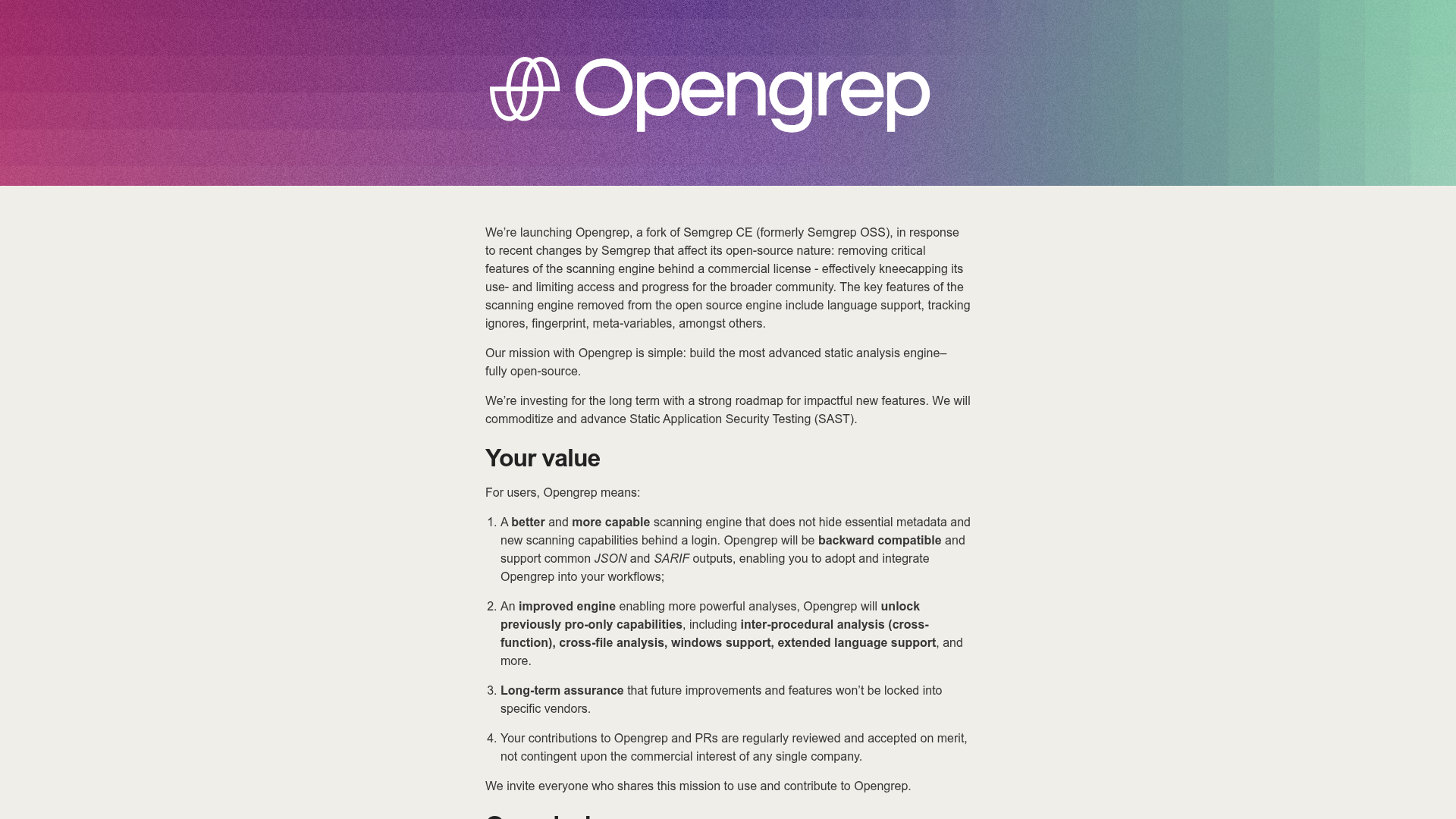
Opengrep is a fork of Semgrep CE (formerly Semgrep OSS) designed to keep the static analysis engine fully open-source. In response to recent changes by Semgrep that restricted critical features behind commercial licenses, Opengrep ensures backward compatibility while unlocking previously pro-only capabilities like inter-procedural analysis, cross-file analysis, and extended language support. - Fully Open-Source Engine: No hidden features or vendor lock-in; all capabilities remain freely accessible. - Advanced Static Analysis: Supports inter-procedural analysis, cross-file analysis, and extended language support. - Backward Compatibility: Maintains compatibility with common outputs like JSON and SARIF for seamless integration. - Community-Driven Development: Regularly reviewed contributions from the community, not contingent on commercial interests. - Long-Term Assurance: Future improvements and features remain open-source and vendor-neutral. - Consortium Backing: Supported by a coalition of organizations including Aikido Security, Amplify, Endor Labs, Kodem, and Orca Security. Opengrep is designed for self-hosting and can be deployed via its GitHub repository. The project is built in OCaml and encourages community contributions to advance static code analysis further.

AI-powered code review for faster, higher-quality deployments
Qodo is an AI-powered code review platform designed to help engineering teams standardize code quality and accelerate development workflows. By leveraging deep codebase intelligence and agentic workflows, Qodo provides context-aware code suggestions that detect critical issues, log breaking changes, and surface dependency conflicts—all within your existing development environment. - Agentic Issue Finding: Detects critical issues in pull requests with AI-powered context awareness, reducing manual review time. - Cross-Repo Context: Understands repository relationships to surface breaking changes and dependency conflicts before they impact production. - Codebase Quality Rules: Enforce coding standards, rules, and best practices across your entire codebase. - Git Integration: Seamless integration with Git platforms for automated PR reviews and real-time feedback. - Full Codebase Intelligence: Context Engine provides deep insights into your codebase for more informed decision-making. - IDE & PR Workflows: Supports agentic workflows in IDEs, pull requests, and security reviews for comprehensive coverage. - Enterprise-Grade Governance: Standardize code quality and review processes across the entire software development lifecycle (SDLC). - Open Source Support: Free for open source projects, with scalable solutions for enterprises. Qodo operates as a cloud-based SaaS platform with seamless integration into existing development workflows. While primarily cloud-hosted, Qodo offers enterprise-grade solutions with customizable deployment options to meet specific security and compliance requirements. The platform supports integration with major Git providers and IDEs, ensuring compatibility with your existing tech stack.

AI-powered pull request reviewer for teams
CodeRabbit is an AI-driven pull request reviewer designed to enhance software development workflows. It provides intelligent, context-aware feedback, line-by-line code suggestions, and real-time chat capabilities to help teams ship code efficiently. - AI-Powered Reviews: Automated, context-aware code reviews with actionable suggestions. - Real-Time Chat: Collaborate with AI agents directly within pull requests. - Priority Management: Automatically prioritize pull requests based on risk, complexity, and activity. - Codebase Health Monitoring: Continuous scanning for vulnerabilities, dependencies, and security issues. - Blast Radius Analysis: Visualize the impact of changes across your codebase. - Dependency Vulnerability Detection: Identifies and flags security vulnerabilities in dependencies. - Enterprise-Grade Security: Designed for secure, scalable code review processes. CodeRabbit is a cloud-based service with no self-hosting option available. It integrates seamlessly with GitHub and other version control platforms to provide automated code reviews and insights.
About SonarQube
SonarQube is a leading static code analysis platform designed to ensure code quality, security, and compliance throughout the software development lifecycle. It provides continuous inspection of code to detect bugs, vulnerabilities, and code smells, helping teams maintain high standards in their codebase.
Key Features of SonarQube
- Static Code Analysis: Detects bugs, vulnerabilities, and code smells in 40+ programming languages
- Security Vulnerability Detection: Identifies security issues with advanced SAST and SCA capabilities
- CI/CD Integration: Seamlessly integrates with GitHub, GitLab, Azure DevOps, and Bitbucket
- Compliance & Reporting: Automates proof of code compliance for regulatory standards
- Developer Guidance: Provides on-the-fly analysis and coding guidance via IDE extensions
- AI Code Quality: Validates AI-generated code for security and quality assurance
- Secrets Detection: Catches exposed secrets and sensitive data in development
- Supply Chain Security: Secures software supply chains against vulnerabilities
Tech / Self-Hosting
SonarQube offers both cloud-based and self-hosted deployment options. The self-hosted version (SonarQube Server) can be deployed on-premises or in private cloud environments, providing full control over data and infrastructure. The platform is compatible with various operating systems and supports containerized deployments for modern infrastructure setups.