8 Best Open Source Msty Nexus Alternatives
A curated collection of the 8 best open source and self-hosted alternatives to Msty Nexus in 2026.
Looking for a free, privacy-friendly, or self-hosted replacement for Msty Nexus in 2026? The top open-source alternative is LiteLLM — Acts as a unified proxy across 100+ LLMs, normalizing them to the OpenAI format while handling virtual keys, budgets, rate limits, fallbacks, and cost tracking..
Other highly rated open-source Msty Nexus alternatives include Portkey AI Gateway, Bifrost and Envoy AI Gateway.
Acts as a unified proxy across 100+ LLMs, normalizing them to the OpenAI format while handling virtual keys, budgets, rate limits, fallbacks, and cost tracking.
Acts as a unified proxy across 100+ LLMs, normalizing them to the OpenAI format while handling virtual keys, budgets, rate limits, fallbacks, and cost tracking.

Unified AI gateway for 1,600+ LLMs and observability
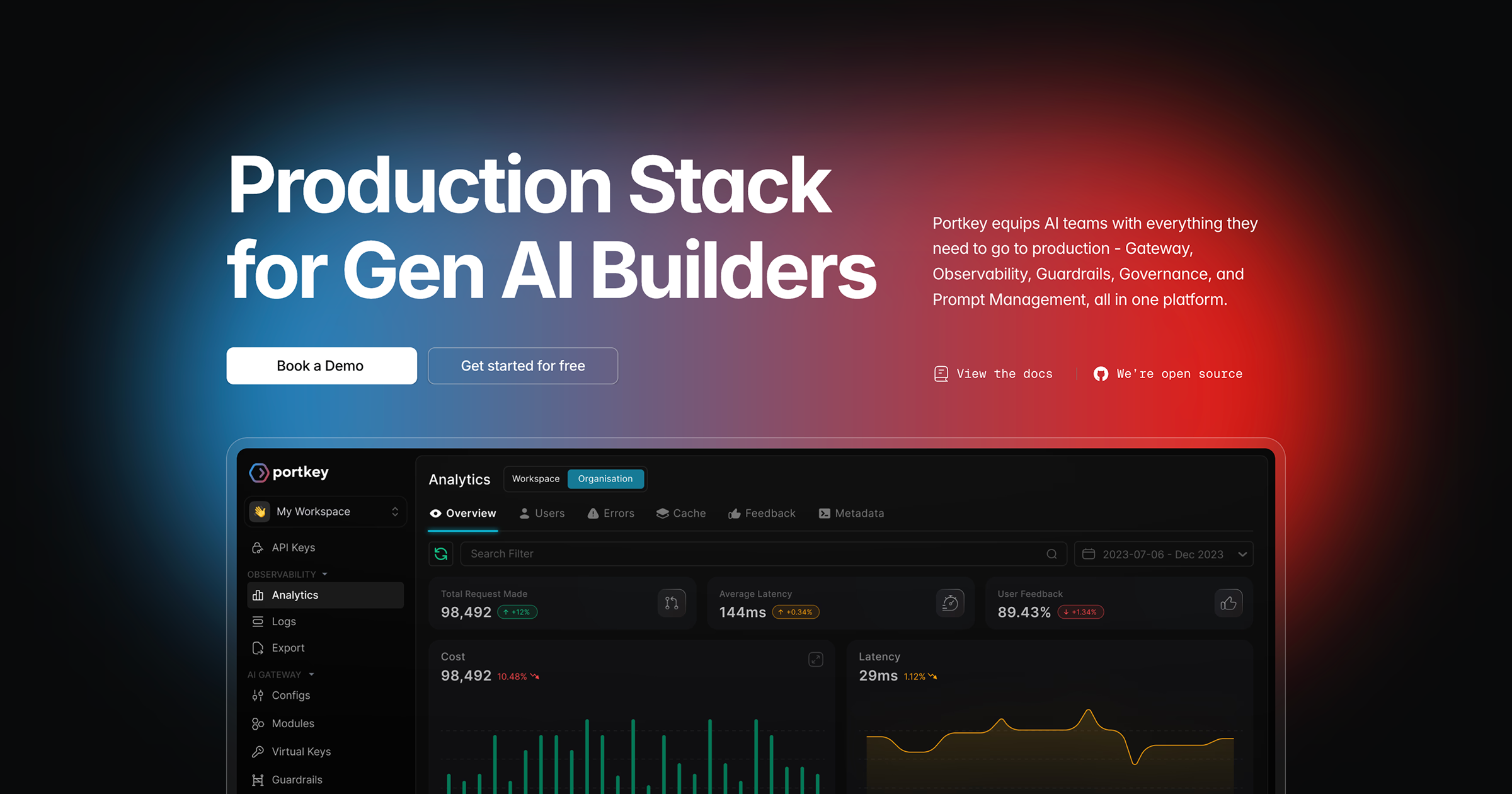
Portkey AI Gateway is a production stack for Gen AI builders, offering a unified solution for AI gateway, observability, guardrails, governance, and prompt management. Designed to help AI teams go to production efficiently, it eliminates the complexity of integrating multiple LLMs while providing real-time monitoring and governance capabilities. - Unified AI Gateway: Access 1,600+ LLMs via a single API, eliminating the need for multiple integrations. - Real-time Observability: Monitor LLM behavior, catch anomalies early, and manage usage proactively with a comprehensive dashboard. - Guardrails & Governance: Implement usage policies, rate limiting, and compliance controls to ensure safe and responsible AI usage. - Prompt Management: Centralize prompt management to streamline AI workflows and reduce redundancy. - Caching & Cost Optimization: Reduce costs by caching repeated API calls and optimizing token usage. - Production-ready Workflows: Deploy agent workflows with built-in support for caching, retries, and fallbacks. - Multi-Model Support: Seamlessly switch between different LLMs without changing your codebase. - Enterprise Scalability: Designed for enterprise-scale deployments with high availability and reliability. Portkey AI Gateway is available as a cloud service with enterprise-grade features. While the core gateway functionality is cloud-hosted, Portkey provides tools and integrations for self-hosting components like caching and observability dashboards. The open-source repository (https://github.com/portkey-ai/gateway) offers foundational tools for building custom integrations and extensions.

Enterprise-grade AI gateway for LLM routing & governance
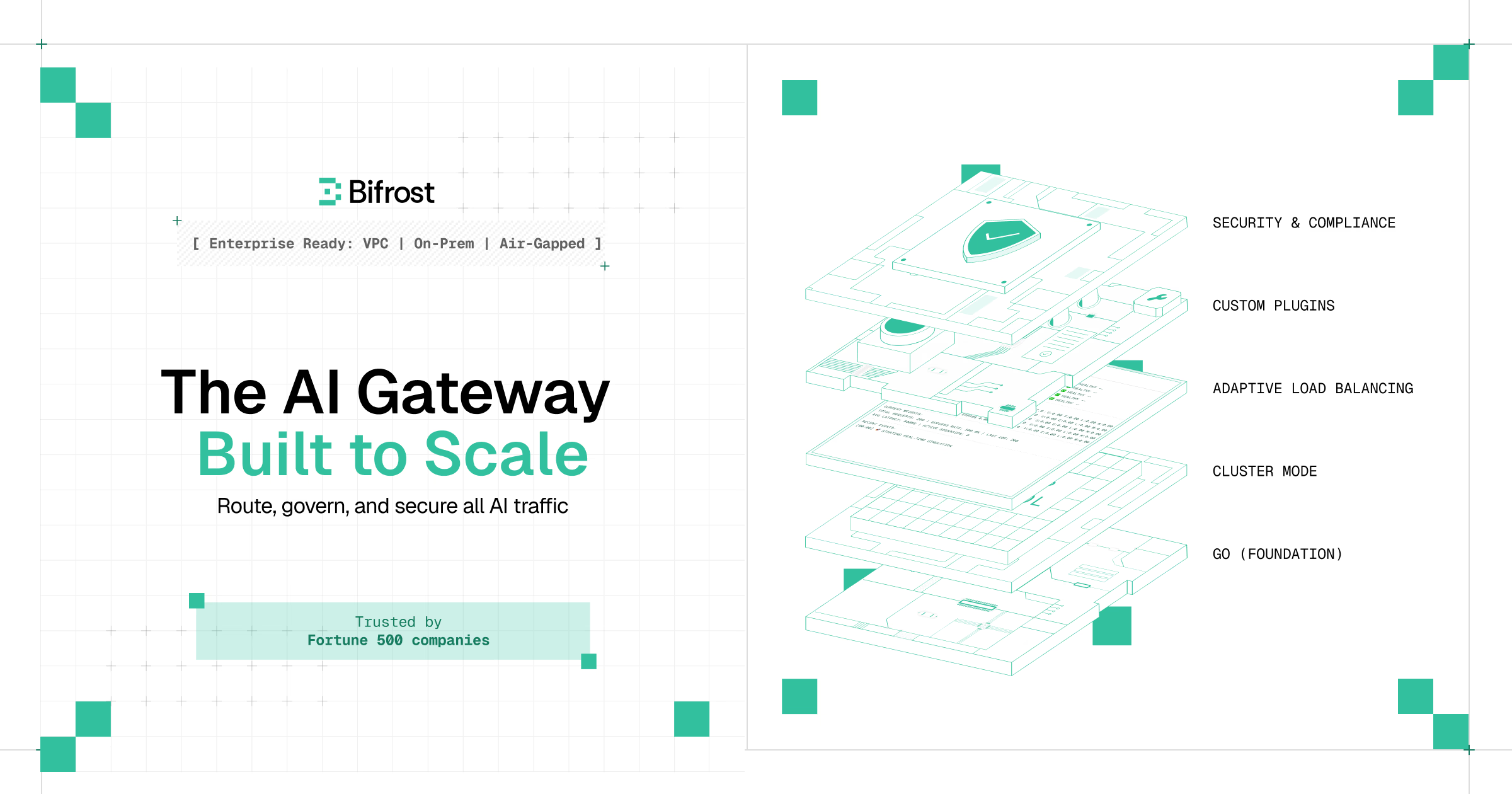
Bifrost is the fastest, most resilient enterprise-grade AI gateway designed for routing, governance, guardrails, and observability. Built for real-world scale, it provides a unified control plane to manage budgets, track audit logs, enforce access control via SSO, and protect models with real-time guardrails. - Ultra-low latency routing: 20 microseconds added latency and 5,000 requests/second throughput - Multi-provider support: Access 8+ providers and 1000+ AI models through a unified interface - Budgeting & cost control: Set spending limits and track costs across teams, projects, and models - Provider fallback: Automatic fallback to ensure high availability and reliability - MCP gateway: Built-in support for Model Context Protocol (MCP) to use tools within agents - Real-time guardrails: Blocks unsafe outputs, enforces compliance, and keeps agents secure - Audit & governance: Track audit logs and maintain access control via SSO - Drop-in replacement: Change just one line of code to work with OpenAI, Anthropic, Vercel AI SDK, LangChain, and more Bifrost is open-source and can be self-hosted. It supports deployment on any infrastructure and is compatible with all major AI SDKs. The project is available on GitHub and can be installed via npx @maximhq/bifrost.

Open source AI gateway for GenAI traffic management
Envoy AI Gateway is an open-source project built on CNCF Envoy Gateway to handle request traffic from application clients to GenAI services. It provides a stable, production-ready control plane API, supports 16+ AI providers, multimodal capabilities, and enterprise observability. - CNCF Envoy Gateway Foundation: Leverages the proven Envoy proxy for high-performance traffic routing - Multi-Provider Support: Native integration with 16+ LLM providers including OpenAI, Anthropic, AWS Bedrock, Azure OpenAI, and Mistral - Stable Control Plane API: Committed-stable API for production deployments - MCP Gateway: Enables Model Context Protocol (MCP) tool calls with per-user identity management - Multimodal Support: Handles text, image, and other multimodal AI requests - Enterprise Observability: Built-in monitoring and metrics for AI service performance - Header Forwarding: Per-user identity management without requiring OAuth infrastructure - Scalability: Benchmarked to handle 2,000+ routes with low latency - Community-Driven: Open development with weekly meetings and active GitHub discussions - Open Source: Fully open-source under the Apache License - Self-Hostable: Can be deployed on any Kubernetes cluster - CNCF Project: Part of the Cloud Native Computing Foundation ecosystem - Documentation: Comprehensive docs available at https://aigateway.envoyproxy.io/docs - Community Support: Active Slack channel and weekly community meetings

Unified API for 40+ LLM providers
LLM Gateway simplifies working with multiple LLM providers by offering a single, OpenAI-compatible API interface. Whether you're using OpenAI, Anthropic, Google, or 40+ other providers, LLM Gateway handles routing, cost tracking, and performance monitoring—all in one place. - Unified API Interface: Keep your existing OpenAI SDK code; just change the base URL to switch providers. - Multi-provider Support: Access 40+ providers through one integration with no vendor lock-in. - Performance Monitoring: Compare latency, cost, and quality across models to optimize your use case. - Secure Key Management: Centralize all provider keys in one dashboard to avoid scattered credentials. - Self-hosted or Cloud: Deploy on your own infrastructure or use the managed cloud service. - Cost-aware Analytics: Track requests, tokens, total spend, and average cost per 1K tokens. - Per-model/provider Breakdown: Analyze usage and spend by provider and model to identify outliers. - Errors & Reliability Monitoring: Monitor error rates, cache hit rates, and reliability trends. - Project-level Usage Explorer: Drill into each project's requests, models, errors, cache, and costs. - Enterprise Audit Logs: Maintain compliance with comprehensive audit trails. - LLM Guardrails: Prevent prompt injection, detect PII, and block malicious requests. LLM Gateway is open source and can be self-hosted for full control over your infrastructure. Alternatively, use the managed cloud service for a hassle-free experience. The project is SOC 2 Type II certified, ensuring enterprise-grade security and compliance.

Run open-source LLMs locally or in the cloud

Ollama is an open-source platform that simplifies running large language models (LLMs) locally or in the cloud while keeping your data private. It provides a seamless way to deploy frontier AI models with enterprise-grade performance and security. - Frontier Open Models: Access the latest open-source LLMs with performance comparable to closed alternatives at a fraction of the cost. - Local & Cloud Deployment: Run models locally for maximum privacy or deploy in the cloud across US, Europe, and Singapore for scalability. - High Performance: Dedicated infrastructure ensures reliable throughput even with multiple concurrent agents. - Easy Integration: Launch popular coding agents (Claude Code, Codex, OpenCode) with a single command and switch models without changing workflows. - Data Privacy: Prompts are never tracked or trained on by providers, ensuring complete data ownership. - Open Source: Fully open-source with open weights, allowing for transparency and customization. - Cross-Platform Support: Works seamlessly across macOS, Windows, Linux, and Docker. Ollama is open-source and can be self-hosted on any infrastructure. The platform supports Docker for easy deployment and provides comprehensive documentation for local and cloud setups. All cloud-hosted models are deployed in compliant regions (US, Europe, Singapore) to meet data residency requirements. View documentation | GitHub repository

Run any AI model locally on any hardware
LocalAI is an open-source AI engine designed to make AI accessible on any hardware, from laptops to GPU clusters. It provides a unified runtime for running text, voice, vision, image, video, 3D, and agent-based models locally, eliminating the need for cloud-based AI services. - Multi-Modal Support: Run text, voice, vision, images, video, 3D, and agents from a single runtime. - Hardware Agnostic: Works on CPUs, GPUs (CUDA, ROCm, Metal, Vulkan), and ARM64 without requiring specialized hardware. - OpenAI-Compatible API: Seamlessly integrates with existing clients using OpenAI, Anthropic, Ollama, or ElevenLabs APIs. - Dynamic Engine Switching: Swap between backends (llama.cpp, vLLM, MLX, etc.) with a single line in the model's config. - Realtime Capabilities: Enable real-time voice interactions, transcription, and speech synthesis over WebRTC without a GPU. - Distributed AI: Scale across multiple machines with smart routing, VRAM-aware placement, and failover support. - Privacy-First: All processing happens locally; no data leaves your machine. - 1,255+ Pre-Configured Models: One-click installation for a wide range of models. - 19 Custom Engines: Built from scratch for specific tasks like real-time voice, vision, and 3D reconstruction. - Agent & MCP Support: Run autonomous agents, RAG, and interactive tools locally. - Self-Hosted: Fully self-hostable on any hardware, including edge devices. - Open Source: MIT-licensed, available on GitHub. - Cross-Platform: Supports x8664, ARM64, and various GPU frameworks (CUDA, ROCm, Metal, Vulkan). - Scalable: From a single laptop to a distributed cluster of machines. - Documentation: Comprehensive docs for setup, configuration, and advanced use cases.

Unified API orchestration for GraphQL and REST

Apollo GraphOS is a cloud-native API orchestration platform designed to connect AI agents, web, and mobile apps to GraphQL and REST APIs. Built for enterprise scalability and reliability, it provides a unified solution for API management, security, and observability. - GraphOS Router: Enterprise-grade runtime for high-performance API orchestration - Apollo Connectors: Declarative GraphQL orchestration for REST APIs - Apollo MCP Server: Connect AI agents to your APIs seamlessly - GraphOS Studio: Web IDE for authoring, testing, and managing GraphQL operations - Schema Management: Version control, proposals, and validation for GraphQL schemas - API Observability: Monitor health, performance, and usage with OpenTelemetry support - Access Management: Secure your GraphOS organization with role-based controls - IDE Extensions: Streamline GraphQL development across popular editors - Performance Tools: Query plan analysis, response caching, and insights Apollo GraphOS is primarily a cloud-native platform with enterprise-grade features. While the core components are managed by Apollo, organizations can deploy the GraphOS Router in their own infrastructure for enhanced control. The platform supports Kubernetes via the Apollo GraphOS Operator, enabling scalable, self-hosted deployments. Open-source components like the Apollo MCP Server and connectors are available for community contributions and custom integrations.
About Msty Nexus
Msty Nexus is a local control center designed to manage AI infrastructure efficiently. It centralizes model catalogs, runtimes, provider credentials, presets, approvals, and usage tracking while exposing familiar OpenAI- and Anthropic-compatible endpoints for seamless integration with approved applications.
Key Features of Msty Nexus
- Model Gateway: Unified catalog across local runtimes and online providers for consistent model access.
- Credential Control: Centralized management of provider credentials to avoid scattered copies across tools.
- Compatible Gateway: Supports OpenAI- and Anthropic-compatible endpoints for easy application integration.
- Runtime Management: Handles Ollama, llama.cpp, MLX runtimes alongside cloud model access.
- Scoped App Tokens: Issue application-specific tokens instead of sharing master keys.
- Usage Visibility: Monitor requests, latency, and usage by application and provider in one dashboard.
- Connection Approvals: Review and approve new model or provider connections before granting access.
- Network Boundary: Default LAN access is restricted; enable only when necessary.
Tech / Self-Hosting
Msty Nexus runs locally as a controlled gateway between models, credentials, and applications. It is designed for self-hosted deployment, ensuring data privacy and compliance with organizational policies. The tool is compatible with major operating systems (macOS, Windows, Linux) and provides installers for seamless setup.