6 Best Open Source incident.io Alternatives
A curated collection of the 6 best open source and self-hosted alternatives to incident.io in 2026.
Looking for a free, privacy-friendly, or self-hosted replacement for incident.io in 2026? The top open-source alternative is Keep — Open-source platform for centralizing alerts, automating responses, and enhancing incident management across your tech stack..
Other highly rated open-source incident.io alternatives include Cachet, OpenStatus and OneUptime.
Open-source platform for centralizing alerts, automating responses, and enhancing incident management across your tech stack.
Open-source platform for centralizing alerts, automating responses, and enhancing incident management across your tech stack.

Open source status page system
Cachet is the leading open source status page system designed to help organizations communicate downtime and system outages transparently. From startups to Fortune 500 companies, Cachet enables teams to keep their customers informed and build trust even during service disruptions. - Branded Status Pages: Customize your status page to reflect your brand identity and maintain a professional appearance across all devices. - API-First Design: Automate incident management with a robust JSON API that integrates seamlessly with monitoring tools. - Multi-Language Support: Communicate with global audiences using built-in support for 10+ languages. - Planned Maintenance: Schedule updates in advance to keep users informed about upcoming maintenance windows. - Custom Metrics & Charts: Visualize system health with custom metrics and generate easy-to-read charts for better transparency. - Security Features: Protect your data with two-factor authentication and password manager integration. - 100% Open Source: Self-host Cachet on your own infrastructure at no cost, with full control over your data. Cachet is built with Laravel, Tailwind CSS, and Filament, making it easy to deploy and maintain. The system is designed for self-hosting, allowing organizations to run it on their own servers or cloud infrastructure. Comprehensive documentation and community support are available to assist with setup and configuration.

Free & open source status page for teams
OpenStatus provides a professional status page and uptime monitoring solution trusted by growing teams. Whether hosted or self-hosted, it helps organizations communicate incidents effectively, demonstrate compliance readiness, and maintain audit trails automatically. - Branded Status Pages: Create custom status pages on your own domain with themes, custom domains, and password protection options. - Uptime Monitoring: Monitor endpoints from 28 regions across multiple clouds with instant alerts via Slack, Discord, PagerDuty, or email. - Automated Incident Communication: Status page updates automatically during incidents with timestamped reports for audit trails. - Compliance Ready: SOC 2 compliant incident communication with documented, timestamped status reports that satisfy auditor requirements. - Programmatic Access: Manage everything via CLI, API (with OpenAPI spec), MCP server for AI agents, or Terraform provider. - Global Speed Checker: Test any URL's response time from 28 regions without account creation or credit card. - Enterprise Features: Themes, maintenance windows, subscriptions, and public or private status pages. OpenStatus is open source and self-hostable. The project is available on GitHub with comprehensive documentation for deployment and management. The platform supports both managed SaaS and self-hosted options, making it suitable for organizations of all sizes.

Open-source observability & incident management

OneUptime is a comprehensive open-source platform designed to streamline reliability operations for modern infrastructure. Whether you're a DevOps engineer, Site Reliability Engineer (SRE), or platform team, OneUptime provides the tools needed to monitor systems, detect incidents, and resolve issues efficiently. - Unified Observability: Consolidate logs, metrics, traces, and exceptions in a single interface for comprehensive system visibility. - Incident Management: Detect outages in seconds, page the right engineer, and coordinate incident resolution with smart routing and escalations. - Status Page: Communicate incidents and maintenance windows to users with a customizable public status page. - AI-Powered Incident Investigation: Leverage AI to investigate incidents and generate fix pull requests for faster resolution. - Topology Mapping: Visualize service, infrastructure, and network dependencies to understand system relationships. - On-Call & Alerts: Configure smart alerting with escalation policies to ensure the right team members are notified promptly. - Scheduled Maintenance: Plan and communicate downtime proactively to minimize user impact. - Security Events: Monitor and respond to security incidents with SIEM signals and Sigma detections. - Multi-Environment Support: Monitor Kubernetes, Docker, cloud services, IoT devices, network devices, and more. - Self-Hosting & Enterprise: Deploy on your own infrastructure or opt for enterprise-grade solutions with dedicated support. OneUptime is 100% open-source and can be self-hosted on your own infrastructure. It supports deployment via Docker, Kubernetes, and other container orchestration platforms. The platform is designed for scalability and reliability, making it suitable for both small teams and large enterprises. Comprehensive documentation and community support are available to assist with deployment and configuration.

Self-hosted OpsGenie replacement with AI root cause analysis
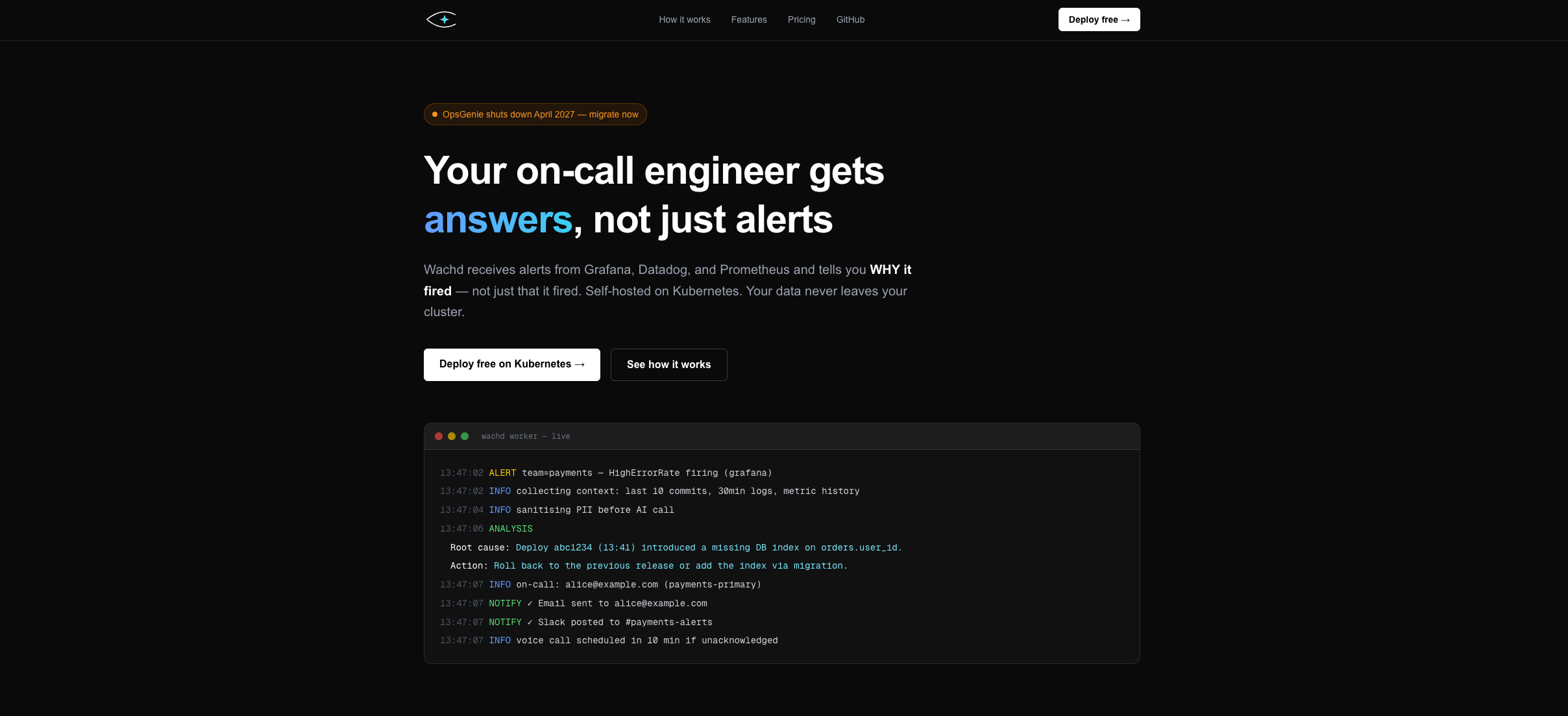
Wachd transforms raw alerts into actionable insights by providing AI-powered root cause analysis for your on-call incidents. Self-hosted on Kubernetes, it integrates with Grafana, Datadog, and Prometheus to deliver clear answers—not just notifications—while keeping all data within your infrastructure. - AI Root Cause Analysis: Automatically correlates commits, logs, and metrics into plain-English root causes using Ollama, vLLM, or any OpenAI-compatible model in-cluster - Flexible On-Call Scheduling: Supports primary, secondary, and custom rotation layers with time-window restrictions and self-service overrides - Per-User Notification Rules: Customizable escalation paths (email, SMS, voice call) with individual engineer preferences - Air-Gapped Ready: Fully functional in isolated VPCs and classified environments with no outbound API calls required - SSO + Local Users: Entra ID, Okta, and Google Workspace integration with local accounts as break-glass options - PII Sanitization: Automatically strips sensitive data before AI processing - CVE Breach Intelligence: Daily scans against NVD, OSV, and CISA KEV with auto-generated fix PRs - Multi-Tenant Isolation: Complete data separation between teams - Read-Only by Design: Only queries infrastructure—never modifies or deploys anything Wachd is designed for Kubernetes environments with: - Helm Chart Deployment: Sane defaults with support for external RDS/ElastiCache or in-cluster Postgres/Redis - Flexible AI Backends: Works with Ollama, vLLM, TGI, LLMKube, or cloud AI (Claude, OpenAI, Gemini) - Zero Vendor Lock-in: Apache 2.0 licensed with no proprietary dependencies - Integrations: Grafana, Datadog, Prometheus, Loki, PagerDuty, GitHub, GitLab, Slack, Microsoft Teams, Twilio All incident data, logs, and analysis remain within your cluster, ensuring full data residency and compliance with GDPR requirements. - Open Source: Free self-hosted version with core AI analysis (Ollama), unlimited teams/users, and Apache 2.0 license - SMB: $99/month for cloud AI options (Claude, OpenAI, Gemini), 30-day incident history exports, and priority support - Enterprise: Custom pricing for regulated organizations with SSO and compliance features

Open-source transactional email platform
Plunk is an open-source, self-hostable email platform designed for transactional emails, marketing campaigns, and automated workflows. Built with privacy in mind, it offers transparent pricing, no contact limits, and full control over your email infrastructure. - Transactional & Marketing Emails: Send both transactional emails and marketing campaigns from a single platform. - Automated Workflows: Trigger workflows based on events sent from your code, with a visual canvas for full transparency. - Inbound Email Handling: Receive emails at your domain by adding an MX record, turning replies into contacts and triggering workflows. - Unlimited Contacts: Store unlimited contacts for free; pay only per email sent ($0.001 per email). - Self-Hosting & Open Source: Fully inspectable, forkable, and self-hostable under AGPL-3.0 license. - MCP Server Integration: Connect AI agents (Claude, Cursor) to manage emails via the Model Context Protocol. - Email Editor & SMTP: Visual editor for emails or direct HTML editing, plus SMTP support for existing clients. - Analytics & Segments: Track delivery, opens, clicks, and bounces per send, with dynamic segments that update in real-time. - License: AGPL-3.0 - Hosting: EU-based cloud or self-hosted via Docker Compose - GitHub Stars: 5,000+ - Setup Time: Under 5 minutes for domain configuration and first send - Exit Strategy: Full control via Docker Compose for seamless migration away from the cloud service.
About incident.io
incident.io is a software reliability platform designed to investigate, respond to, and prevent incidents. Powered by AI that deeply understands your organization, it combines on-call management, agentic root cause analysis, incident response, and status pages into a unified workflow.
Key Features of incident.io
- Agentic Root Cause Analysis: AI-driven analysis that scans thousands of signals to deliver structured hypotheses in seconds, working alongside teams until resolution.
- On-call Management: Automated alert routing, noise filtering, and escalation to reduce burnout and ensure the right people respond.
- Incident Response: Streamlined coordination with Slack, Teams, and mobile apps for seamless incident management.
- Status Pages: Public-facing status pages to keep customers informed during outages.
- Nexus Model: A living model of your production environment built from incidents, systems, and team knowledge, continuously learning and improving.
- Integrations & Workflows: Connects with tools like Linear, Zendesk, and Slack to centralize incident data and automate responses.
- Insights & Analytics: Data-driven insights to identify patterns, trends, and areas for reliability improvement.
Tech / Self-Hosting
incident.io is a fully managed SaaS platform with no self-hosting options. It is designed for cloud-native environments and integrates with existing infrastructure via APIs and integrations. The platform is built with a focus on security, compliance, and scalability, making it suitable for enterprises and high-growth teams.