10 Best Open Source Hasura Alternatives
A curated collection of the 10 best open source and self-hosted alternatives to Hasura in 2026.
Looking for a free, privacy-friendly, or self-hosted replacement for Hasura in 2026? The top open-source alternative is Cube — Agentic analytics platform with a semantic layer.
Other highly rated open-source Hasura alternatives include Turso, Forgecode and Nitric.

Agentic analytics platform with a semantic layer

Cube is the agentic analytics platform built on a semantic layer, delivering AI-native business intelligence and embedded analytics with answers your team and customers can trust. - Semantic Layer Foundation: Single governed model ensures consistent, reliable analytics across all surfaces. - Agentic AI Capabilities: Enables AI agents to query and interpret business data accurately. - Embedded Analytics: Ship AI-powered analytics inside your product without rebuilding your BI stack. - Multi-tenant Governance: Built-in multi-tenancy with permissions flowing from your semantic model. - Analytics Chat API: Build custom AI analytics experiences with agent-to-agent capabilities via MCP. - Creator Mode: Allow customers to build their own workbooks and dashboards within your app. - Core Data APIs: Maximum control at the data layer for flexible UI integration. - Trusted by Enterprises: Used by modern data teams at Maersk, Wix, Patagonia, Tesla, and more. Cube is available as a cloud-hosted solution or can be self-hosted for full control over your data infrastructure. The platform integrates seamlessly with major data warehouses including Snowflake, Databricks, and BigQuery.

Lightweight SQLite database for AI agents
Turso is a lightweight, cloud-native database built on SQLite, optimized for the era of AI agents. It enables developers to deploy databases everywhere—on servers, in browsers, or on devices—just like files, with no cold starts or wake-up penalties. - Millions of Databases: Spin up unlimited databases for every user, agent, or tenant at minimal cost. - Vector Search: Native similarity search for AI apps and RAG workflows, no extensions required. - Concurrent Writes: Multiple writers with zero conflicts, eliminating locking issues. - Browser & Persistence: Runs in the browser with WebAssembly and OPFS for offline-first applications. - SQLite Compatible: Fully backwards compatible with SQLite, extending its capabilities for modern workloads. - Always On: Databases are files, not processes, ensuring no cold starts or scale-to-zero penalties. - Branching: Create isolated Copy-on-Write branches for rapid experimentation and rollbacks. - Replication & Sync: Keep devices in sync with each other on demand via Turso Cloud. - Analytics: Monitor performance and usage across databases in real-time. Turso is built on libSQL, an open-source fork of SQLite, and is available as: - Turso Cloud: Fully managed cloud service with unlimited databases. - Embedded Engine: Deploy Turso locally or on-device for offline-first applications. - Self-Hosting: The open-source libSQL engine can be self-hosted for full control over your infrastructure. Turso is designed to scale effortlessly, making it ideal for AI-driven applications, multi-tenant systems, and edge computing scenarios.
AI coding harness that runs inside your terminal, mixes LLMs per task, and uses multi-agent architecture to handle large codebases without bloating context.
AI coding harness that runs inside your terminal, mixes LLMs per task, and uses multi-agent architecture to handle large codebases without bloating context.

Infrastructure from code for any cloud
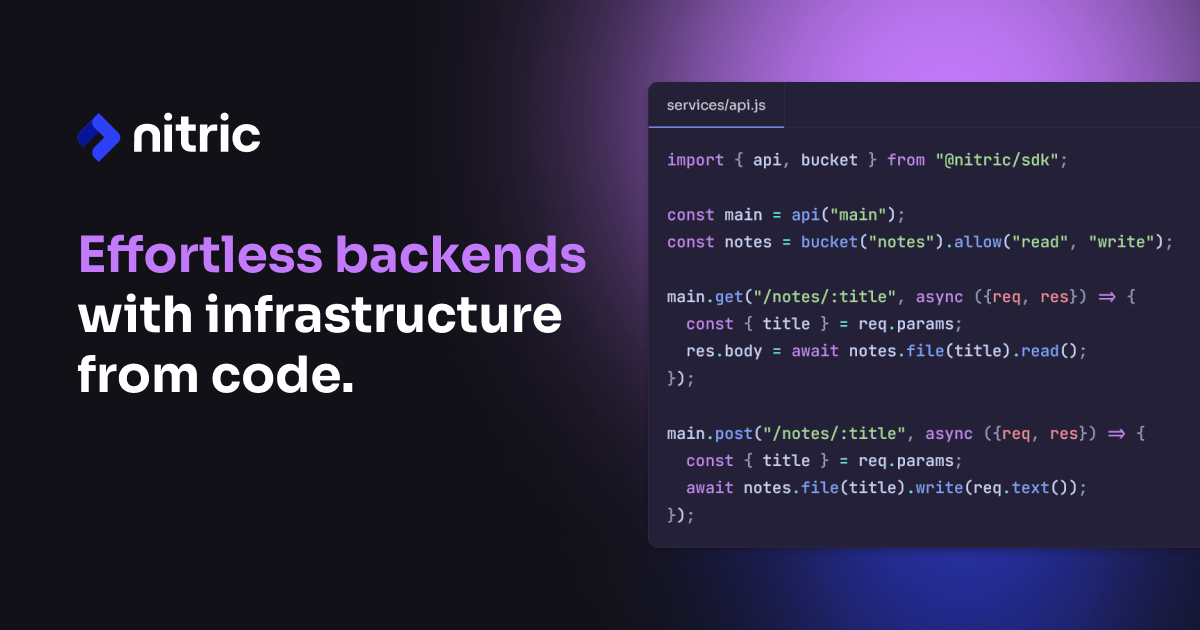
Nitric is an open-source cloud-native framework that transforms infrastructure management by generating cloud resources directly from your application code. Designed for developers, it eliminates manual cloud configuration, enabling faster deployments across AWS, Google Cloud, and Azure. - Infrastructure from Code: Define cloud resources (functions, APIs, databases) in your code and let Nitric handle provisioning - Multi-Cloud Support: Deploy to AWS, Google Cloud Platform, or Azure with a single codebase - Developer-First Approach: Focus on writing application logic while Nitric manages infrastructure complexity - Open Source: Fully open-source under the Apache 2.0 license - Security by Default: Built-in security best practices for authentication, networking, and data protection - Scalable Architecture: Designed for both small projects and enterprise-grade applications - Local Development: Test and debug infrastructure locally before deployment - Integration Ready: Works with existing CI/CD pipelines and cloud-native tools Nitric is primarily designed for cloud deployment but can be self-hosted on compatible cloud platforms. The framework uses standard cloud provider APIs, making it portable across environments. For local development and testing, Nitric provides tools to simulate cloud services on your development machine. The core framework is open-source (Apache 2.0) with enterprise features available through Nitric's commercial offerings.

Open-source GraphQL Federation platform with governance
WunderGraph Cosmo is an enterprise-ready platform for teams scaling from their first subgraph to thousands of daily operations. It provides a complete solution for building and running supergraphs with governance, schema registry, and distributed tracing capabilities. - GraphQL Federation v1 & v2: Support for both legacy and modern GraphQL Federation standards - Schema Registry: Centralized management of GraphQL schemas with versioning - Subscriptions: Real-time data updates for federated GraphQL APIs - EDFS (Event-Driven Subscriptions): Advanced event-driven subscription system - Analytics & Tracing: Comprehensive metrics and distributed tracing (OpenTelemetry compatible) - Breaking Change Detection: Automated detection of schema changes that could break clients - Schema Composition: Automatic composition of subgraphs into a unified supergraph - Governance & Ownership: Platform for managing API ownership and governance at scale - Distributed Tracing: Full observability with OpenTelemetry integration - No Vendor Lock-in: Open-source solution that prevents dependency on proprietary platforms WunderGraph Cosmo is open-source and can be self-hosted. The platform is built with modern technologies including: - Router: High-performance GraphQL router for federated queries - Studio: Web-based interface for managing schemas and operations - Connect: Integration layer for connecting to various data sources - ConnectRPC: RPC-style integration for microservices - MCP Gateway: Model Context Protocol gateway for AI integration - Streams: Event streaming capabilities for real-time updates The project is available on GitHub and provides comprehensive documentation for self-hosting and deployment options.
A fully open-source schema registry, analytics, and gateway for GraphQL federation and APIs
A fully open-source schema registry, analytics, and gateway for GraphQL federation and APIs

Open source Postgres development platform

Supabase is an open-source platform that provides developers with a full suite of tools to build scalable applications quickly. Built on top of PostgreSQL, it offers integrated features like authentication, real-time data synchronization, edge functions, and storage. - Postgres Database: Full PostgreSQL database with built-in authentication and Row Level Security (RLS). - Authentication: Secure user sign-ups and logins with RLS for data protection. - Edge Functions: Write and deploy custom code without managing servers. - Realtime: Enable multiplayer experiences with live data synchronization. - Storage: Store, organize, and serve large files like videos and images. - Vector Embeddings: Integrate ML models to store, index, and search vector embeddings. - Instant APIs: Ready-to-use REST APIs for seamless data access. - Dashboard: Manage your app directly from the dashboard with tools like Table Editor, SQL Editor, and RLS Policies. Supabase is open-source and can be self-hosted. It is built on PostgreSQL, making it highly portable and extensible. The platform is trusted by fast-growing companies worldwide and offers a free tier to get started.

Instant GraphQL API for PostgreSQL databases
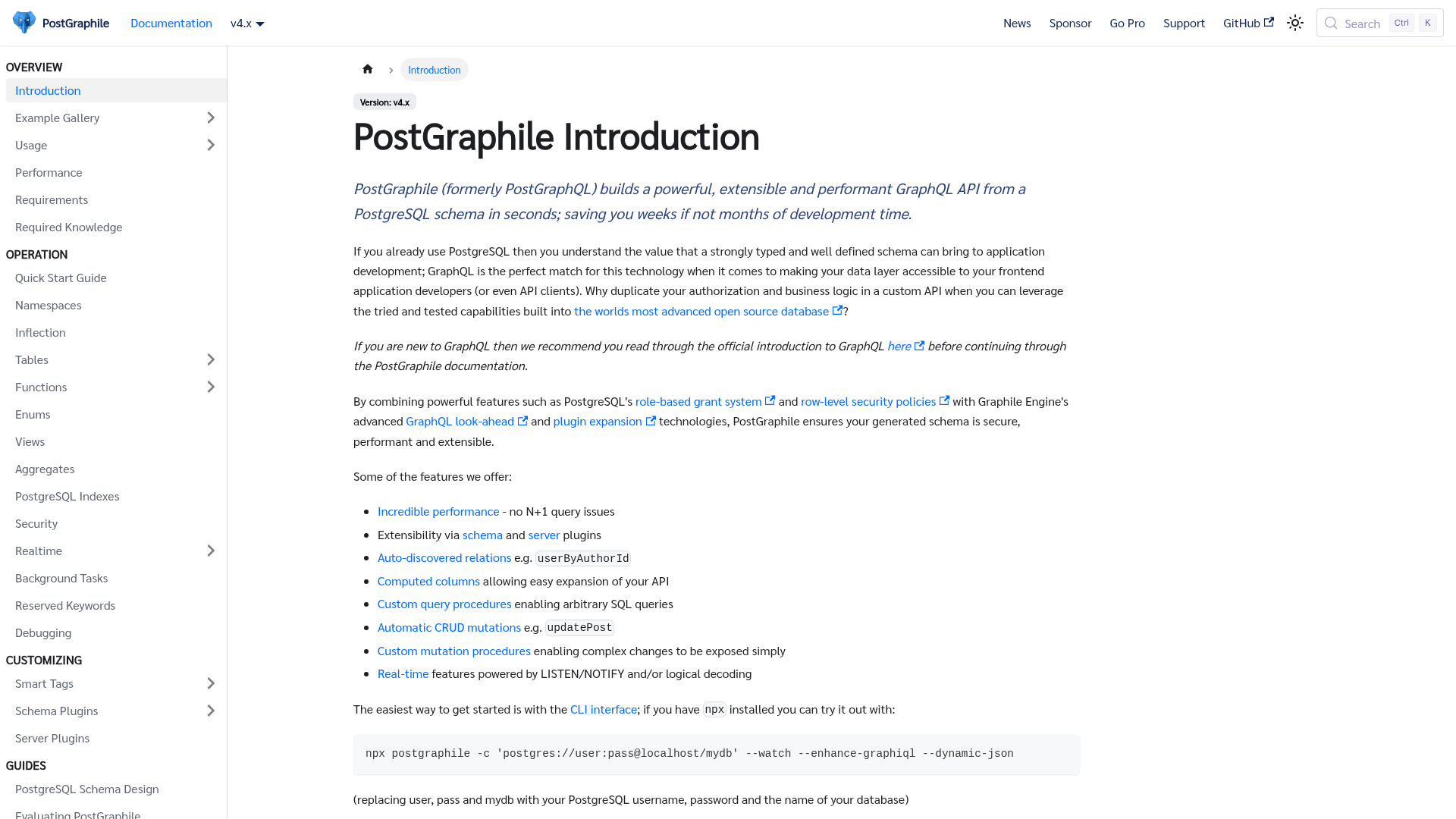
PostGraphile is a lightning-fast tool that instantly generates a powerful, extensible GraphQL API directly from your PostgreSQL database schema. By leveraging PostgreSQL's built-in features like role-based access control and row-level security, it provides a secure and performant data layer for your applications without the overhead of writing custom backend code. - Instant API Generation: Automatically creates a GraphQL API from your PostgreSQL schema in seconds - Security Integration: Uses PostgreSQL's native role-based access control and row-level security policies - Extensible Architecture: Supports plugins and smart tags for customizing the generated API - Real-time Capabilities: Enables real-time updates through PostgreSQL's native features - Performance Optimized: Built with Graphile Engine's advanced GraphQL look-ahead and plugin expansion technologies - Flexible Deployment: Can be run as a standalone server, library, or deployed on platforms like Heroku, AWS Lambda, and Docker - JWT Authentication: Supports JSON Web Token authentication out of the box - Schema Customization: Allows fine-tuning of the GraphQL schema through smart tags and plugins PostGraphile is a self-hosted solution that requires a PostgreSQL database. It can be deployed on any platform that supports Node.js applications, including: - Standalone server - Docker containers - Cloud platforms (Heroku, AWS Lambda, GCP) - As a library within your existing application The tool is open source (MIT licensed) and actively maintained by the Graphile team. For production use, consider the PostGraphile Pro version which offers additional features and support.

Managed backend platform with Postgres & GraphQL
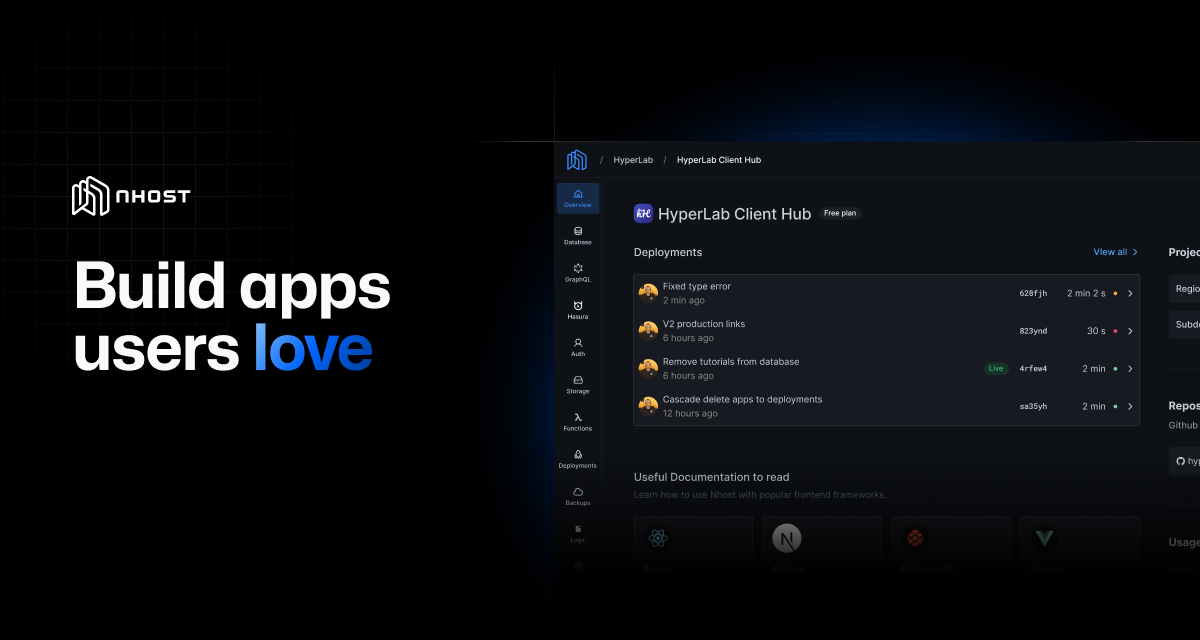
Nhost is a fully managed, extensible backend platform designed for speed, flexibility, and scale—without the infrastructure headaches. Ideal for developers building apps from prototypes to production-grade applications. - Postgres Database: Enterprise-grade SQL database instantly ready for use. - GraphQL API: Real-time API for your data with instant setup. - Authentication: Secure user sign-up, sign-in, and management. - Storage: File uploads, downloads, and CDN integration. - Serverless Functions: Scalable JavaScript/TypeScript backend logic without managing servers. - Bring Your Own Containers: Deploy services written in any language. - AI Toolkit: Auto-Embeddings, Assistants, File Stores, and more. - Local Development: CLI for running the entire Nhost stack locally with a single command. - Git-based Deployments: Simple CI/CD with automatic backend deployments on code push. - Production-Ready Infrastructure: Autoscaling, load balancing, and global CDN with 80+ locations. Nhost is primarily a managed service, but it offers a CLI for local development and supports self-hosting for advanced users. The platform is built for scalability, with production-ready infrastructure and built-in observability tools. Regions span 4 continents, ensuring low-latency global deployment.

Unified API orchestration for GraphQL and REST

Apollo GraphOS is a cloud-native API orchestration platform designed to connect AI agents, web, and mobile apps to GraphQL and REST APIs. Built for enterprise scalability and reliability, it provides a unified solution for API management, security, and observability. - GraphOS Router: Enterprise-grade runtime for high-performance API orchestration - Apollo Connectors: Declarative GraphQL orchestration for REST APIs - Apollo MCP Server: Connect AI agents to your APIs seamlessly - GraphOS Studio: Web IDE for authoring, testing, and managing GraphQL operations - Schema Management: Version control, proposals, and validation for GraphQL schemas - API Observability: Monitor health, performance, and usage with OpenTelemetry support - Access Management: Secure your GraphOS organization with role-based controls - IDE Extensions: Streamline GraphQL development across popular editors - Performance Tools: Query plan analysis, response caching, and insights Apollo GraphOS is primarily a cloud-native platform with enterprise-grade features. While the core components are managed by Apollo, organizations can deploy the GraphOS Router in their own infrastructure for enhanced control. The platform supports Kubernetes via the Apollo GraphOS Operator, enabling scalable, self-hosted deployments. Open-source components like the Apollo MCP Server and connectors are available for community contributions and custom integrations.
About Hasura
The fastest and simplest way to build, operate, collaborate on, and evolve an enterprise-grade GraphQL API.