10 Best Open Source Devin Alternatives
A curated collection of the 10 best open source and self-hosted alternatives to Devin in 2026.
Looking for a free, privacy-friendly, or self-hosted replacement for Devin in 2026? The top open-source alternative is OpenCode — Open source AI coding agent for developers.
Other highly rated open-source Devin alternatives include OpenHands, Cline and Aider.

Open source AI coding agent for developers
OpenCode is an open-source AI coding agent designed to help developers write, debug, and manage code efficiently. It integrates seamlessly with your terminal, IDE, or desktop app, providing real-time assistance powered by advanced AI models. - Multi-Model Support: Connect to any AI model from providers like Claude, GPT, or Gemini, or use local models. - LSP Integration: Automatically loads the right Language Server Protocols (LSPs) for the LLM to enhance coding accuracy. - Multi-Session Workflows: Run multiple agents in parallel on the same project for complex tasks. - Shareable Sessions: Generate shareable links for debugging or reference, ideal for team collaboration. - Editor Agnostic: Available as a terminal interface, desktop app (macOS, Windows, Linux), and IDE extensions. - Privacy-First Design: Does not store your code or context data, ensuring compliance with sensitive environments. - GitHub Copilot Integration: Log in with GitHub to use your existing Copilot account. - OpenAI Integration: Use your ChatGPT Plus or Pro account directly within OpenCode. - Zen Models: Access handpicked, benchmarked models optimized specifically for coding agents. OpenCode is open-source and can be self-hosted for full control over your data and infrastructure. It supports integration with 75+ LLM providers through Models.dev, including local model deployment. The desktop app is available for macOS, Windows, and Linux, while the terminal interface and IDE extensions provide flexibility across development environments.

Open platform for cloud coding agents
OpenHands is the open-source, model-agnostic platform for cloud coding agents. It enables engineers to automate real engineering work securely and transparently, providing full control over the agentic software development lifecycle (SDLC). - Model-Agnostic: Works with any AI model or agent framework - Agent Canvas: Visual interface for customizing and automating agent workflows - Cloud & Local Deployment: Run agents in the cloud or on-premise - SDK & Plugins: Extensible SDK with MCP servers, skills, and plugins - Security & Transparency: Built-in audit trails and secure execution environments - Enterprise Control Plane: Centralized management for large-scale deployments - Skill Management: Enable/disable default skills and add custom ones - Repository Context: Deep integration with GitHub and other version control systems OpenHands is fully open-source (Apache 2.0) and can be self-hosted. The platform supports both cloud and local deployment options, with enterprise features available for larger organizations. Documentation and setup guides are provided for all deployment scenarios.

Open-source AI coding agent for developers
Cline is an open-source AI coding agent designed to help developers understand, refactor, and automate codebases directly within their IDE, terminal, or SDK. It supports Plan and Act modes for strategic execution, integrates with MCP for tool access, and works with any model—Claude, GPT, Gemini, or local models like Ollama. - Cross-Platform Edits: Coordinated multi-file changes with linter-aware fixes, diffs, and one-click undo. - Terminal Execution: Runs bash commands and reacts to output in real-time, handling long-running processes like dev servers and tests. - Plan & Act Modes: Toggle Plan mode to align on strategy, then Act to execute with approval or autopilot. - Custom Rules & Skills: Define .clinerules to teach the agent your coding standards, architecture, and deployment conventions. - Model Flexibility: Use any model—Claude, GPT, Gemini, local Ollama/LM Studio, or OpenAI-compatible endpoints. Bring your own keys or weights. - MCP Integration: Extend functionality with the Model Context Protocol (MCP) for tool access and custom workflows. - IDE & CLI Support: Works in VS Code, JetBrains, Cursor, Windsurf, and via CLI for scripts, cron jobs, and CI pipelines. - Enterprise Ready: Trusted by global enterprises like Samsung, Salesforce, Oracle, Amazon, and Microsoft. Cline is open-source (Apache 2.0) and can be self-hosted. It supports local model integration (e.g., Ollama, LM Studio) and is compatible with any OpenAI-compatible endpoint. The CLI and SDK allow embedding Cline in custom workflows or products.
AI pair programming in your terminal
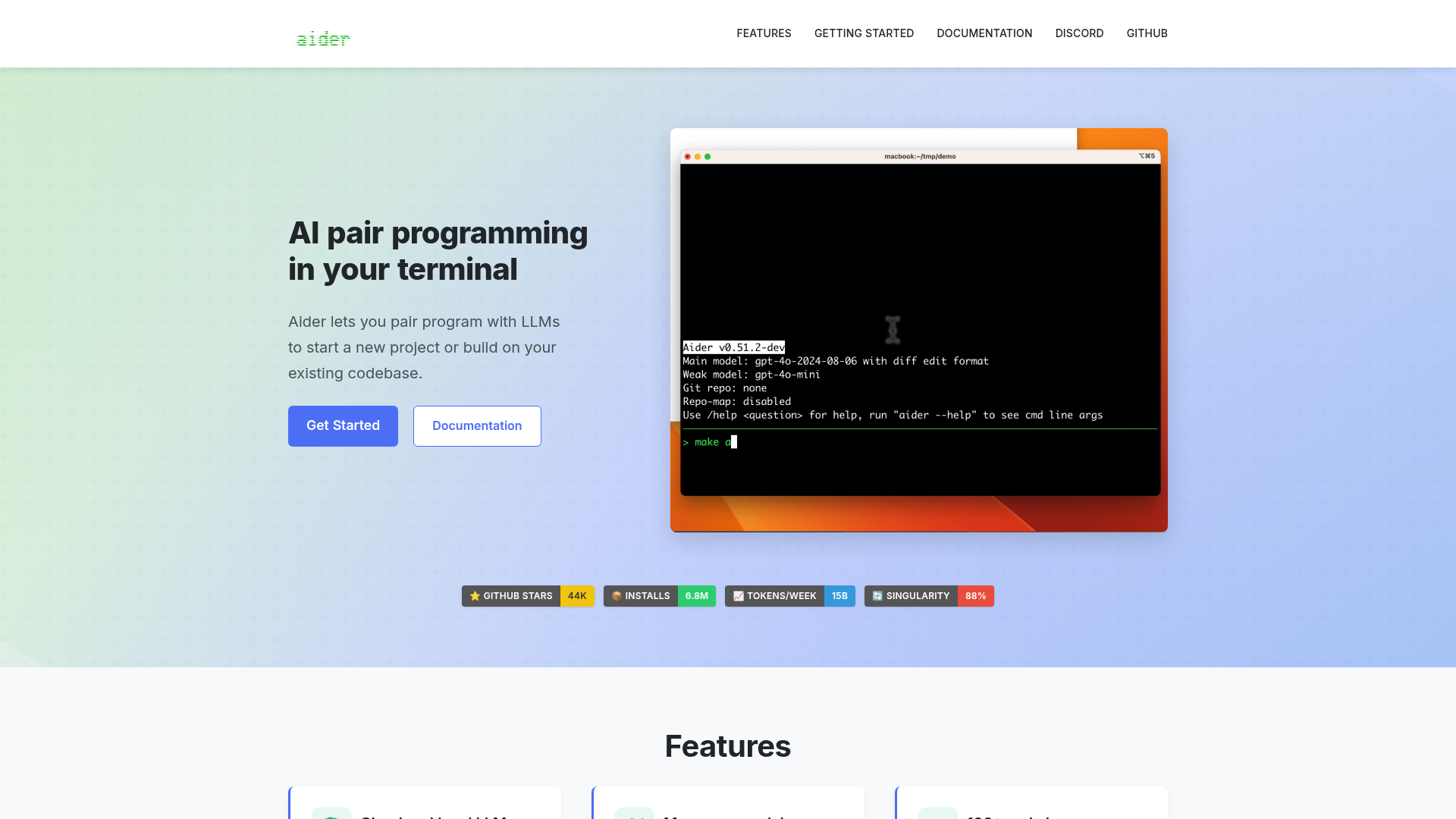
Aider is an AI pair programming tool that lets you collaborate with large language models (LLMs) directly in your terminal. Whether you're starting a new project or enhancing an existing codebase, Aider helps you write, edit, and debug code efficiently. - Cloud and local LLMs: Works with models like Claude 3.7 Sonnet, DeepSeek R1, OpenAI o1, and local models. - Codebase mapping: Creates a map of your entire codebase for better context in larger projects. - 100+ programming languages: Supports Python, JavaScript, Rust, Ruby, Go, C++, PHP, HTML, CSS, and more. - Git integration: Automatically commits changes with sensible messages and allows easy diffing and undoing of AI changes. - IDE integration: Use Aider within your favorite editor to request changes via comments. - Images & web pages: Add visual context, screenshots, or reference docs to the chat. - Voice-to-code: Speak your requests to implement new features, test cases, or bug fixes. - Linting & testing: Automatically lints and tests code, fixing issues detected by linters and test suites. - Web chat interface: Streamlines copy/pasting code with browser-based LLMs. Aider is a self-hosted, open-source tool that runs locally in your terminal. It connects to cloud-based LLMs or local models, making it flexible for different workflows. No server setup is required beyond installing the tool and configuring your preferred LLM API keys.

AI-powered terminal coding agent
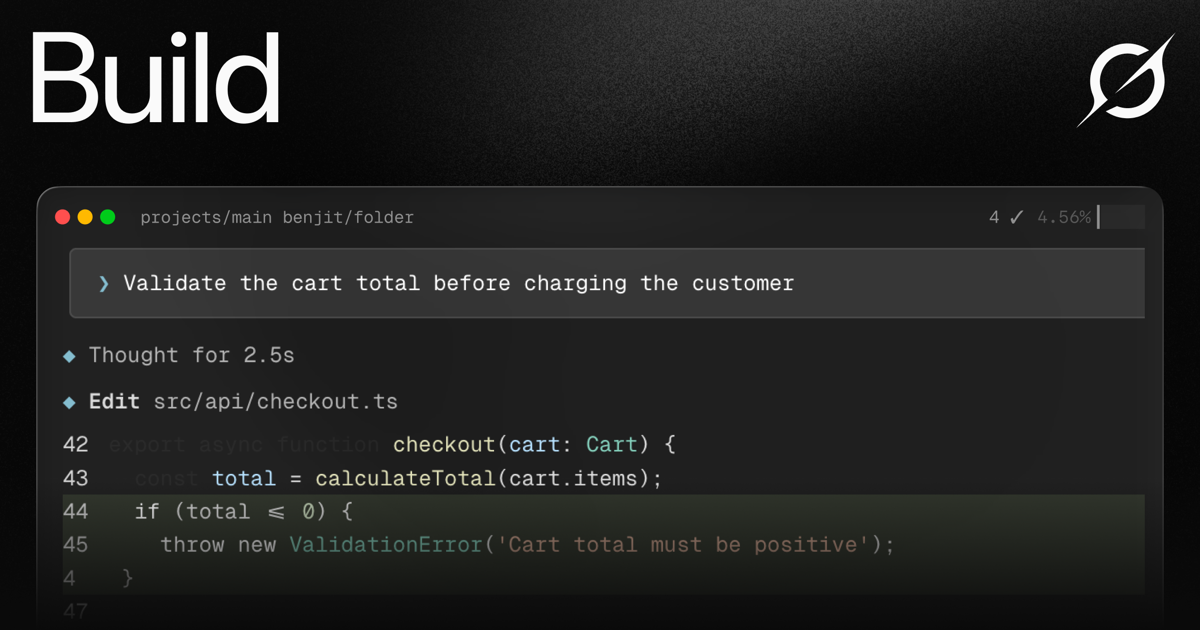
Grok Build is a powerful terminal-native coding agent designed to streamline complex software development workflows. Powered by Grok 4.6, it combines advanced AI capabilities with a developer-first interface to handle planning, coding, testing, and deployment seamlessly. - Plan Mode: Architect complex projects with structured plans that require approval before execution, with clean diff visualization - Subagents: Parallel AI agents for research, testing, and code review that work simultaneously in separate worktrees - Skills System: Convert workflows into reusable slash commands with AGENTS.md, plugins, hooks, and MCP servers - Terminal-First UI: Clean, keyboard-driven interface with minimal chrome and expressive visuals - Deep Reasoning: Step-by-step thinking for complex problems with live streaming execution - Multi-file Edits: Refactor across files using search-and-replace with context-aware changes - Git Integration: Full Git workflow support including staging, committing, pushing, and branch management - Code Search: Fast grep and navigation across large codebases - MCP Integration: Connect to Linear, Sentry, Grafana, and other tools via Model Context Protocol servers - Headless Mode: Script Grok Build in CI/CD pipelines for automated workflows Grok Build is available as a CLI tool that can be installed with a single command. The open-source components allow for self-hosting and customization, though the primary Grok 4.6 model requires access to XAI's infrastructure. The system is designed to work with any codebase and programming language, making it highly adaptable to existing development environments.

AI-powered autonomous software engineering agent
SWE-agent is an autonomous AI agent designed to assist with software engineering tasks by leveraging language models to interact with tools and repositories. - Autonomous Issue Resolution: Uses language models (e.g., GPT-4o, Claude Sonnet 4) to autonomously fix issues in GitHub repositories. - Tool Integration: Supports custom tools and configurations for extended functionality. - Batch Processing: Enables running multiple instances for batch processing of tasks. - Trajectory Inspection: Provides tools to inspect and analyze agent trajectories and outputs. - Flexible Deployment: Can be installed from source, in browser (Codespaces), or via Docker. - Configuration Management: Supports detailed configuration files for models, tools, environments, and demonstrations. - Tutorials & Guides: Includes comprehensive tutorials for getting started, command-line basics, and advanced usage. - API Reference: Full documentation for run, instance, agent, and environment configurations. - Open Source: Available under the MIT License on GitHub. - Self-Hosted: Can be deployed locally or in cloud environments (e.g., Codespaces, Docker). - Model Support: Compatible with various language models, including GPT-4o and Claude Sonnet 4. - Dependencies: Requires Python and Docker for local deployment.
AI coding harness that runs inside your terminal, mixes LLMs per task, and uses multi-agent architecture to handle large codebases without bloating context.
AI coding harness that runs inside your terminal, mixes LLMs per task, and uses multi-agent architecture to handle large codebases without bloating context.

AI coding agent that ships reviewable PRs
Roomote is an AI-powered coding agent designed to act as your engineering teammate. It runs in your actual dev environment, verifies its work, reviews code with a different model, and submits PRs with live previews for approval. This enables faster development with unlimited parallel tasks while maintaining full control over your workflow. - Model-Agnostic: Bring your own model (BYOK) and mix providers for intelligence, price, or throughput optimization. - Automated Workflows: Handles inbound issues and proactively finds improvements without manual prompting. - Live Previews: Runs your actual app before marking work complete and provides reviewable URLs. - Built-in Review Loops: Reviews its own changes, catches issues early, and fixes problems before human intervention. - Multi-Platform Integration: Works seamlessly with Slack, Teams, Discord, Telegram, and mobile devices. - Single-Tenant Architecture: Always isolated deployments whether cloud or self-hosted. - Source-Available: Full transparency with readable, modifiable code. - Built-in Analytics: Tracks inference costs, team productivity, and performance metrics. - Multi-Repo Support: Compatible with GitHub, GitLab, Azure DevOps, Gitea, and Bitbucket. Roomote offers two deployment options: Cloud Hosting: - Live deployment in 2 minutes - Isolated sandboxes managed by Roomote - Free 7-day trial available - Pricing starts at $49/month for up to 10 users Self-Hosting: - Docker-based deployment on your infrastructure - Full control over data and hosting - No license required for teams under 10 users - Up and running in 10 minutes Both options maintain single-tenant isolation and model flexibility.

Open-source spec-driven AI development platform
OmoiOS transforms plain-English feature specifications into autonomous agent pipelines that execute overnight, delivering tested pull requests ready for review. Built for developers who want AI to handle the heavy lifting while maintaining full control and traceability. - Spec-to-Code Pipeline: Convert plain-English specs into requirements, design, and implementation plans with full traceability - Autonomous Overnight Execution: Agents work while you sleep, executing isolated sandboxes with dependency-aware sequencing - Self-Healing Execution: Automatic test failure detection, diagnosis, and retry without manual intervention - Full Lineage Tracking: Every code change links back to its originating requirement for transparent review - Multi-Agent Orchestration: Parallel agent execution with dependency management for scalable throughput - Model Agnostic: Bring Your Own Key (BYOK) support for Anthropic, OpenAI, and other providers - Self-Hostable: Deploy on your infrastructure with full control over data and execution - GitHub Integration: Seamless integration with GitHub repositories for PR generation and review - Spec Contract Enforcement: Requirements, constraints, and acceptance criteria enforced at every step OmoiOS is open-source (Apache 2.0 licensed) and designed for self-hosting. The platform runs as a cloud service for autonomous execution but can be deployed on your own infrastructure. Supports Docker-based deployment with configuration for model providers, repositories, and execution environments. Documentation includes setup guides, configuration examples, and API references for integration with existing development workflows. Tech Stack: Python, FastAPI, Docker, GitHub API Self-Hosting Requirements: Docker, GitHub account, Anthropic/OpenAI API keys (optional for BYOK), PostgreSQL database

Open source desktop multi-agent workforce
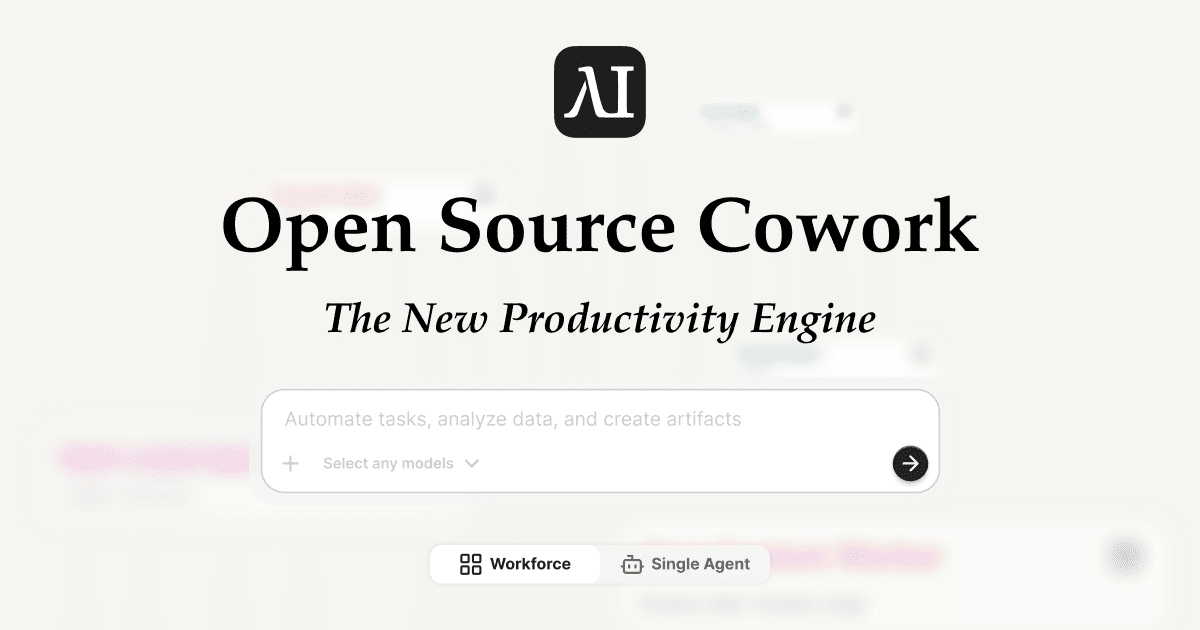
Eigent is an open-source desktop multi-agent workforce that connects to your context and automates real work by controlling browsers and desktop applications. Powered by your preferred AI model, it enables you to collaborate with agents while maintaining full oversight. - Multi-Agent Workspaces: Build reusable agent setups with shared context, tools, and instructions for teams. - Model Agnostic: Use any AI model of your choice for flexibility and control. - Local-First Architecture: Secrets and data remain bound locally for enhanced security. - Automation & Scheduling: Run tasks on a schedule, event, or condition with outputs ready for review. - Remote Monitoring: Track progress and respond from anywhere via browser or messaging channels like WhatsApp. - Memory & Context: Carry confirmed knowledge across tasks, scoped to users, Spaces, or Sessions. - Browser & App Control: Agents interact with web pages and desktop apps to perform real-world tasks. - Enterprise-Ready: Designed for teams with versioned Space profiles and reusable configurations. Eigent is open-source and can be self-hosted. The desktop application is available for download, and the project is actively maintained on GitHub. It supports local execution with optional cloud-based AI model integration. Tech Stack: - Cross-platform desktop application (Windows, macOS, Linux) - Model Context Protocol (MCP) for tool integration - Local-first architecture with secure secret management - Open-source core with enterprise features available
About Devin
AI-powered software engineer that autonomously codes, debugs, and deploys applications. Handles complex programming tasks end-to-end with reasoning capabilities.