5 Best Open Source Cloudflare R2 Alternatives
A curated collection of the 5 best open source and self-hosted alternatives to Cloudflare R2 in 2026.
Looking for a free, privacy-friendly, or self-hosted replacement for Cloudflare R2 in 2026? The top open-source alternative is MinIO — High-performance object storage for AI and enterprise data.
Other highly rated open-source Cloudflare R2 alternatives include Ceph, SlateDB and Storj.

High-performance object storage for AI and enterprise data

MinIO is a high-performance, distributed object storage system designed for AI and enterprise data workloads. Built for scalability and resilience, it provides persistent memory and AI-ready data storage for training, inference, and intelligent agents. - AIStor Memory: Persistent memory foundation for AI agents and applications - S3 Compatibility: Full compatibility with S3 API and S3 Express for seamless integration - Data Resilience: Active data replication, versioning, and anti-ransomware protection - Security & Compliance: Enterprise-grade encryption, identity management, and compliance certifications - Hardware Acceleration: Optimized for high-performance AI workloads - Multi-Tenancy Support: Secure isolation for multiple teams and applications - Observability: Comprehensive monitoring and traffic management tools - Protocol Support: S3, Iceberg Catalog, MCP, SFTP, and Delta Sharing interfaces MinIO is open-source and can be self-hosted on any infrastructure. It supports Kubernetes, bare metal, and cloud environments, with enterprise-grade features available for production deployments.

Open-source distributed storage system

Ceph is an open-source, distributed storage system designed to evolve with data. It provides a unified storage service with object, block, and file interfaces from a single cluster built from commodity hardware components. - Unified Storage: Supports object, block, and file storage in a single system - Scalability: Horizontally scalable to exabytes with no single point of failure - High Availability: Self-healing and fault-tolerant architecture - Commodity Hardware: Runs on standard servers and storage devices - Cloud Native: Integrates with Kubernetes and cloud environments - Multiple Interfaces: RADOS Block Device (RBD), CephFS, and RADOS Gateway (RGW) - Open Source: Fully open-source under LGPL-2.1 license - Enterprise Ready: Used by major organizations worldwide Ceph can be deployed on commodity hardware or cloud infrastructure. The system uses the Reliable Autonomic Distributed Object Store (RADOS) as its foundation. Installation options include: - Cephadm: Simplified deployment and management - Manual Installation: For custom configurations - Containerized Deployments: Using Docker or Kubernetes Documentation and community support are available at docs.ceph.com.
Embedded key-value database on object storage
SlateDB is an open-source embedded key-value database built on an LSM tree architecture that relies solely on object storage for durability. Designed for modern cloud-native applications, it eliminates the need for local disks while maintaining 99.999999999% durability and transactional semantics. - Zero-disk architecture: Persist data directly to object storage (S3, R2, GCS) without local disks or cross-AZ traffic, reducing costs and complexity. - Flexible deployment: Single-writer multi-reader model with formally verified manifest fencing for consistency, supporting embedded or separate compaction processes. - Transactional semantics: Full ACID transactions, snapshots, and optimistic concurrency control for demanding OLTP workloads. - Tunable performance: Optimize write durability latency vs. API request costs and leverage hybrid memory/disk caching for reads. - Clones & branches: Zero-copy checkpointing enables efficient cloning, forking, and rescaling operations with O(1) splits and merges. - Multi-language support: Rust core with Go, Java, Node.js, and Python bindings for broad compatibility. - Cloud-agnostic: Runs on AWS S3, Cloudflare R2, Google Cloud Storage, and most S3-compatible object stores. - Apache 2.0 license: Free and open-source with permissive licensing. SlateDB is designed for self-hosting and cloud-native environments. It requires no local storage infrastructure and can be deployed as an embedded library or with separate compaction processes. The system is optimized for object storage performance and cost efficiency, making it ideal for scalable, distributed applications. Configuration is handled through standard object storage settings, and the project provides comprehensive documentation for quick setup and tuning.

Decentralized cloud storage and compute platform
Storj is a decentralized cloud storage and compute platform designed to accelerate media, entertainment, and AI workflows with global access to objects and GPUs. - Distributed Object Storage: High-performance, scalable storage with 99.999999999% durability. - Cloud Compute: On-demand GPU rentals for AI/ML workloads and media processing. - Object Mount: Access any object storage via a virtual filesystem. - Global Collaboration: Low-latency data access across regions. - Active Archive: Cost-effective long-term storage for cold data. - CDN Origin: Serve content globally with high availability. - Backup & Recovery: Secure, redundant data protection. - Enterprise-Grade Security: End-to-end encryption and compliance. Storj is a fully managed cloud service with no self-hosting option. The platform is built on a decentralized architecture, ensuring high availability and fault tolerance without requiring user-managed infrastructure.

High-performance open-source S3-compatible object storage
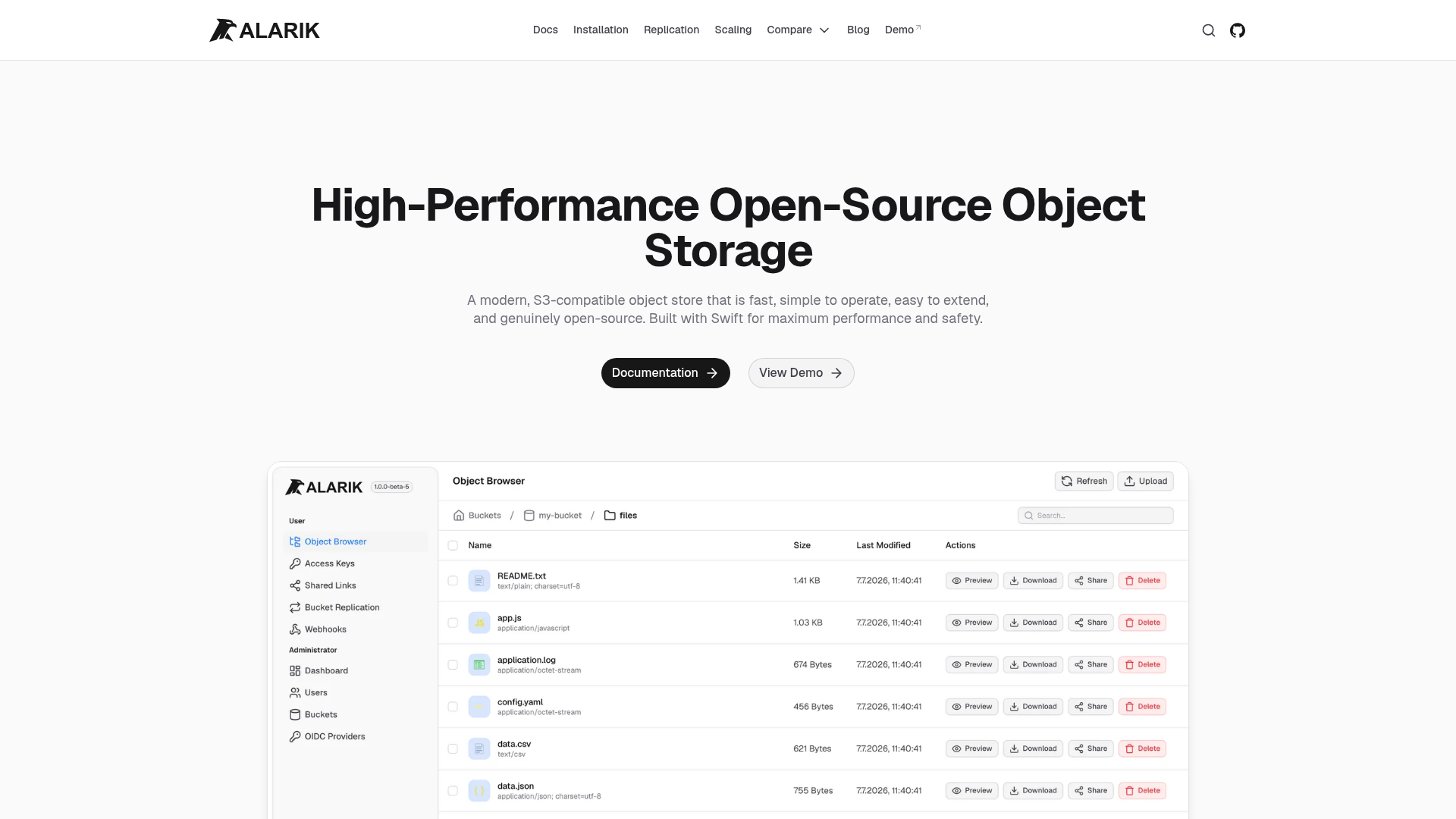
Alarik is a modern, S3-compatible object store designed for speed, simplicity, and transparency. Built with Swift for maximum performance and safety, it offers a drop-in replacement for existing S3 workflows while providing horizontal scaling capabilities. - S3 Compatibility: Drop-in replacement for existing S3 workflows. Use AWS SDKs, s3cmd, or rclone without any code changes. - High Performance: Built for low-latency I/O and highly parallel request handling with SwiftNIO. - Memory Safe: Leverages Swift’s memory safety guarantees for predictable performance and security. - Simple Deployment: Easy setup with Docker Compose—just two containers, one command. - Web Console: Built-in Nuxt-based web console for managing buckets and objects with a modern UI. - Horizontal Scaling: Grow from a single node to a Postgres-backed, sharded, and replicated cluster without re-architecting. - Erasure Coding: Data protection with Reed-Solomon erasure coding for distributed deployments. - Apache 2.0 Licensed: Truly open-source with no hidden dependencies or vendor lock-in. Alarik is designed for self-hosting and can be deployed in minutes using Docker Compose. It supports single-node deployments for simplicity and scales horizontally to distributed clusters with Postgres-backed control planes. The project is written in Swift, leveraging SwiftNIO for efficient networking and concurrency. Deployment Options: - Single-node deployment (default) - Distributed cluster with sharding and replication - Postgres-backed control plane for metadata management Use Cases: - Self-hosted cloud storage replacement - Application backend storage (user uploads, media files) - Backup and archive solutions - Development and testing environments
About Cloudflare R2
Scalable, durable, affordable object storage
Cloudflare R2 is globally distributed object storage designed for modern applications. It provides S3-compatible APIs, near-infinite scale, and zero egress fees, making it ideal for storing application data, AI training datasets, logs, and analytics without breaking the bank.
Key Features of Cloudflare R2
- Near-infinite scale: Create millions of buckets and store unlimited data globally.
- Zero egress fees: Download data without worrying about transfer costs.
- S3-compatible APIs: Use existing tools and SDKs without rewriting code.
- Progressive migration: Gradually migrate from legacy storage providers without large-scale data transfers.
- R2 Data Catalog: Iceberg-compatible catalog for querying structured data with SQL tools like DuckDB, Spark, or Snowflake.
- Native Workers integration: Directly access R2 buckets from Cloudflare Workers without managing API keys.
- Multi-cloud data portability: Store data neutrally and access it from any cloud provider without transfer fees.
- Enterprise-grade reliability: Built on infrastructure powering 20% of the internet.
Tech / Self-Hosting
R2 is a fully managed cloud service provided by Cloudflare. It does not require self-hosting and is designed for seamless integration with existing workflows. For developers, R2 offers a native API for direct access from Cloudflare Workers and supports standard S3-compatible tools and SDKs.